Imagine launching a marketing campaign that completely flops. The messaging doesn’t resonate, the engagement is low, and conversions are nowhere near what you expected.
What went wrong?
Most likely, you weren’t speaking to the right audience in the right way. This is where customer personas become a game-changer.
A customer persona is more than just a description of your target audience – it’s a deep, research-backed profile that tells you who your customers are, what they need, and what drives them to take action. It helps you craft messaging that speaks directly to their challenges, align your sales strategies, and even shape your product roadmap.
Why Are Customer Personas Important?
Without a well-defined persona, businesses struggle with:
- Ineffective marketing campaigns – Messaging that doesn't resonate with the right audience.
- Wasted ad spend – Targeting the wrong people, leading to poor conversions.
- Misaligned sales strategies – Sales teams struggling to engage and convert leads.
- Product-market fit issues – Building products/services that don't fully address customer needs.
On the other hand, businesses that build strong buyer personas:
- Increase engagement and conversions by crafting highly relevant messaging.
- Reduce acquisition costs by focusing on the most valuable customers.
- Improve customer satisfaction and retention by delivering personalized solutions.
What This Guide Will Cover
In this guide, we’ll walk you through how to create a detailed customer persona step-by-step based on our customer persona template that covers everything from demographics to buying triggers.
By the end of this guide, you’ll have a clear, actionable persona that helps you refine your marketing, boost conversions, and build deeper customer connections.
Let’s dive in!
The Key Elements of a Customer Persona
Creating a highly detailed buyer persona requires more than just listing a job title and industry. To truly understand and connect with your audience, you need to map out their journey – where they are now, where they want to be, what holds them back, and what drives their decisions.
Below, we’ll break down the main components of an ICP, so you can capture the insights that matter most.
1. Niche & Demographics: Who Are They?
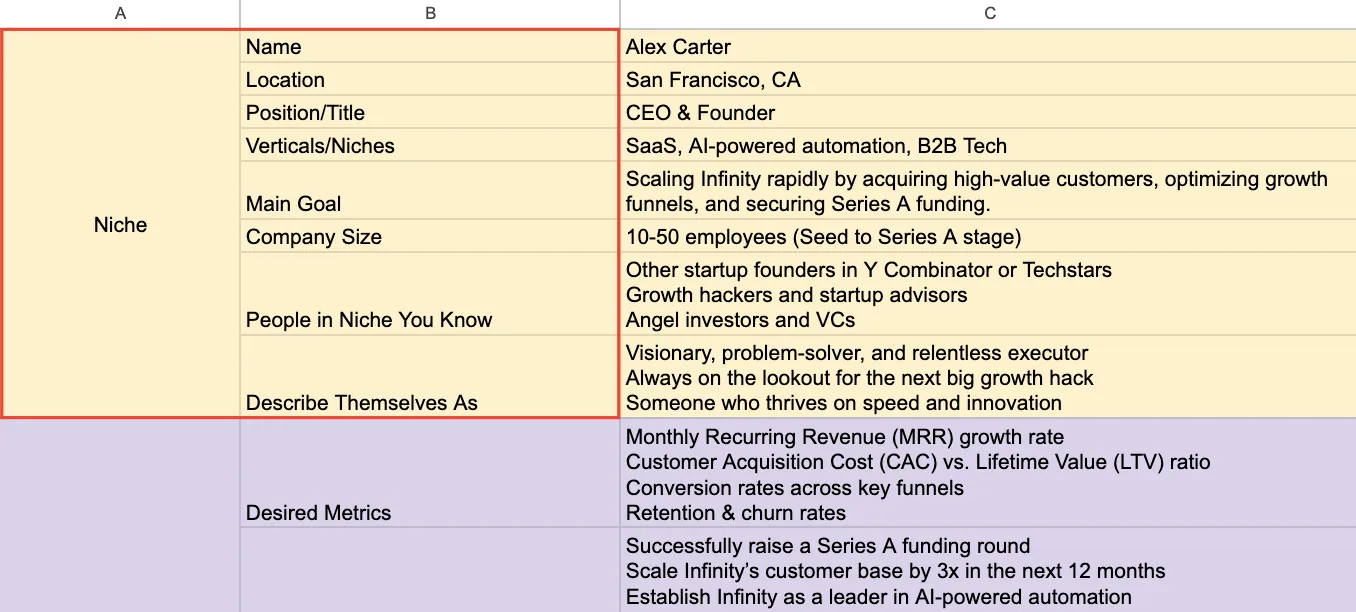
Before you can craft messaging that resonates, you need to understand the basic identity of your persona. Here’s what we want to cover:
🔹 Name – Give them a relatable name to humanize them.
🔹 Location – Where do they operate? A global company vs. a local business will have different needs.
🔹 Position/Title – Are they a CEO, Marketing Manager, or HR Lead? Their role determines their priorities.
🔹 Company Size – A small startup founder vs. a corporate executive will have vastly different pain points.
🔹 Industry/Vertical – B2B SaaS vs. eCommerce vs. Healthcare – each industry has unique challenges.
🔹 Main Goal – What are they trying to achieve? (e.g., increase revenue, reduce churn, scale operations).
🔹 People in Niche They Know – Who are their peers, mentors, or industry connections?
Why It Matters:
Knowing these details ensures your messaging is specific and personalized rather than generic.
2. Desired State: Where They Want to Be
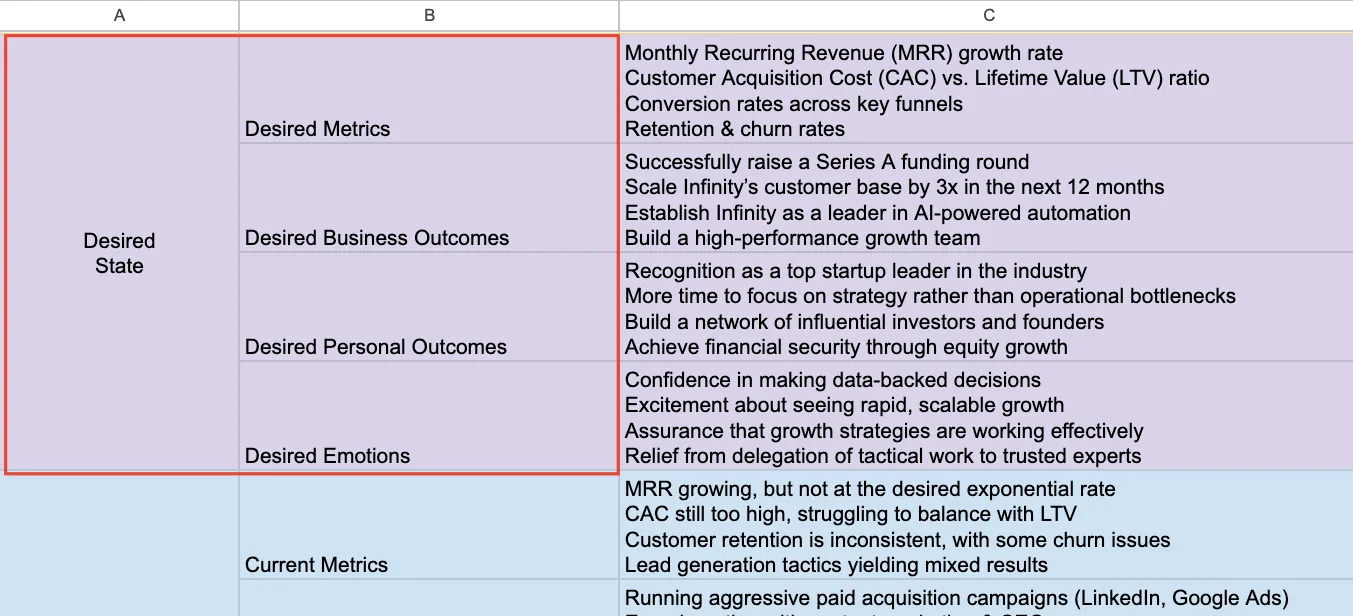
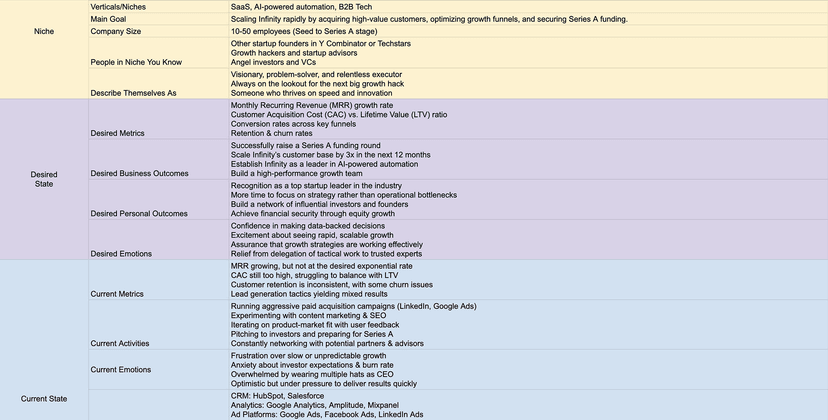
Before you can position your product or service as the solution, you need to understand where your ICP wants to be. Here’s how we define their desired state:
🔹 Desired Metrics – What key performance indicators (KPIs) matter most to them? (e.g., increasing conversion rates, reducing churn, boosting revenue).
🔹 Desired Business Outcomes – What are they trying to achieve at a company level? (e.g., scaling operations, expanding into new markets, improving customer retention).
🔹 Desired Personal Outcomes – How does success benefit them personally? (e.g., career growth, recognition, job security, work-life balance).
🔹 Desired Emotions – What feelings do they want to experience once they achieve their goals? (e.g., relief, confidence, excitement, empowerment).
Why It Matters:
- Your messaging should align with both business and personal aspirations. People don’t just buy products – they buy the results and emotions tied to them.
- If you can frame your solution as the bridge to their desired state, they’ll see its value more clearly.
- Appealing to their emotions alongside hard data creates a stronger, more persuasive connection.
3. Current State: Where They Are Now
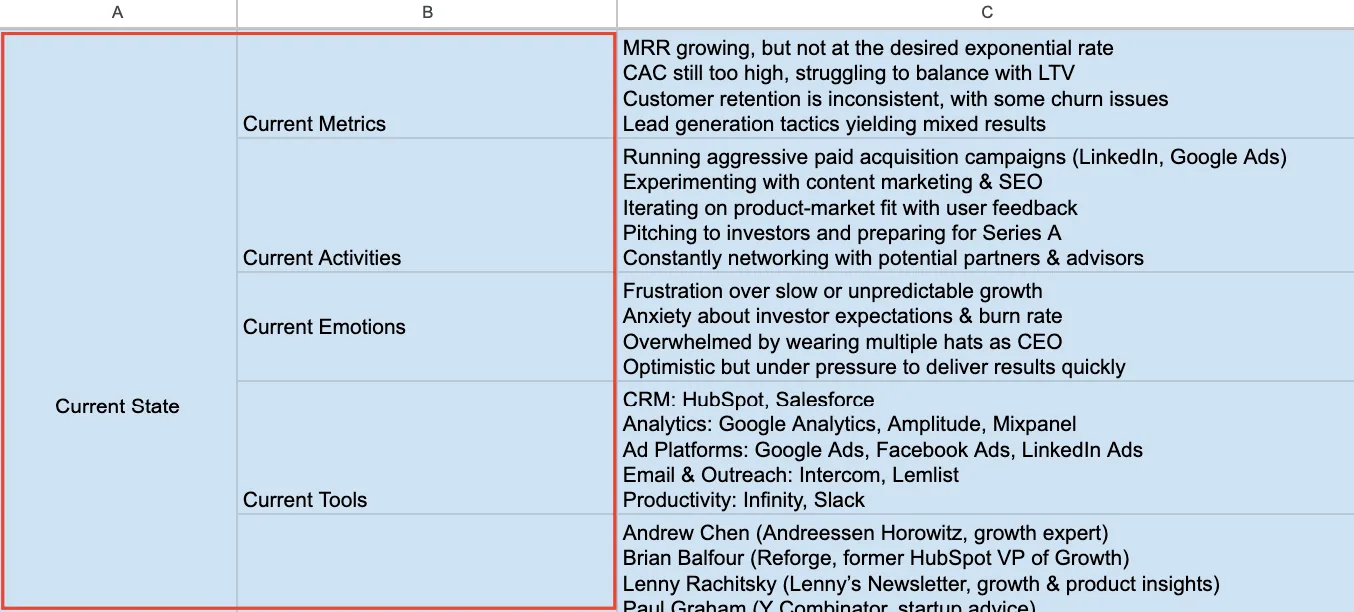
Before you can guide your persona toward their desired state, you need to understand what their reality looks like today. We define their current state through:
🔹 Current Metrics – What numbers are they dealing with right now? (e.g., high customer churn, low conversion rates, slow sales cycles).
🔹 Current Activities – What tasks, strategies, and processes do they focus on daily? (e.g., running paid ads, cold calling leads, analyzing customer data).
🔹 Current Emotions – How do they feel about their current situation? (e.g., frustrated with inefficiencies, overwhelmed by manual work, pressured to hit targets).
🔹 Current Tools – What software, platforms, or resources are they using? (e.g., HubSpot for marketing, Salesforce for CRM, Slack for communication).
🔹 Current Influencers – Who or what is shaping their thinking? (e.g., industry thought leaders, competitors, colleagues, executive leadership).
🔹 Current Information Sources – Where do they go for knowledge and insights? (e.g., LinkedIn groups, industry blogs, webinars, trade conferences).
Why It Matters:
- Understanding their current pain points helps you position your solution as the answer.
- If they’re already using certain tools, you can highlight how your product is a better alternative.
- Knowing their information sources allows you to meet them where they are – through the right content.
4. Problems: What’s Blocking Their Success?
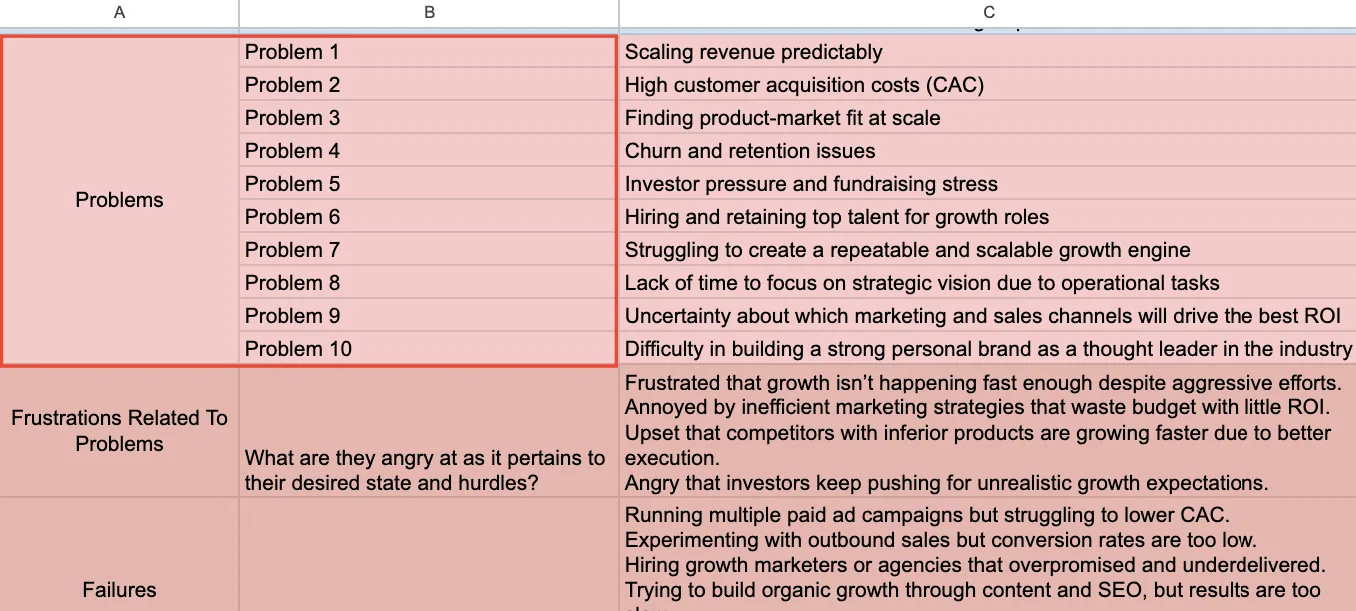
Your customer persona has roadblocks preventing them from reaching their goals. These challenges create frustration and drive their need for a solution. Here is an example of what the problems might be for a certain company:
🔹 Problem 1 – Struggling to generate high-quality leads.
🔹 Problem 2 – Low customer retention despite marketing efforts.
🔹 Problem 3 – Too many manual processes slowing down productivity.
🔹 Problem 4 – Lack of visibility into key performance metrics.
🔹 Problem 5 – Difficulty scaling operations efficiently.
🔹 Problem 6 – Budget constraints limiting technology investments.
🔹 Problem 7 – Competing against bigger brands with more resources.
🔹 Problem 8 – Unclear messaging and inconsistent branding.
Why It Matters:
Understanding their biggest frustrations helps you position your product as the direct solution. Instead of listing features, your messaging should speak to how you eliminate these pain points and drive results.
5. Barriers & Market Pressures: What’s Keeping Them Stuck?
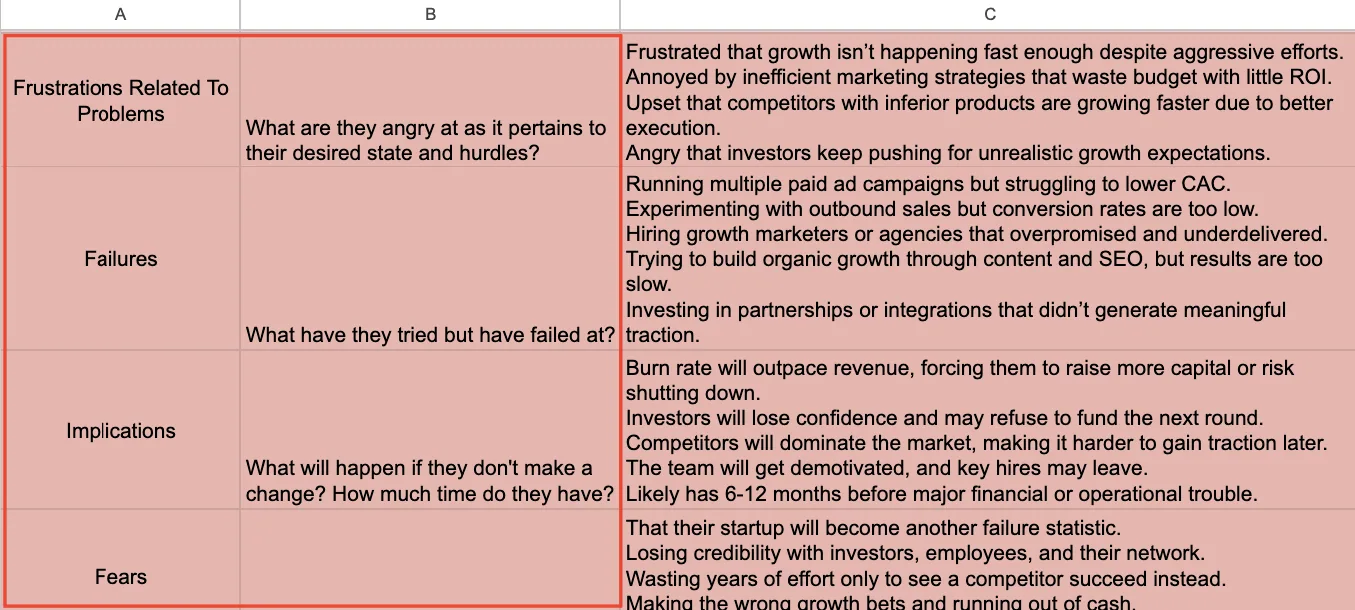
Beyond specific problems, frustrations, failures, fears, and external forces shape how your persona thinks and behaves. Understanding these factors helps you craft messaging that speaks to their deepest concerns and motivations.
🔹 Frustrations Related to Problems – What makes them angry about their current situation? (e.g., "We're spending thousands on ads, but conversion rates are still low.").
🔹 Failures – What have they already tried but didn’t work? (e.g., Implementing a CRM that sales reps never adopted, launching a campaign that flopped).
🔹 Implications – What happens if they don’t change? (e.g., Competitors will outpace them, revenue will decline, they’ll lose their job).
🔹 Fears – What are they afraid of? (e.g., Making the wrong investment or losing customers).
🔹 Suspicions – What don’t they trust? (e.g., Overpromising vendors, "quick-fix" solutions, hidden costs).
🔹 Enemies – What or who do they “hate”? (e.g., Bureaucratic red tape, slow decision-making, competitors stealing market share).
🔹 Forces & Winds – What market trends are working against them? (e.g., AI automation is disrupting their industry, new regulations are making compliance harder).
Why It Matters:
- If you can articulate their frustrations better than they can, they’ll trust you more.
- Addressing failures and skepticism upfront helps overcome objections.
- Tapping into market forces shows urgency – why they need to act now.
6. Acquisition: What Moves Them to Take Action?
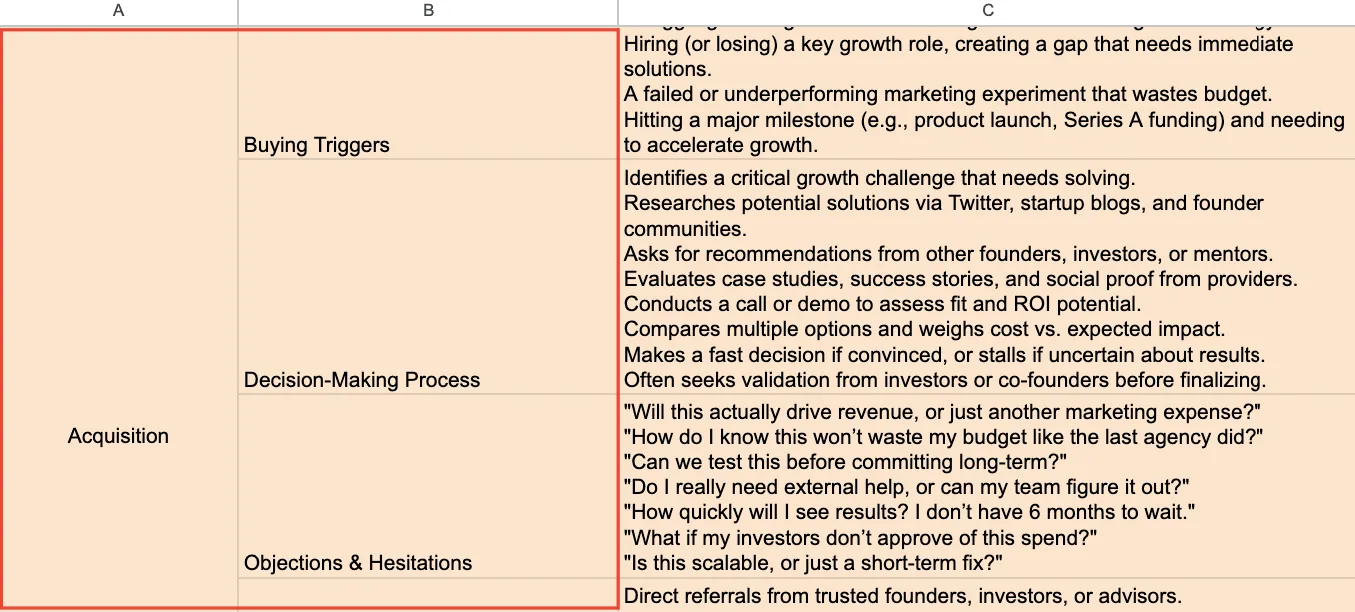
Understanding how your persona makes buying decisions helps you optimize your marketing, sales, and messaging to reduce friction and increase conversions. Here’s how to define this section:
🔹 Buying Triggers – What events push them to seek a solution? (e.g., declining revenue, leadership pressure, hitting a growth plateau).
🔹 Decision-Making Process – How do they evaluate solutions? (e.g., Do they research independently? Consult their team? Need executive buy-in?).
🔹 Objections & Hesitations – What might stop them from buying? (e.g., Budget concerns, fear of switching, skepticism about ROI).
🔹 Preferred Channel – Where do they engage with brands? (e.g., Email, LinkedIn, webinars, etc).
🔹 Emotional Drivers – What emotions influence their decision? (e.g. security, trust, excitement, FOMO).
Why It Matters:
Knowing what triggers action, creates hesitation, and drives decisions allows you to craft more persuasive messaging and sales strategies. Addressing objections upfront builds trust, while meeting them in their preferred channels increases engagement.
7. Bodacious Claim: The Bold Promise That Grabs Attention
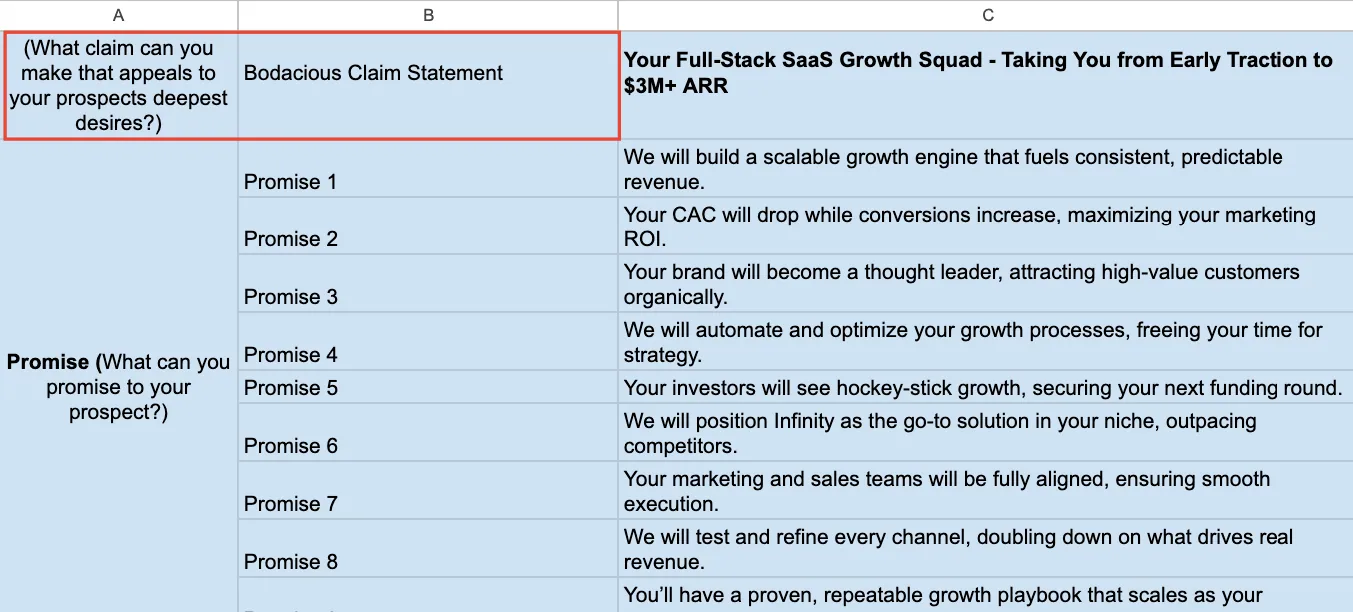
A bodacious claim is a big, bold, and confidence-driven statement that speaks directly to your persona’s deepest desires. It should be clear, specific, and emotionally compelling, positioning your solution as the ultimate answer to their problems.
🔹 Bodacious Claim Statement – What’s the most powerful, attention-grabbing promise you can make?
💡 Examples:
- For a B2B Growth Platform: “Double your qualified leads in 90 days – or your money back.”
- For a SaaS AI Tool: “Automate 80% of your workflow with AI-powered precision.”
- For an E-commerce Growth Agency: “We’ll scale your brand to $1M+ in revenue – or you don’t pay.”
Why It Matters:
- A strong claim differentiates you from competitors and immediately captures interest.
- It taps into your persona’s biggest desires – whether it’s growth, efficiency, or security.
- If backed by proof (case studies, guarantees), it builds trust and drives conversions.
8. Promise: What Can You Guarantee to Your Prospect?
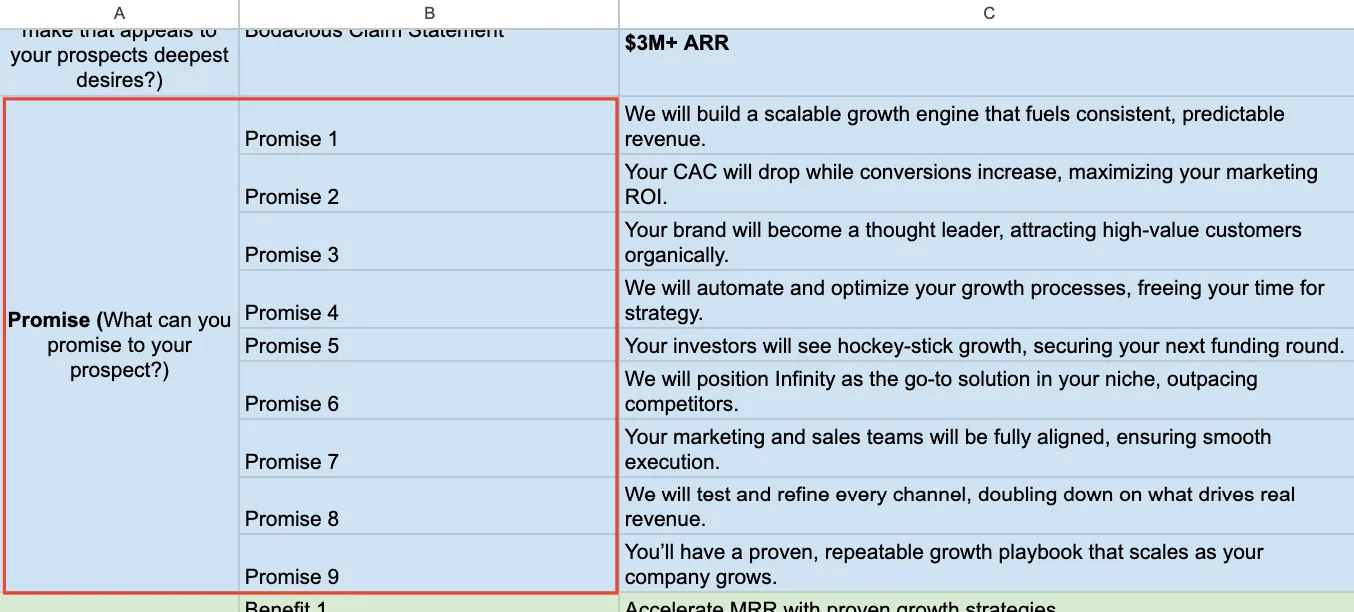
Your promises reinforce your bodacious claim by showing your prospect exactly what they can expect. These should be clear, measurable, and outcome-driven, ensuring that your customer persona feels confident in your solution. Some examples:
🔹 Promise 1 – You will achieve [specific result] in [timeframe].
🔹 Promise 2 – Your team will save [X hours] per week using our solution.
🔹 Promise 3 – We provide seamless integration with [popular tools they use].
🔹 Promise 4 – Our process is 100% data-driven – no guesswork, just proven strategies.
And so on.
Why It Matters:
- Promises create trust and give your persona confidence in making a decision.
- They differentiate you from competitors by making your offer clearer and more compelling.
- If your prospect is hesitant, strong promises can remove doubts and drive action.
9. Transformation & Benefits: How Your Solution Changes Their Life
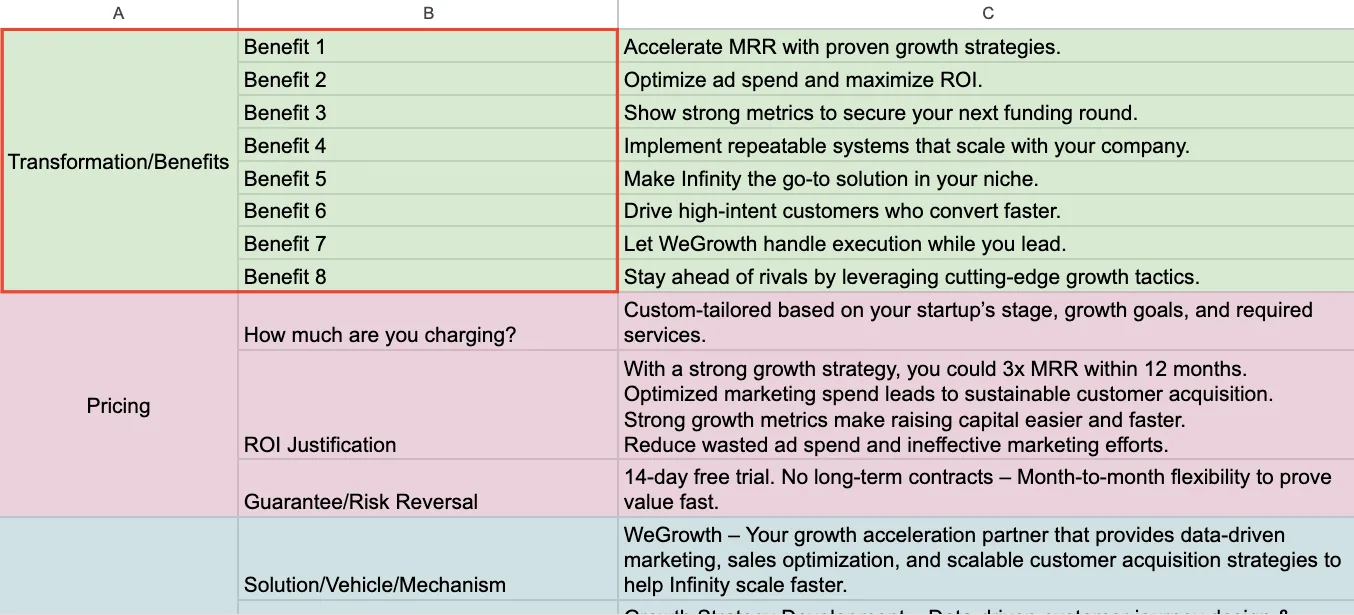
Your persona isn’t just looking for a product or service – they’re looking for a transformation. These benefits showcase how your solution improves their business, workflow, or personal success.
🔹 Benefit 1 – Save [X hours] per week by automating manual tasks.
🔹 Benefit 2 – Increase [desired metric] (e.g., revenue, leads, retention) in [timeframe].
🔹 Benefit 3 – Reduce stress and eliminate inefficiencies with an easy-to-use system.
🔹 Benefit 4 – Get real-time insights to make smarter, faster decisions.
🔹 Benefit 5 – Stay ahead of competitors with cutting-edge technology.
🔹 Benefit 6 – Scale your business effortlessly with a solution that grows with you.
🔹 Benefit 7 – Get personalized support and expert guidance whenever you need it.
🔹 Benefit 8 – Enjoy peace of mind knowing your business is running at peak performance.
Why It Matters:
- People buy outcomes, not just features – this section connects your product to real impact.
- Tangible benefits make it easier for prospects to visualize success and take action.
- When framed correctly, these benefits reinforce the emotional and logical reasons for purchasing.
10. Pricing & ROI Justification: Proving Your Value
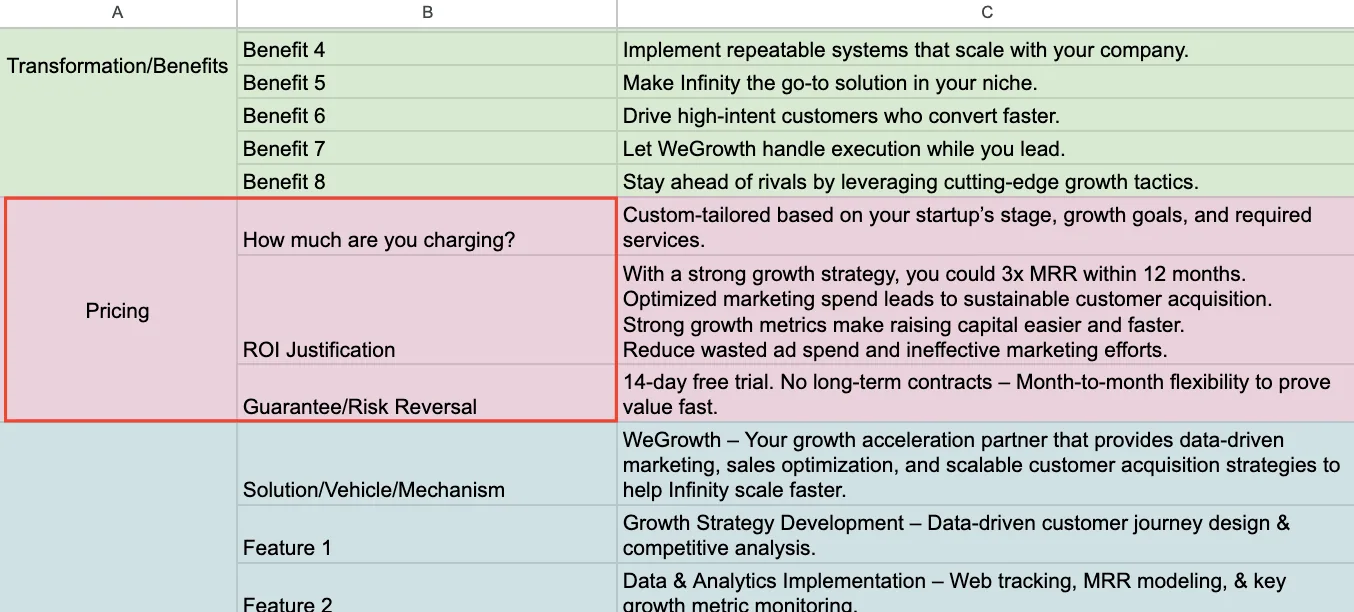
Your persona needs to understand the cost of your solution, the return on investment (ROI), and the level of risk involved before making a decision. This section ensures they see your offer as a high-value, low-risk investment rather than an expense.
🔹 How Much Are You Charging? – Clearly state your pricing model (e.g., subscription-based, one-time, etc).
🔹 ROI Justification – Show how your solution pays for itself by saving time, increasing revenue, or reducing costs. (e.g., "For every $1 spent, you’ll generate $5 in return").
🔹 Guarantee/Risk Reversal – Reduce hesitation by offering a money-back guarantee, free trial, or flexible contract. (e.g., "Try it risk-free for 30 days, or get your money back.")
Why It Matters:
- Pricing transparency builds trust and reduces friction in the decision-making process.
- ROI justification positions your product as a smart investment rather than an expense.
- Risk reversal removes objections and helps hesitant buyers move forward with confidence.
11. Product/Solution Assumptions: How Your Product Delivers Results
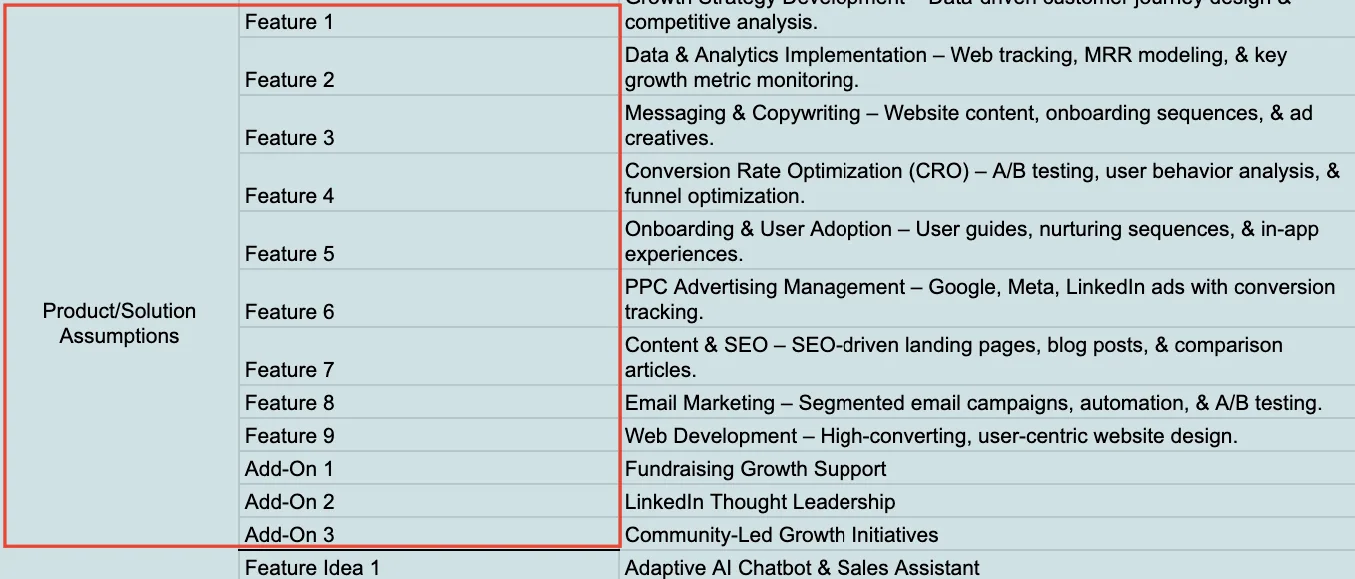
Your solution, features, and add-ons determine how effectively you can help your persona achieve their desired state while eliminating their pain points. This section outlines the core capabilities of your product or service.
🔹 Solution/Vehicle/Mechanism – What is the main way your product or service delivers value? (e.g., SaaS platform, consulting service, automation tool).
🔹 Feature 1 – Feature 10 – Key features that drive efficiency, automation, insights, or business growth. These should align with your persona’s most pressing pain points and goals.
🔹 Add-On 1 – Add-On 3 – Optional upgrades, integrations, or premium services.
🔹 Feature Idea 1 – Feature Idea 4 – New functionalities that could enhance your solution’s effectiveness.
🔹 Add-On Idea 1 – Add-On Idea 2 – Additional services or integrations that could provide more value.
Why It Matters:
- Clearly outlining features helps prospects connect the product to their specific needs.
- Add-ons increase flexibility, allowing different user types to customize their experience.
- New feature ideas keep your solution competitive and future-proof.
12. Points of Difference: How Do You Stand Out from the Competition?
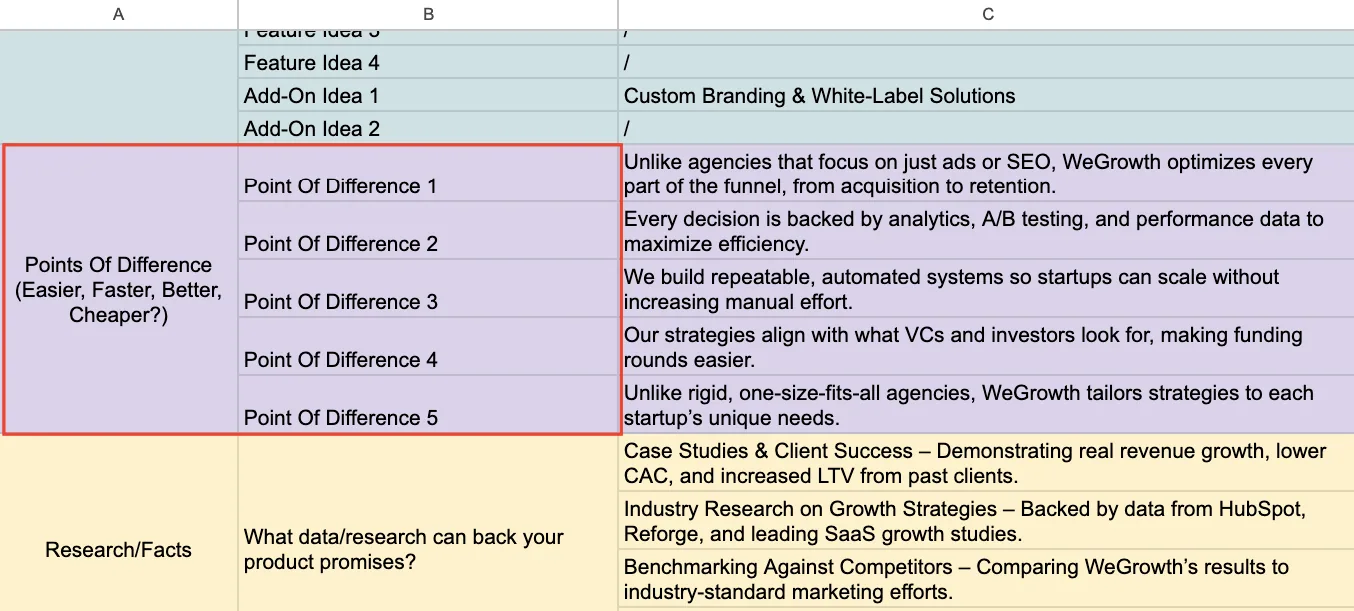
Your unique value proposition (UVP) sets you apart from competitors. This section highlights the key differentiators that make your solution the best choice for your buyer persona.
🔹 Point of Difference 1 – Is your product easier to use than alternatives? (e.g., no-code setup).
🔹 Point of Difference 2 – Is your solution faster in delivering results? (e.g. real-time analytics).
🔹 Point of Difference 3 – Is your offering better in terms of accuracy, efficiency, or outcomes?
🔹 Point of Difference 4 – Is your product cheaper or does it offer better value? (e.g. better ROI).
Why It Matters:
- Clearly defining your competitive edge helps customers see why they should choose you over others.
- Aligning your differences with your persona’s priorities (e.g., speed, cost, ease of use) increases conversions.
- This messaging should be emphasized in marketing, sales, and positioning strategies.
13. Research & Facts: Backing Your Product Promises with Data
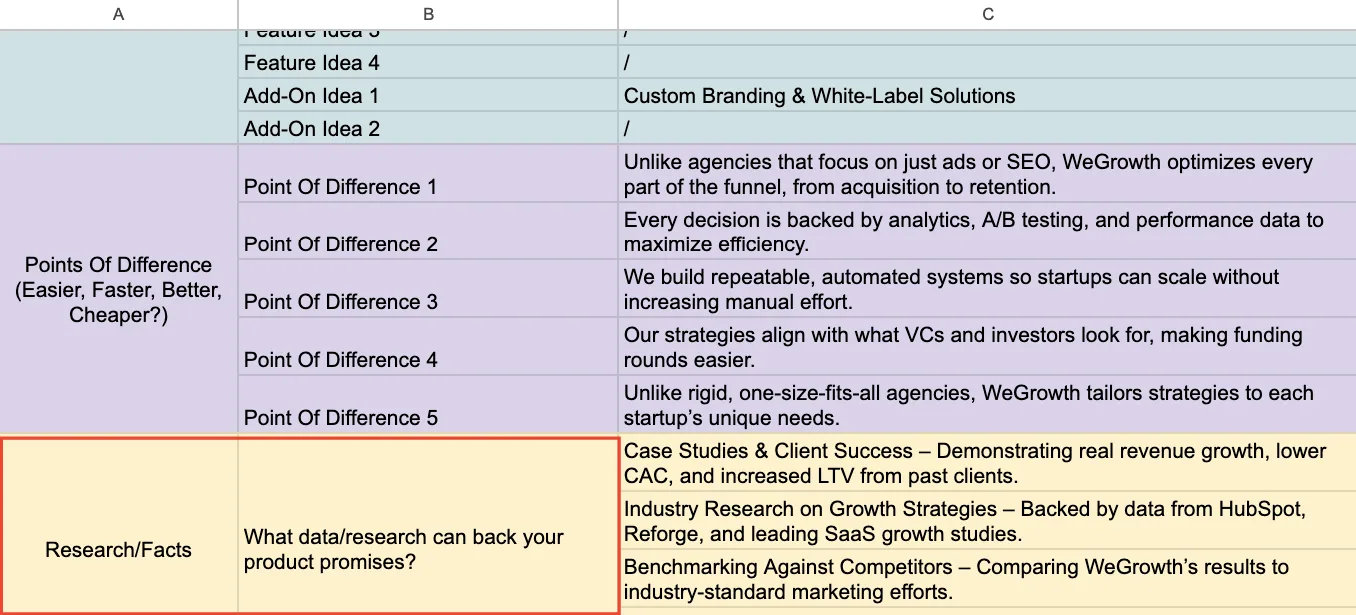
Your persona needs proof that your solution works. Providing research, statistics, case studies, or third-party validation builds credibility and removes doubt.
🔹 What data/research can back your product promises?
- Industry benchmarks showing the effectiveness of your approach.
- Case studies from real customers showcasing measurable results.
- Third-party reports, whitepapers, or research validating your solution’s benefits.
- Testimonials from industry leaders or recognized brands using your product.
Why It Matters:
- Data-driven proof reassures prospects that your claims are legitimate.
- Case studies and statistics help justify investment and reduce objections.
- Research-backed marketing increases trust and credibility in competitive markets.
Now that we've outlined what makes a strong persona, let's look at the common mistakes businesses make – and how to avoid them.
3 Common Mistakes in Customer Persona Creation (and How to Avoid Them)
Creating a customer persona isn’t just about filling out a template – it’s about using real data and insights to make the best possible business decisions. Many companies make critical mistakes that result in generic, ineffective personas that don’t impact marketing or sales.
Here are the three most common mistakes and how to avoid them:
Mistake 1: Relying on Assumptions Instead of Data
- The Problem: Many businesses create personas based on internal opinions rather than customer research.
- How to Avoid It: Use customer interviews, analytics, and industry reports to ensure accuracy. Persona AI helps by pulling in real-time data from multiple sources.
Mistake 2: Creating Too Many Personas or Being Too Vague
- The Problem: Some companies overcomplicate their strategy with too many personas, while others keep them too broad and generic.
- How to Avoid It: Focus on 1-3 high-impact personas that represent your key customer segments. Make them detailed but actionable.
Mistake 3: Ignoring Emotional and Psychological Drivers
- The Problem: Many personas focus only on demographics and job titles but ignore emotions, fears, and decision-making processes.
- How to Avoid It: Dive deeper into pain points, buying triggers, and emotional motivators to craft compelling messaging.
Building a Data-Driven Customer Persona with Persona AI
Creating an accurate and actionable customer persona is crucial for effective marketing and sales strategies. Persona AI by WeGrowth simplifies this process by analyzing your website or landing page to generate a detailed persona tailored to your business.
Here's how it works:
Step 1: Enter Your Website or Landing Page
- Begin by providing your company name, email, and the URL of your website or landing page. There's no need to manually input detailed information; Persona AI will analyze your site content to extract key insights.
Step 2: Unlock AI-Powered Insights
- Persona AI utilizes advanced AI technology to evaluate your site's content, extracting essential details about your ideal customer, including their goals, challenges, and preferences.
Step 3: Receive/Download Your Customer Persona
- Within seconds, you'll receive a comprehensive and actionable customer persona tailored to your business. You can download it as a Google Sheet for easy sharing and collaboration.
Actionable Steps: How to Use Your Persona to Drive Growth
Once you have a customer persona, the next step is leveraging it to optimize your marketing, sales, and messaging. Here's how to put your persona to work:
- Refine Website Copy – Ensure your landing pages, headlines, and CTAs speak directly to your persona's pain points, goals, and desires – making them feel like your solution was built for them.
- Enhance Ad Campaigns – Use insights to craft laser-targeted ad copy that resonates with your ideal customers, leading to higher engagement and conversions.
- Improve Sales Pitches – Equip your sales team with a deep understanding of customer motivations and objections, allowing them to tailor pitches and close deals faster.
- Boost Email Outreach – Personalize your email campaigns by aligning your messaging and offers with your persona's specific needs, challenges, and buying triggers.
- Align Your Team – Ensure marketing, sales, and product teams are working with the same persona insights, creating a unified approach to customer engagement.
- Save Time & Effort – Automate persona creation with Persona AI, generating detailed, data-backed personas in seconds instead of spending hours on manual research.
Conclusion
A customer persona isn't just a document – it's the foundation for marketing that resonates, sales strategies that convert, and products that truly meet customer needs. Without one, businesses waste ad spend, miss opportunities, and struggle to create messaging that lands.
The best brands don't just market – they speak directly to their customers' goals, frustrations, and desires. A strong buyer persona ensures that every campaign, sales pitch, and product decision is aligned with what truly matters to your audience.
If you don't have a persona yet, now is the time to build one. And if you already do, ask yourself: is it actively shaping your strategy, or just sitting in a document collecting dust? Personas should evolve alongside your customers, continuously guiding how you communicate, sell, and grow.
No matter where you are in the process, refining your persona is one of the most impactful moves you can make. If you're looking for a faster way to generate an accurate, ready-to-use persona, then don't miss out on the chance to try Persona AI for free. For a comprehensive approach to your SaaS growth strategy, explore our free growth marketing plan.
![150 Customer Acquisition Channels for B2B & SaaS Startups, Ranked [+ Free Template]](/_next/image?url=%2Fimages%2Fblogs%2Ftop-customer-acquisition-channels%2Ftop-customer-acquisition-channels-featured.png&w=828&q=75)