We are living through the deliverability collapse. According to data from Instantly, average cold email reply rates have fallen from 8.5% in 2019 to just 3.43% in 2026, driven downward by stricter Google and Yahoo bulk-sender rules that enforce mandatory authentication and brutal spam complaint limits.
Most agencies are still selling the old numbers, pretending that volume alone can overcome the math. The question is no longer whether cold email works as a channel, but whether an agency has adapted its technical approach to the post-2024 infrastructure reality. If they do not understand SPF, DKIM, and DMARC architecture at a fundamental level, they will burn your domains to the ground.
This guide compares the agencies that have successfully navigated this technical shift, focusing on B2B SaaS specialists, their pricing models, and their stance on the single most critical factor in modern outbound: infrastructure ownership.
Comparing other channels? See our guides to the best B2B & SaaS Google Ads agencies, Meta Ads agencies, LinkedIn Ads agencies, and SEO agencies.
For a broader view, see our SaaS growth marketing agency roundup.
The Shortlist at a Glance
No single agency is best for everyone. Here is the fast version, with each pick explained in full below.
| Agency | Best for | Pricing |
|---|---|---|
| WeGrowth | Full-funnel SaaS outbound inside a growth system | Monthly subscription, no long-term contract; 14-day trial |
| Belkins | Proven scale and omnichannel appointment setting | From ~$5,000/mo |
| CIENCE | Enterprise-volume SDR programs | Custom enterprise pricing |
| Martal Group | Fractional sales team with transparent pricing | $4,100–$7,000/mo (published) |
| SalesAR | Cold email plus LinkedIn, deepest review trail | Custom, based on volume |
| Leadium | Transparent pricing and client-owned infrastructure | ~$3,500–$5,000/mo, no setup fee |
| SalesCaptain | B2B SaaS GTM teams | Custom, based on scope |
| LevelUp Leads | Published pricing, cold-email-first programs | ~$4,000–$7,000/mo |
| DMT Business Development | Boutique SaaS appointment setting | Custom, based on SDR pod size |
Pricing is as published or reported at the time of writing. Confirm current rates with each agency.
How We Evaluated These Agencies
This guide is published by WeGrowth, and we have included ourselves in it. To keep the comparison fair, every agency here is evaluated against the same criteria, with a particular focus on how they handle the technical reality of modern inbox placement. We prioritized verified third-party reviews, transparent pricing, and explicit service capabilities over marketing claims.
The figures cited below—including review counts, ratings, and pricing tiers—were captured in August 2026. Because these metrics drift over time, verify current standing directly on Clutch or G2 before making a commercial decision.
What a B2B SaaS Outbound Email Agency Is (and Isn't)
A B2B SaaS outbound email agency acts as a specialized extension of your sales operation, handling the technical infrastructure, prospect research, and sequence execution required to place your team in front of qualified software buyers.
The distinction between a strategic partner and a volume-driven lead mill usually comes down to infrastructure ownership.
- It is a technical operation that configures secondary sending domains, implements proper authentication protocols, and warms mailboxes to protect your primary corporate domain. They map your Ideal Customer Profile, enrich data manually, and test messaging until a predictable booked-meeting motion emerges.
- It isn't an inbound marketing firm, a replacement for the Account Executives who must actually close the generated pipeline, or a magic solution for a product that lacks fundamental market fit.
The 9 Best B2B & SaaS Outbound Email Agencies (2026)
1. WeGrowth
WeGrowth treats outbound email as one moving part within a connected growth system, refusing to run cold outreach in isolation. Strategy, target account selection, positioning, and sequence messaging are deliberately aligned with the broader go-to-market motion, ensuring that the people you email receive the exact same narrative they see in your ads and on your landing pages.
Rather than blasting unverified lists and hoping for a one percent reply rate, WeGrowth builds rigorous, fully authenticated sending infrastructure to meet post-2024 deliverability standards. Quality dictates the pace. We map the ICP, configure secondary domains to protect your primary brand, and write messaging tailored to the skepticism of the modern software buyer, feeding qualified meetings directly to your closing team.
What to expect
- Outbound messaging strictly aligned with positioning, target accounts, and overall GTM strategy.
- Technically sound infrastructure builds with secondary domains, SPF, DKIM, and DMARC correctly configured.
- High-touch copywriting designed for complex B2B sales cycles.
- Direct integration with other growth channels to surround the buying committee.
Best fit for
- SaaS teams that want outbound email connected to the rest of the revenue engine, not treated as a silo.
- Founders who require marketing and sales to tell the exact same story.
Keep in mind: Since we publish this guide, treat our spot here as disclosed rather than a third-party verdict.
Reputation and recognition
- Tailored specifically for B2B SaaS growth operations.
- Outbound is built on our SaaS go-to-market strategy work; see client results in our case studies.
Pricing
Flexible monthly subscription, no long-term contract. Startups can begin with a 14-day trial plus $1,000 in ad credit. Scope-based; get in touch for a quote.
2. Belkins
Belkins commands this category through sheer review volume, backed by more than 223 verified Clutch reviews that cite consistent appointment-setting execution. They are the most-cited name in the space for a reason, running a massive, omnichannel machine that rarely relies on a single channel to secure a meeting.
They surround target accounts using cold email, LinkedIn outreach, and cold calling simultaneously, bringing predictability to pipelines that require relentless, multi-touch pressure to break through.
What to expect
- Omnichannel outbound campaigns blending email, LinkedIn, and phone.
- Complete end-to-end appointment setting.
- A highly standardized, proven process for scaling outreach across large addressable markets.
Best fit for
- Established organizations that need to scale a proven sales motion aggressively.
- Teams requiring multi-touch prospecting to penetrate enterprise buying committees.
Keep in mind: Their minimum engagement size requires substantial budget, making them a better fit for funded growth-stage companies rather than pre-seed teams running their first test.
Reputation and recognition
- Roughly 4.9 on Clutch across 223+ reviews, and 4.8 on G2 (as of August 2026).
- Universally recognized as a dominant force in B2B appointment setting.
Pricing: Engagements typically begin around $5,000 per month.
3. CIENCE
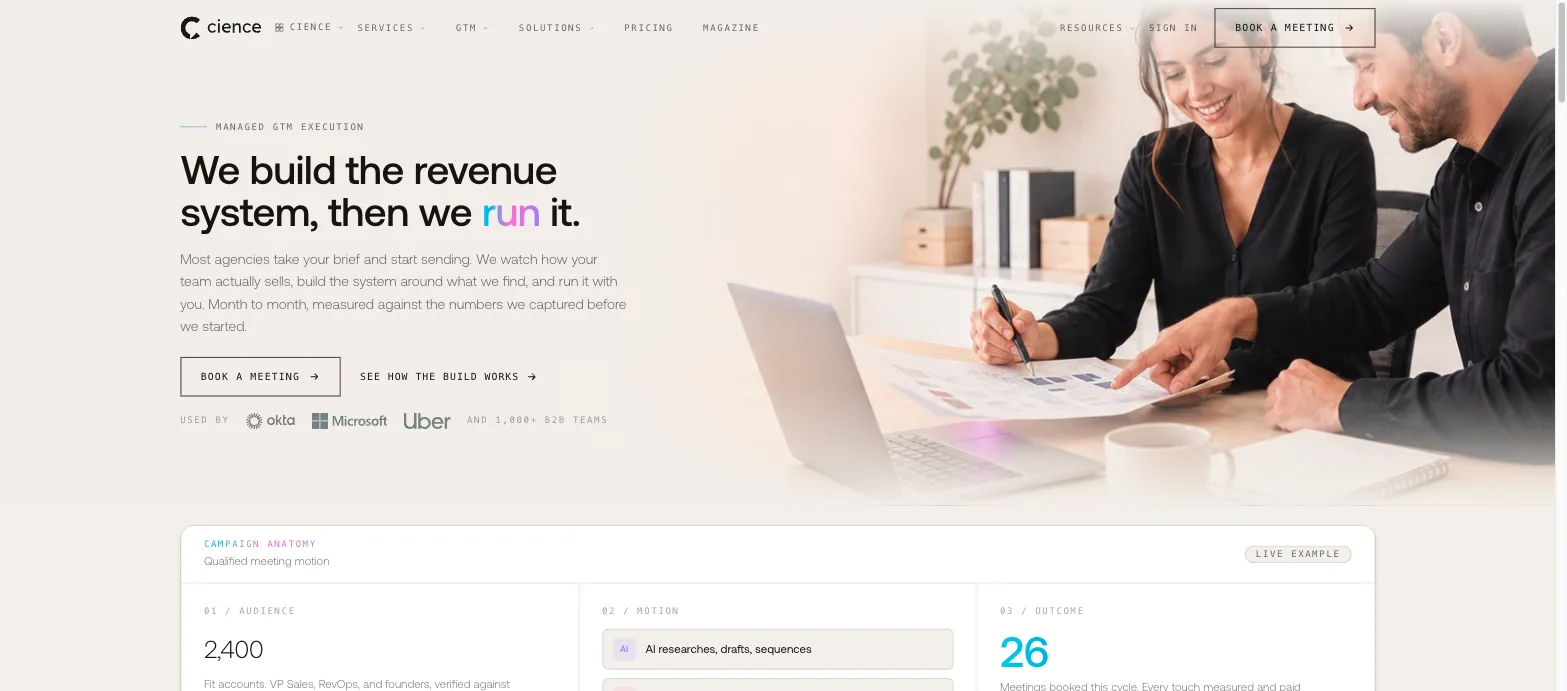
CIENCE brings industrial scale to the outbound problem, deploying massive SDR pods for enterprise clients, but they require an honest caveat: their proprietary tech stack means you rent your infrastructure, you do not own it.
Driven by their internal GO Data and GO Show tooling, they operate a high-volume, done-for-you prospecting machine. The sheer scale of their operation allows them to move faster than almost anyone else, provided you are comfortable building your pipeline on borrowed ground.
What to expect
- Massive, fully staffed SDR pods handling high-volume email and calling.
- Operation entirely within their proprietary GO platform ecosystem.
- Rapid deployment built for enterprise-scale account targeting.
Best fit for
- Enterprise organizations or heavily funded scale-ups needing immediate, massive volume.
- Companies that prefer to rent an entire SDR machine rather than build and manage one internally.
Keep in mind: Because you are renting their proprietary stack, if you decide to leave, you leave the infrastructure and historical sending reputation behind.
Reputation and recognition
- Clutch rating in the 4.2 to 4.4 range across roughly 142 reviews (as of August 2026).
- G2 rating in the 3.7 to 3.8 range across roughly 188 reviews.
Pricing: Custom enterprise pricing geared toward large-scale deployments.
4. Martal Group
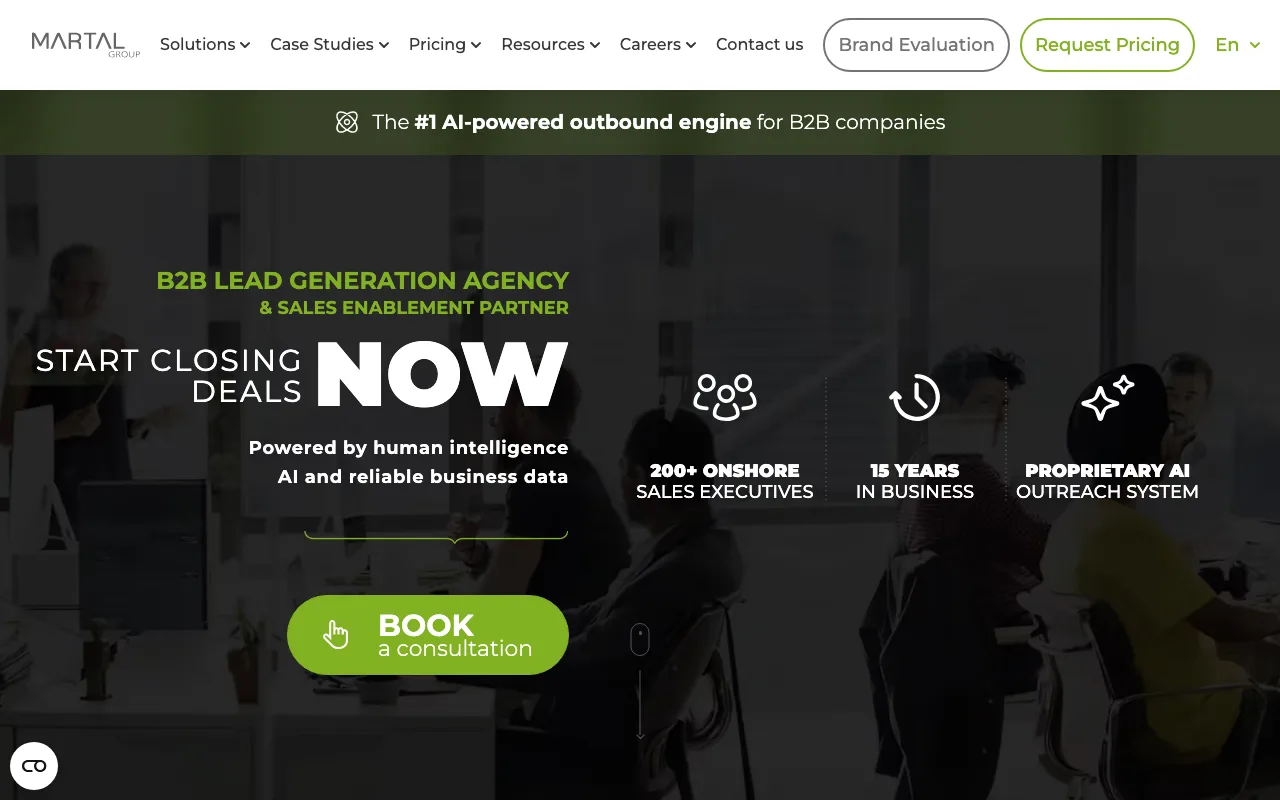
Martal Group operates on a fractional sales team model, which is a fundamentally different thing than a traditional cold email agency. They supply US-based SDRs and account executives who plug directly into your company, leveraging both human expertise and a proprietary AI-SDR platform to generate pipeline.
This model provides a middle ground for SaaS companies that want the control of an in-house team without the staggering overhead and turnover associated with hiring internal reps.
What to expect
- Fractional, US-based sales development representatives.
- Multichannel execution utilizing an AI-assisted methodology.
- Transparent, tiered pricing models published upfront.
Best fit for
- B2B SaaS companies that want a dedicated US-based team without the internal hiring burden.
- Founders who need a fractional sales unit to generate meetings they can close themselves.
Keep in mind: You are buying into their specific fractional model and methodology; if you only want someone to configure domains and write sequences behind the scenes, this is the wrong structure.
Reputation and recognition
- 4.8 on Clutch across 100+ reviews (as of August 2026).
- 4.6 on G2 with a verified track record.
Pricing: Published pricing typically ranges from $4,100 to $7,000 per month.
5. SalesAR
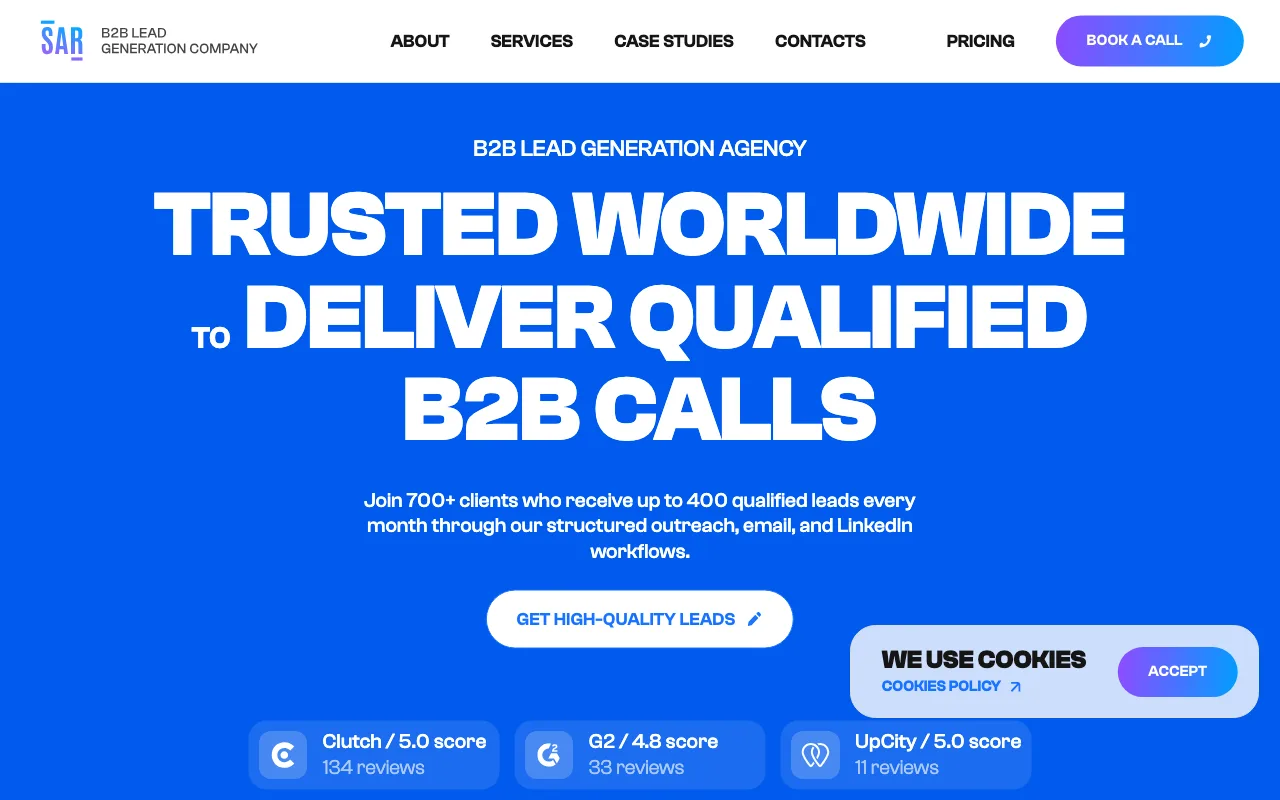
SalesAR carries the strongest dual-platform verification on the roster, boasting a 4.9 rating across 134 Clutch reviews and a matching 4.9 across 33 G2 reviews. They operate a pure-play outbound model focused tightly on cold email and LinkedIn, orchestrating more than 30 different tools while ensuring the sending infrastructure remains fully owned by the client.
They handle the intensive manual labor of list building and deliverability protection, claiming to have served over 700 clients with a highly analytical approach to A/B testing and sequence optimization.
What to expect
- Manual prospect research and rigorous data enrichment.
- Deliverability-obsessed multichannel outreach (email and LinkedIn).
- Tool-agnostic management where you retain full ownership of the digital assets.
Best fit for
- Companies that want expert management but demand full ownership of their domains and data.
- Teams that value deep analytical rigor and constant A/B testing.
Keep in mind: They are built for volume, so ensure your internal closing team has the capacity to handle the calendar density they generate when campaigns succeed.
Reputation and recognition
- 4.9 on Clutch (134 reviews, including 107 Premier-Verified) and 4.9 on G2 (33 reviews).
- Self-reported results highlight significant meeting volumes for B2B industrial and tech clients.
Pricing: Custom scoping based on expected volume and campaign complexity.
6. Leadium
Leadium leads with an uncompromising ownership stance: all data, infrastructure, and work product are 100% yours when the engagement ends. That is the headline for this boutique agency, which deliberately caps its active roster to maintain quality control.
Founded in Las Vegas, they treat deliverability as a core engineering challenge rather than an afterthought. They offer flat monthly pricing with no long-term contracts, making them one of the most transparent operators in the space.
What to expect
- Expert sequence writing and manual contact enrichment.
- Rigorous technical setup of email infrastructure and ongoing deliverability monitoring.
- Absolute client ownership of all data, sending domains, and warmup history.
Best fit for
- B2B SaaS teams that demand a highly customized, boutique relationship.
- Revenue leaders who prioritize infrastructure ownership above all else.
Keep in mind: Because they strictly cap their client roster at roughly 30 to 35 active accounts, you may encounter a waitlist before they can take your business.
Reputation and recognition
- 5.0 on Clutch across 76 reviews (48 Premier-Verified) and 4.7 on G2 (62 reviews).
- Claims to have generated over $1 billion in qualified pipeline across 1,500+ organizations.
Pricing: Roughly $3,500 per month for cold-call-only; $4,000 to $5,000 per month for multichannel. No setup fee.
7. SalesCaptain
SalesCaptain positions its service explicitly, running cold email like performance marketing. Based in London, their 80-person team brings deep technical proficiency to the outbound problem, operating as certified experts in advanced data orchestration platforms like Clay, Salesforge, and Lemlist.
They build complex RevOps automations that trigger highly personalized messaging based on specific account signals, replacing the old volume-based approach with data-driven precision.
What to expect
- Advanced data orchestration utilizing tools like Clay and Lemlist.
- Cold email executed with the analytical rigor of a performance marketing channel.
- Comprehensive RevOps integration and CRM automation.
Best fit for
- B2B SaaS GTM teams that appreciate a highly technical, data-centric approach to outbound.
- Companies requiring deep account enrichment to power hyper-personalized messaging at scale.
Keep in mind: Their Clutch rating of 4.7 across 22 reviews is a secondary source (not live-confirmed at the time of writing), and they currently lack a qualifying G2 profile.
Reputation and recognition
- Serves over 60 organizations, listing recognized tech brands among their client roster.
- Reviewers report rapid meeting generation within the first month of campaign launch.
Pricing: Custom pricing based on RevOps requirements and campaign scope.
8. LevelUp Leads
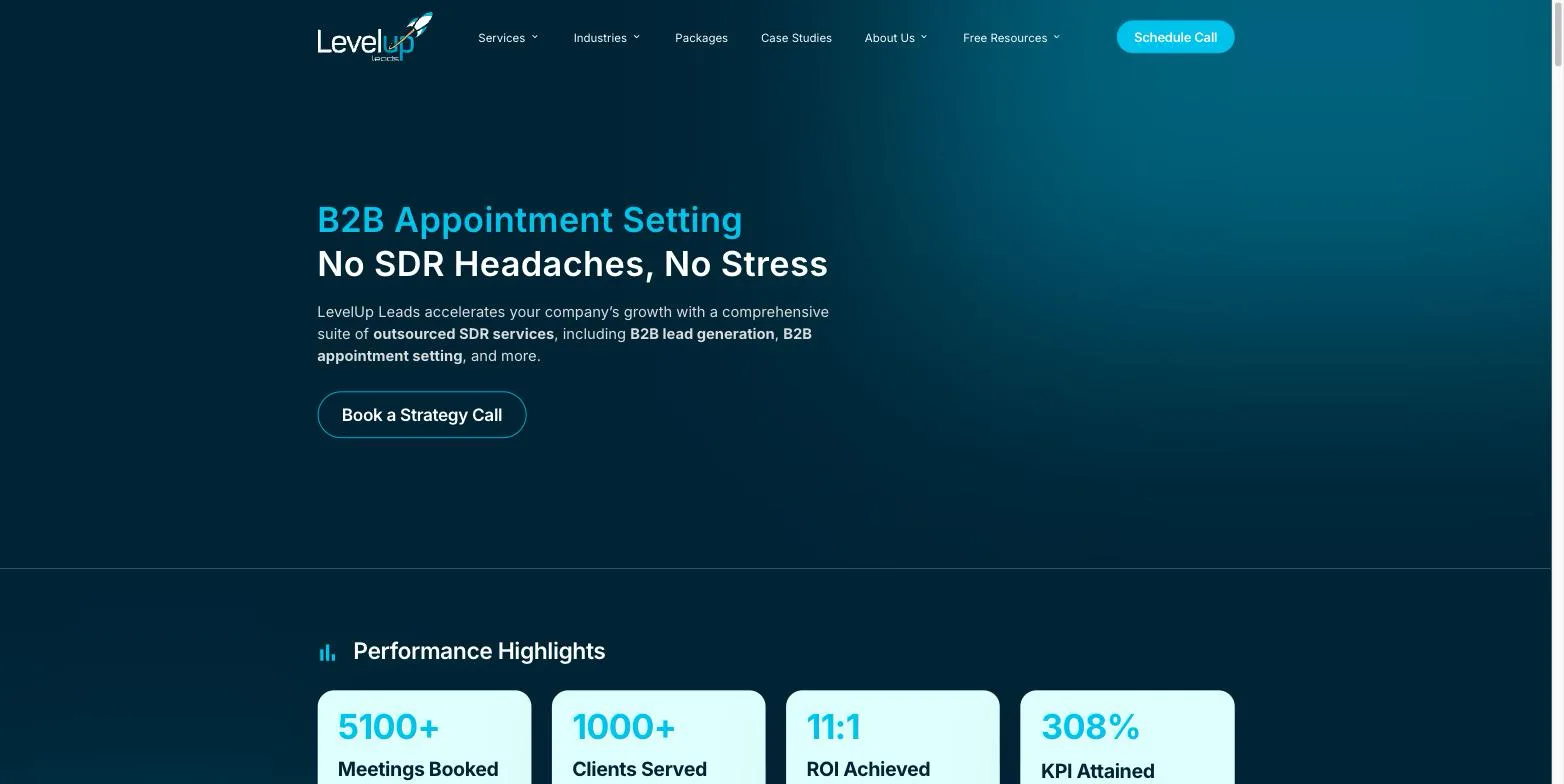
LevelUp Leads stands out for published pricing transparency, a rarity in an industry that prefers to hide costs behind discovery calls. They operate a strong cold-email-first program, building automated outbound systems that eventually fold in LinkedIn and cold calling to drive appointments.
They specialize in building plug-and-play outbound machines for their clients, managing the system from initial strategy through to meeting execution and CRM management.
What to expect
- Structured, cold-email-first system builds and automation.
- Phased introduction of multichannel outreach, including LinkedIn and SDR calling.
- Clear, published pricing minimums that remove the guesswork.
Best fit for
- Companies seeking a highly structured, plug-and-play outbound program with clear deliverables.
- Teams that value pricing transparency before entering a sales cycle.
Keep in mind: Their 5.0 rating on Clutch across 56 reviews is drawn from a secondary source (not live-confirmed at the time of writing).
Reputation and recognition
- Case studies report significant KPI over-performance and high meeting volumes for enterprise clients.
Pricing: Typically ranges from $4,000 to $7,000 per month, with a minimum project size of $1,000.
9. DMT Business Development
DMT Business Development deploys a full SDR pod model for every account, assigning a Business Development Manager, Customer Success Manager, researcher, copywriter, and a dedicated deliverability expert to your campaigns.
Operating out of Ottawa (and formerly known as SalesNash before a 2024 rebrand), they specialize in B2B SaaS and IT services, leaning heavily on manual data research to achieve what they claim is 99% accuracy across highly customized, multichannel outreach.
What to expect
- A fully staffed, multi-disciplinary SDR pod dedicated to your account.
- Manual list building emphasizing data accuracy over sheer scrape volume.
- Deep specialization in the B2B SaaS and IT services sectors.
Best fit for
- SaaS companies that want a boutique experience backed by a full team of specialists.
- Leaders who prefer a dedicated pod structure over a single overloaded account manager.
Keep in mind: Their Clutch rating (across 79 reviews) was not live-confirmed at the time of writing, so requesting recent client references during the evaluation process is highly recommended.
Reputation and recognition
- Claims 99% data accuracy driven by manual research protocols.
- Reviewers cite highly relevant meeting quality for complex software products.
Pricing: Custom scoping based on the required SDR pod allocation.
Where These Agencies Share Their Playbooks
The most capable agencies do not hide their methodology; they publish it. A fast way to audit technical competence before a sales call is to read what an agency gives away for free.
Look for operators like Leadium, who publicly document their infrastructure and data ownership philosophies, or SalesCaptain, who regularly break down complex workflows in Clay and Lemlist. If an agency's blog is dominated by generic thought leadership rather than tactical deliverability advice or exact messaging tear-downs, they likely lack the engineering depth required to survive in the modern inbox.
What B2B SaaS Outbound Email Management Costs
Outbound email is not a budget line item where cheap execution pays off; paying for cheap leads usually results in damaged corporate domains and zero closed-won revenue.
A standard agency retainer typically ranges from $3,500 to $7,000 per month. At an average of $5,000 per month yielding roughly 10 to 15 booked meetings, the cost-per-meeting will hover between $330 and $500.
Compare this against the cost of building an internal SDR function:
- Fully loaded in-house SDR costs range from $116,500 to $210,000 per year (UnboundB2B).
- According to RepVue, the median SDR base salary is $60,000 with an $85,000 OTE.
- SDR turnover is notoriously high (roughly 39% annually), costing $40,000 to $90,000 per departure, complicated by a three-to-six month ramp time.
- An agency, by contrast, can usually deploy infrastructure and begin booking initial meetings within two to four weeks.
While pay-per-meeting models exist, they introduce a dangerous incentive, encouraging agencies to book unqualified calls simply to hit quota. A flat retainer tied to strict qualification criteria is the safer structure for SaaS companies protecting their pipeline quality.
Before you hire, run your numbers through our free SaaS unit economics calculator to see what CAC and payback period your budget can actually support. Outbound lives or dies on who you target, so build a clear buyer profile first with Persona AI, our free customer persona generator.
How to Choose the Right Type for Your Stage
Your current growth stage largely dictates whether you should hire an outbound agency at all.
- Pre-PMF or Low ACV (Under $10k). Do not hire an outbound agency. If you have not validated your messaging yourself, an agency cannot invent product-market fit for you. Furthermore, a $500 cost-per-meeting will fundamentally break the unit economics of a low-ACV or Product-Led Growth model.
- Growth Stage (ACV $15k–$20k+). This is the ideal window. You know exactly who buys your software and why they buy it. Hire an agency to build the technical infrastructure, systematize the sequences, and scale the meeting volume efficiently.
- Enterprise and High-ACV. You require a full, omnichannel SDR stack. Cold email alone will not penetrate large buying committees; you need an agency capable of coordinating email, LinkedIn, and cold calling simultaneously.
Common Mistakes B2B SaaS Teams Make With Outbound Email
Even with a strong agency, an outbound motion can fail if the strategy relies on outdated metrics. Here are the errors that routinely destroy SaaS campaigns.
-
Optimizing for Open Rates
Why it happens: Historically, open rates served as a reliable proxy for interest. Following Apple's Mail Privacy Protection (MPP) rollout, images auto-load on the server side, artificially inflating open rates to near 100% for certain segments. Fix: Ignore open rates completely. Measure success exclusively by reply rate, positive reply rate, and booked meetings. Walk away from any agency that uses open rates as a primary KPI.
-
Sending from the Primary Domain
Why it happens: Teams want their emails to look perfectly official, so they run outbound from their primary
@yourcompany.comdomain. Fix: Never send cold outreach from your primary corporate domain. A single spike in spam complaints will blacklist the domain, taking down your internal communications and transactional product emails with it. Always purchase and authenticate secondary domains (e.g.,@getyourcompany.com). -
Hiring Pre-PMF Before Validating the Message
Why it happens: Founders want to outsource the brutal, rejection-heavy process of finding their first ten customers. Fix: Founder-led sales is non-negotiable in the early days. Agencies are built to amplify a message that already works; validate your value proposition manually before paying someone to scale it.
-
Measuring Success at the Meeting, Not the Close
Why it happens: A booked meeting is the easiest KPI for an agency to report and celebrate. Fix: Track the cohort of agency-generated meetings all the way to closed-won revenue. If an agency books twenty meetings but none progress past the initial discovery call, the targeting is wrong, regardless of what the dashboard says.
-
Ignoring Infrastructure Ownership in the Contract
Why it happens: Companies assume they own the assets, only asking the question when they try to terminate the relationship. Fix: Explicitly mandate in the contract that you retain 100% ownership of all sending domains, warmup history, and exported prospect data upon exit.
Before You Sign: The Deliverability Checklist
A competent outbound agency must pass a strict deliverability audit before you sign a contract. Because infrastructure ownership is the spine of modern outbound, use this exact checklist to vet their technical approach.
Quick checklist:
- You own the sending domains and the warmup history when the contract ends.
- They use secondary domains entirely separate from your primary corporate domain.
- They cap sending volume at a strict maximum of 30 to 50 emails per mailbox, per day.
- They manually configure SPF, DKIM, and DMARC records on every single domain.
- They mandate a two-to-three week automated warmup period before live sending begins.
- They test inbox placement using backend tools, not vanity open rates.
- They commit to keeping your spam complaint rate strictly under 0.1%.
- They pause campaigns automatically if the bounce rate creeps above 2%.
Questions worth asking:
- Who owns the domains and the warmup history when this contract ends?
- How do you track inbox placement given the unreliability of open rates?
What a Good First 90 Days Looks Like
A healthy outbound engagement follows a predictable technical and strategic arc. Knowing the sequence helps you identify red flags early.
- Month 1: Infrastructure and Onboarding. The agency purchases secondary domains, sets up DNS records, connects mailboxes to a warmup protocol, and defines your ICP to craft initial messaging. Red flag: they start sending thousands of live emails in the first week.
- Month 2: Launch and Calibration. Live sending begins at deliberately low volumes. The agency tests subject lines, value propositions, and angles. You should see initial replies and the first few booked meetings. Red flag: bounce rates spike above 2% or spam complaints register, indicating compromised list hygiene.
- Month 3: Scaling and Pipeline Velocity. Winning messages are identified, volume scales up safely across the warmed domains, and a predictable cadence of booked meetings emerges. According to 2026 data, expect an average reply rate around 3.43%. Red flag: the agency reports massive open rates, but the reply rate sits under 1% and no calendar invites are sent.
Conclusion
Outbound email for B2B SaaS is no longer a volume game; it is a highly technical channel that demands infrastructure mastery and rigorous market research. The days of spray-and-pray are dead, replaced by the reality of authenticated domains and strict complaint limits.
Match the agency type to your stage and budget, then interrogate their stance on deliverability and infrastructure ownership before handing over your credit card.
If you want WeGrowth to audit your current outbound setup or discuss building a full-funnel growth engine that goes beyond merely booking meetings, book a strategy call and let's see how we can work together.