Prefer to work it out online? Use our free SaaS Unit Economics Calculator, no spreadsheet needed.
About the SaaS Unit Economics Calculator
If you want to scale your SaaS without burning budget, you need to understand the economics behind every new customer.
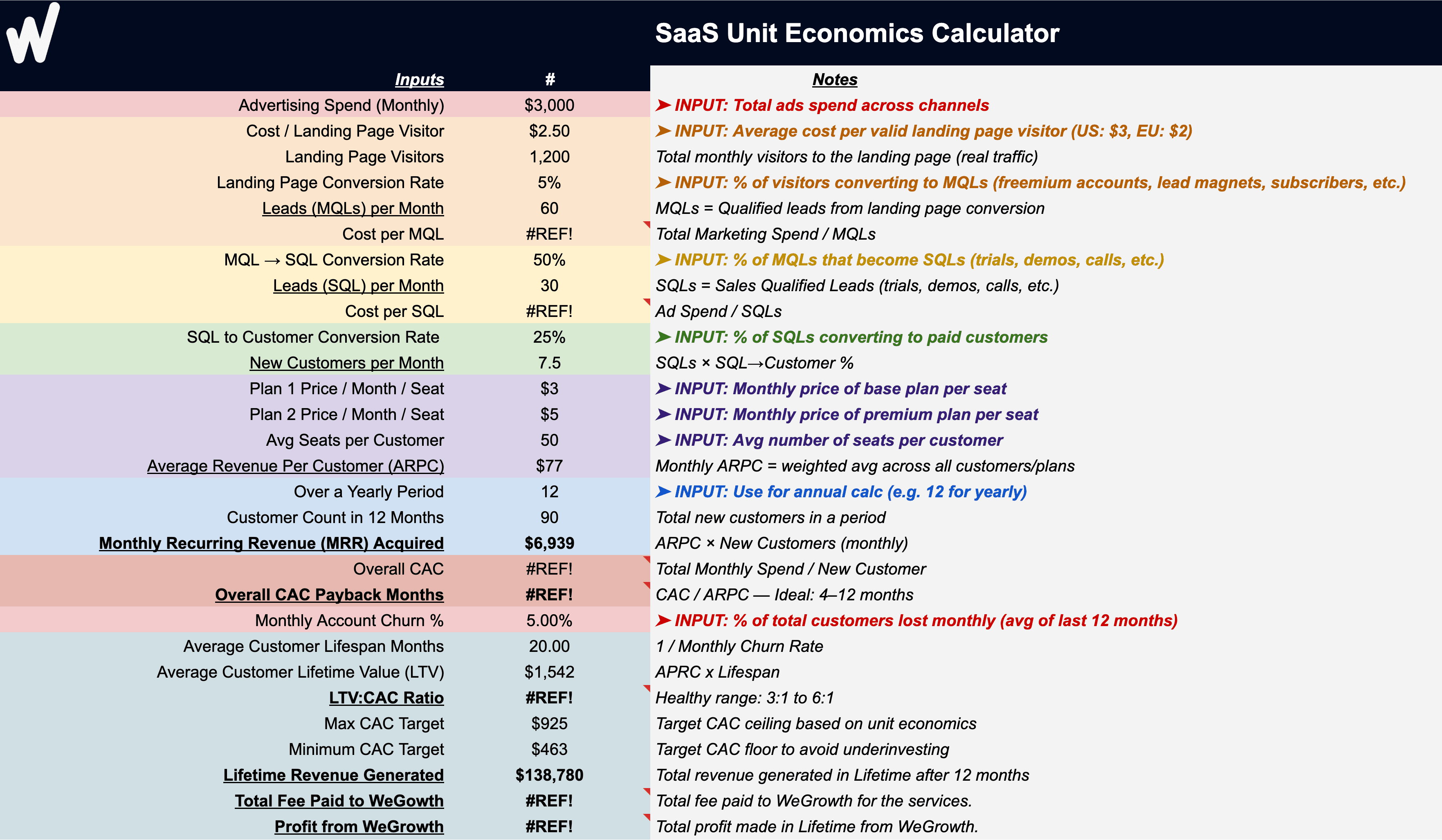
Our SaaS Unit Economics Calculator connects your advertising spend, funnel conversion rates, pricing, churn, CAC, and LTV to show whether your current acquisition model makes financial sense.
Instead of looking at individual metrics in isolation, you can see how changes across your funnel affect customer acquisition costs, payback periods, lifetime value, and your overall growth potential.
With this calculator, you can:
- Calculate CAC based on your monthly acquisition spend and new customers.
- Track costs from landing page visitor to MQL, SQL, and paying customer.
- Measure conversion rates across each stage of your acquisition funnel.
- Calculate monthly recurring revenue generated from new customers.
- Estimate customer lifespan based on your monthly churn rate.
- Calculate average customer lifetime value.
- Measure your LTV:CAC ratio to evaluate acquisition efficiency.
- Determine a target CAC range based on your unit economics.
- Estimate lifetime revenue generated from acquired customers.
- Model whether your current growth investment can produce a positive return.
Benefits of Using Our SaaS Unit Economics Calculator
- Know what you can afford to spend on acquisition before increasing your advertising budget.
- Identify expensive funnel stages by comparing visitor, MQL, SQL, and customer acquisition costs.
- Understand CAC payback and how quickly new customers recover your acquisition investment.
- Measure the impact of churn on customer lifespan, LTV, and overall profitability.
- Evaluate acquisition efficiency using your LTV:CAC ratio.
- Find funnel bottlenecks where better conversion rates could significantly reduce CAC.
- Make better growth decisions using actual economics instead of relying on top-line growth alone.
How to Use This Calculator
- Enter your monthly advertising spend and average cost per landing page visitor.
- Add your landing page conversion rate to calculate monthly MQL volume and cost per MQL.
- Enter your MQL-to-SQL conversion rate to estimate qualified trials, demos, calls, or opportunities.
- Add your SQL-to-customer conversion rate to calculate new customers acquired each month.
- Enter your pricing and average seats per customer to calculate average monthly revenue per customer.
- Add your monthly customer churn rate to estimate customer lifespan and lifetime value.
- Review your CAC, CAC payback period, and LTV:CAC ratio to understand whether acquisition is sustainable.
- Use the calculated CAC targets to guide advertising budgets and future growth investments.
Understand Your SaaS Unit Economics
Growing revenue is not enough if acquiring each new customer costs more than the value they eventually generate.
That is why SaaS companies need to understand the relationship between acquisition cost, conversion, recurring revenue, churn, and customer lifetime value.
The calculator gives you a connected view of those economics.
For example, your spreadsheet can show whether:
- Your CAC is too high relative to LTV.
- Your acquisition spend is being lost at a specific conversion stage.
- Your customers stay long enough to recover acquisition costs.
- You have room to invest more aggressively in customer acquisition.
- Improving conversion or reducing churn would have the greatest impact on growth.
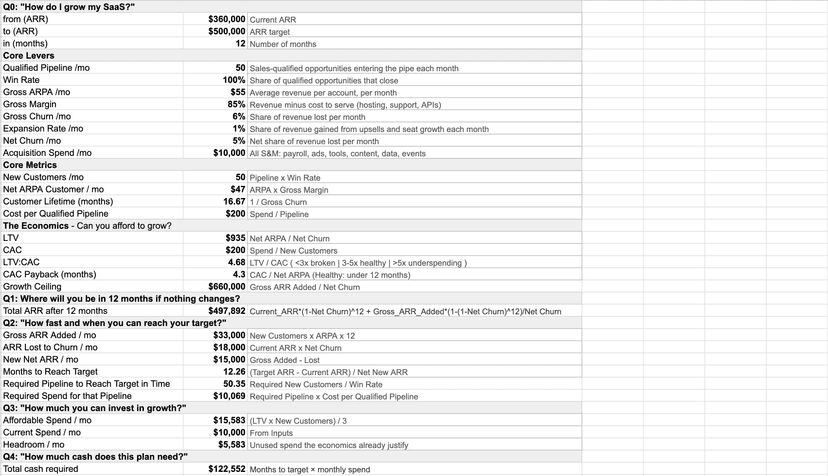
The calculator uses a 3:1 to 6:1 LTV:CAC ratio as a healthy reference range and 4–12 months as an ideal CAC payback range, helping you quickly evaluate your current economics.
To improve the numbers behind your growth model, explore our SaaS growth marketing services or get started with a free growth marketing plan.