B2B and SaaS companies have no shortage of ways to reach potential customers. Search, paid media, content, outbound sales, partnerships, marketplaces, referrals, events, communities, and product-led loops can all contribute to growth.
The challenge is choosing the customer acquisition channels that match how customers evaluate and buy the product.
A low-ticket SaaS company may rely on self-service discovery, lifecycle communication, collaboration invites, and shareable product outputs. A high-ticket enterprise company may need account-based marketing, warm introductions, sales outreach, strategic partners, and direct access to decision-makers.
Those businesses should not evaluate channels using the same assumptions.
To make channel selection more practical, WeGrowth evaluated 150 channel entries across two separate frameworks:
- 100 channels for low- and mid-ticket product-led SaaS
- 50 B2B customer acquisition channels for high-ticket and enterprise companies
Some channel families appear in both lists because the execution, economics, conversion event, and success metric change between product-led and sales-led acquisition.
Want the list ranked for your company? The free Acquisition Channel Finder re-ranks all 150 channels for your stage, budget, team and goals.
At a glance: The rankings reveal two different acquisition systems. Product-led companies benefit most when the product helps users reach value, invite others, share useful outputs, and expand their usage. Sales-led companies depend more heavily on trust, timing, account access, and human guidance. Search, referrals, email, partnerships, and sales support can work across both models, but they must be executed and measured differently.
What Counts as a Customer Acquisition Channel?
Customer acquisition channels are the repeatable paths through which a company reaches potential buyers and moves them toward becoming customers.
A channel may help a business:
- Create awareness
- Capture existing demand
- Support product or vendor evaluation
- Generate signups, leads, or sales opportunities
- Convert users or accounts
- Encourage referrals, expansion, or reactivation
In this guide, the term includes more than traditional marketing channels. It also covers product-led mechanisms, sales motions, partnerships, marketplaces, and customer-driven distribution.
The 150 entries include:
- Digital marketing channels such as search, social media, email, and content
- Performance marketing channels such as paid search, paid social, sponsorships, and retargeting
- Product-led growth channels such as collaboration invites, public outputs, referrals, freemium, and reverse trials
- B2B sales channels such as outbound email, phone, field sales, and account-based marketing
- Marketplaces, integrations, and embedded distribution
- Consultants, resellers, agencies, and co-selling partners
- Communities, webinars, events, podcasts, and thought leadership
- Lifecycle, nurture, expansion, and reactivation programs
- Launches, offers, and time-bound campaigns
Some entries are permanent distribution channels. Others are growth motions, product loops, ecosystems, or campaigns. We use “channel” as an umbrella term because each creates a repeatable route to acquisition or revenue.
Customer Acquisition Channels Depend on How Customers Buy
The best customer acquisition channels depend on more than audience size or potential reach.
They must fit:
- Product price and customer value
- Product complexity
- Time to value
- Buying-cycle length
- Number of decision-makers
- Required level of human support
- Sales and implementation costs
- Available team, budget, and capabilities
A channel that works for a $29-per-month self-service product may be uneconomical for an enterprise vendor or incapable of supporting a six-figure buying decision.
Conversely, field sales, executive dinners, and heavily personalized campaigns may be too expensive for a low-ticket product.
Product-Led Customer Acquisition
Product-led customer acquisition relies on the product to help users understand, experience, adopt, purchase, share, or expand their usage.
It usually has several characteristics:
- Users can experience meaningful value with limited sales involvement
- Signup and evaluation are relatively fast
- Activation is a critical measure of acquisition quality
- Product usage can introduce additional users or accounts
- Distribution needs to scale without proportional sales costs
- Customer acquisition cost must fit lower or mid-range customer value
Strong SaaS acquisition channels for this motion include lifecycle communication, collaboration invites, shareable outputs, integration marketplaces, freemium entry, reverse trials, high-intent search, customer referrals, and product-qualified sales assist.
These channels do not only generate the first signup. Many of the strongest product-led growth channels improve what happens after acquisition by helping users activate, invite teammates, share the product, upgrade, or return.
Sales-led customer acquisition
Sales-led customer acquisition is designed for products that require human guidance, stakeholder alignment, technical validation, procurement, or implementation support.
It often involves:
- Higher contract values
- Longer buying cycles
- Multiple decision-makers and influencers
- Greater trust and education requirements
- Security, compliance, legal, or procurement reviews
- Direct involvement from sales, executives, partners, or consultants
- Higher acquisition costs justified by larger account value
Strong sales-led growth channels include customer referrals, warm introductions, signal-based outbound, account-based marketing, executive networks, professional-services partnerships, strategic integrations, industry associations, analyst relations, and cloud marketplaces.
These enterprise customer acquisition channels are less dependent on immediate product activation. They are more likely to be evaluated through pipeline quality, opportunity conversion, win rate, contract value, and sales-cycle impact.
Product-Led vs. Sales-Led Customer Acquisition
Whichever motion you run, check what a channel can afford before you commit: the free SaaS unit economics calculator shows the highest CAC your customer value supports.
How We Ranked the Channels
A channel should not be judged by traffic, reach, leads, or signup volume alone.
One channel may create results quickly but generate little trust or customer value. Another may take longer to build but produce stronger activation, larger customers, better retention, or more expansion revenue.
We scored each channel across commercial fit, execution fit, and strategic priority.
Criteria Shared by Both Lists
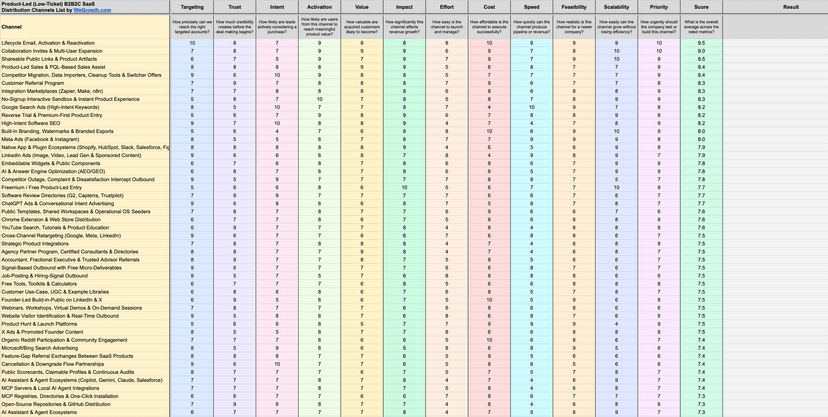
- Targeting: How precisely the channel can reach the right users or accounts
- Trust: How much credibility it creates before a buying decision
- Intent: How likely prospects are to be actively considering a solution
- Customer value: How valuable acquired customers are likely to become
- Revenue impact: How significantly the channel could affect revenue growth
- Effort: How easy the channel is to launch, manage, and maintain
- Cost: How affordable it is to execute successfully
- Speed: How quickly it can produce useful signals, pipeline, or revenue
- Feasibility: How realistic it is for a newer or resource-constrained company
- Scalability: How easily it can grow without rapidly losing efficiency
- Priority: How urgently the company should consider testing or building it
Product-Led Activation
The product-led framework includes one additional criterion:
- Activation: How likely users acquired through the channel are to reach meaningful product value
Activation matters because a channel that creates thousands of inactive signups may be less valuable than one that attracts fewer users who adopt, convert, retain, and expand.
Each criterion uses a 1–10 scale, with a higher number representing a more favorable result.
A high Cost score means the channel is relatively affordable. A high Effort score means it is comparatively easy to execute.
How the Final Scores Are Calculated
The two frameworks calculate their final scores differently.
In the sales-led table, the final Score is the average of the 11 rated criteria.
In the product-led table, the final Score is the prioritization index provided in the original WeGrowth source sheet. Because the sheet does not document a reproducible weighting formula, the product-led Score should not be interpreted as a simple mathematical average.
Scores should only be compared within their respective tables.
About the rankings: The ratings were developed by WeGrowth as practical prioritization benchmarks for B2B and SaaS teams. They reflect channel characteristics, execution requirements, buying-motion fit, and growth experience. They are not universal industry averages or guaranteed performance forecasts. Adjust them using your pricing, market, team, budget, customer behavior, and actual results.
100 Product-Led Customer Acquisition Channels for SaaS
This list is designed for low- and mid-ticket SaaS products where users can discover, experience, adopt, or purchase the product with limited sales involvement.
It combines traditional SaaS marketing channels with product-native distribution, lifecycle programs, marketplaces, ecosystems, referrals, monetization models, and product-led sales plays.
The strongest channels tend to do at least one of three things:
- Help acquired users reach meaningful product value
- Turn product usage into further distribution
- Capture demand when the user is actively evaluating a solution
The downloadable template also includes a Result field so you can replace the initial benchmark with real performance data from your own experiments.
Customer Acquisition Channels Worth Considering First
The two tables contain 150 possible distribution channels and growth plays. Most companies should not attempt to use all of them.
The following channel families deserve early consideration because they appear consistently across B2B and SaaS acquisition strategies and support different stages of the customer journey.
They are not a universal top 10. Their relevance depends on the product, market, customer value, existing traction, and buying motion.
Customer referrals and word of mouth
Referrals combine strong trust with direct access to people who may share the same problem.
For product-led SaaS, referrals may be encouraged through account credits, additional usage, or benefits for both users. In sales-led B2B, introductions from customers, investors, advisors, executives, and former champions can open doors that cold outreach cannot.
Best for: Products with satisfied customers and clear peer relevance
Track: Referral volume, qualified introductions, conversion, customer value, and retention
Main trade-off: Referral quality can be high, but volume is difficult to predict
High-intent SEO and paid search
Search reaches buyers already researching a category, use case, competitor, or problem.
Paid search can validate demand and messaging quickly. High-intent SEO takes longer but can create a compounding acquisition asset through comparison pages, alternatives, use-case content, integration pages, and solution-focused landing pages.
If you plan to bring in outside help, compare the best B2B SaaS Google Ads agencies and SEO agencies.
For enterprise products, search may introduce the vendor before sales, analysts, partners, or review platforms shape the rest of the evaluation.
Best for: Categories with measurable existing demand
Track: Qualified traffic, conversion, pipeline, CAC, activated-user CAC, and revenue
Main trade-off: Paid search can be expensive, while SEO requires time and sustained quality
Content, thought leadership, and original research
Content helps buyers understand a problem, compare approaches, and build confidence in a company before they speak to sales or try the product.
Useful formats include practical guides, executive perspectives, use-case content, benchmark reports, product education, customer examples, and original research.
Product-led companies can connect content directly to a signup or product experience. Sales-led companies can use it to educate buying committees and support longer nurture cycles.
Best for: Products that require education or category development
Track: Qualified traffic, engagement, assisted conversions, pipeline influence, and sales usage
Main trade-off: Content does not compound without clear positioning, quality, and distribution
Lifecycle email and owned-list nurture
Email remains valuable because it reaches an audience the company already has permission to contact.
Product-led lifecycle email responds to user behavior: incomplete setup, unused features, activation milestones, limits, upgrades, and inactivity. Sales-led nurture supports account education, stakeholder alignment, event follow-up, and sales conversations.
The strongest programs adapt to user or account behavior rather than sending identical sequences to everyone.
Best for: Companies with measurable customer-journey stages
Track: Activation, response, opportunity creation, conversion, expansion, and reactivation
Main trade-off: Poor segmentation turns email into repetitive noise
Product-led growth loops
Product-led growth loops use the product itself to create acquisition or expansion.
Examples include collaboration invites, shared reports, branded exports, public pages, embedded widgets, referrals, templates, freemium entry, and reverse trials.
These channels can scale efficiently because distribution happens during normal product usage. However, the loop must provide real value to both the existing user and the person being introduced.
Best for: Products with collaboration, sharing, publishing, or repeatable outputs
Track: Invites, viewers, acceptance, activation, assisted signups, and expansion
Main trade-off: A sharing prompt is not a growth loop unless it improves the product experience
Outbound sales and intent signals
Outbound remains one of the most direct B2B acquisition channels when targeting and timing are strong.
Useful signals include hiring activity, executive job changes, competitor usage, technology adoption, website visits, intent data, funding, expansion, compliance requirements, and operational changes.
The outreach should connect the signal to a relevant problem or useful next step. High-volume generic messages usually reduce trust rather than create pipeline.
If you would rather outsource it, see our comparison of B2B SaaS outbound email agencies.
Best for: Defined account segments with identifiable triggers and sufficient customer value
Track: Positive responses, meetings, opportunities, pipeline, win rate, and CAC
Main trade-off: Better targeting improves relevance but can reduce the number of reachable accounts
LinkedIn and account-based marketing
LinkedIn supports executive thought leadership, founder-led content, targeted advertising, account engagement, employee advocacy, and direct outreach. If you are hiring a partner for the paid side, see the best B2B SaaS LinkedIn Ads agencies.
Account-based marketing goes further by coordinating marketing and sales activity around a defined list of high-value accounts. Tactics may include customized content, advertising, outbound, executive engagement, events, direct mail, and partner introductions.
Best for: B2B audiences identifiable by role, company, industry, or seniority
Track: Qualified engagement, account reach, meetings, opportunities, win rate, and pipeline influence
Main trade-off: Visibility does not guarantee intent, while deep personalization requires significant resources
Strategic partnerships and integrations
Partners can distribute, recommend, implement, bundle, or strengthen a product.
This includes integration marketplaces, consultants, agencies, resellers, technology partners, cloud marketplaces, managed-service providers, educators, and nearbound co-selling programs.
The strongest partnerships solve a shared customer problem and create value for both sides. A logo exchange or occasional webinar rarely becomes a meaningful channel on its own.
Best for: Products that complement established tools, workflows, or service providers
Track: Partner-sourced pipeline, installs, referrals, activation, conversion, and customer value
Main trade-off: Partnerships take time and require active enablement
Review, comparison, and migration channels
Buyers often consult review platforms, comparison pages, alternatives, and peer recommendations during active evaluation.
Migration tools and switcher offers go further by reducing the operational cost of leaving an existing solution.
Product-led companies can use automated imports and self-service switching. Sales-led vendors may provide implementation support, migration planning, and commercial incentives.
Best for: Established categories with recognizable competitors
Track: Comparison traffic, review-site leads, migration starts, opportunities, conversion, and retention
Main trade-off: A weak comparison or migration experience can reduce trust at a high-intent stage
Webinars, events, and sales-assisted education
Webinars, workshops, virtual demonstrations, executive dinners, roundtables, and conferences help companies explain complex products and engage several stakeholders.
Product-led businesses can use on-demand education to improve activation. Sales-led teams can use events to create conversations, deepen relationships, and move accounts through evaluation.
The session should address a real customer problem rather than operate as a long product pitch.
Best for: Complex products, unfamiliar categories, and high-consideration purchases
Track: Attendance, engagement, product usage, meetings, opportunities, and influenced pipeline
Main trade-off: Events can generate attention without creating repeatable acquisition
Common Mistakes When Choosing Marketing Distribution Channels
Channel selection usually fails because the company uses the wrong evaluation model, metric, or level of investment.
Choosing Channels Because They Are Popular
A widely discussed channel is not automatically appropriate for your audience, customer value, buying motion, or team.
TikTok, LinkedIn, search, Product Hunt, events, account-based marketing, and partnerships can all work under the right conditions. Popularity says little about whether a channel fits your company.
Start from where your buyers actually spend time. If you don't have a clear picture yet, Persona AI generates a customer persona from your website in minutes.
Using the Wrong Channel for the Buying Motion
A low-ticket self-service product should not depend on expensive field sales.
A six-figure enterprise platform may not convert through a frictionless signup funnel alone.
The channel must support the amount of education, trust, stakeholder alignment, and human involvement required by the purchase.
Copying Competitors Without Understanding Their Economics
Competitors may have different:
- Pricing
- Brand awareness
- Sales capacity
- Funding
- Partner relationships
- Customer value
- Activation rates
- Retention
- Existing audiences
Study where competitors distribute, but do not copy visible tactics without understanding the system and economics that support them.
Comparing Channels With the Wrong Metrics
Product-led channels should be evaluated through activation, paid conversion, retention, and expansion.
Sales-led channels require metrics such as qualified pipeline, opportunity conversion, win rate, contract value, sales-cycle length, and payback.
Using lead or signup volume alone can make weak channels appear successful.
Testing Too Many Channels at Once
Several underfunded tests rarely produce useful conclusions.
Most teams learn more by selecting a small number of channels, defining a clear hypothesis for each one, and giving each test sufficient resources and time.
Treating Campaigns as Permanent Channels
Product launches, Black Friday offers, conferences, PR campaigns, and limited-time promotions can generate concentrated attention.
They do not automatically become repeatable acquisition systems.
Campaigns should support an ongoing SaaS distribution strategy, not replace one.
Ignoring Product, Partner, and Expansion Distribution
Customer acquisition is not limited to external marketing channels.
Collaboration, integrations, referrals, public product outputs, customer advocates, resellers, consultants, and expansion programs can create additional distribution after the first user or account has been acquired.
Judging Compounding Channels Too Quickly
SEO, content, communities, analyst relations, partnerships, and audience development often need sustained effort before they become reliable.
Evaluating them after only a short test can lead to abandoning potentially valuable channels before they have enough time to develop.
Scaling Before the Economics Work
Product-led teams should confirm that acquired users activate, convert, and retain before increasing acquisition spend.
Sales-led teams should validate opportunity quality, win rate, contract value, sales cost, implementation burden, and payback.
Scaling an inefficient system usually increases losses faster than it increases growth.
Build a Customer Acquisition Strategy Around Your Buying Motion
There is no universally best customer acquisition channel.
The right choice depends on what you sell, who participates in the buying decision, how much the customer is worth, how quickly value can be demonstrated, and how much human involvement the purchase requires.
Product-led SaaS companies should prioritize SaaS acquisition channels that support low-friction discovery, activation, sharing, conversion, and expansion.
Sales-led B2B companies should place more weight on account intent, trust, stakeholder access, partnerships, and sales-assisted conversion.
Use the two rankings as shortlists, not universal playbooks.
Select channels that fit your economics, define the evidence each experiment must produce, and evaluate performance using metrics appropriate to your buying motion.
Treat acquisition as a connected system rather than a list of isolated tactics. The strongest strategies combine demand creation, demand capture, product experience, sales engagement, partnerships, customer success, and expansion.
Use the editable WeGrowth template to review the complete scoring matrices and prioritize the channels that fit your product, customer value, audience, and buying process.
Need help turning the rankings into a focused channel strategy? WeGrowth can assess your product, economics, and current traction to build a practical testing roadmap.


![150 Customer Acquisition Channels for B2B & SaaS Startups, Ranked [+ Free Template]](/_next/image?url=%2Fimages%2Fblogs%2Fcards%2Ftop-customer-acquisition-channels.png&w=3840&q=75)