"Traffic went up, demos didn't." It is the single most common complaint B2B SaaS leaders have after a year of investing in SEO. Rankings no longer mean what they used to, especially when AI Overviews can cut organic click-through rates by up to 58 percent on top queries.
The fix requires looking past search volume and evaluating how a partner actually connects search visibility to revenue pipeline. The agencies on this roster represent genuinely different strategic philosophies: BOFU-first versus topical authority, content-led versus technical-first, programmatic versus editorial.
This guide breaks down the agencies that execute these methodologies, detailing their verified pricing, stage fit, and how they handle the shift toward AI search. Start with the shortlist below.
Comparing other channels? See our guides to the best B2B & SaaS Google Ads agencies, Meta Ads agencies, LinkedIn Ads agencies, and outbound email agencies.
For a broader view, see our SaaS growth marketing agency roundup.
The Shortlist at a Glance
No single agency is best for everyone. Here is the fast version, with each pick explained in full below.
| Agency | Best for | Pricing |
|---|---|---|
| WeGrowth | Full-funnel SaaS growth | Monthly subscription, no long-term contract; 14-day trial |
| Siege Media | Content-driven digital PR | ~$11,000–$30,000+/mo (reported) |
| RevenueZen | Month-to-month flexibility | ~$5,000–$9,000/mo, month-to-month |
| Skale | SaaS unit economics and attribution | ~$8,000–$20,000/mo (reported) |
| Minuttia | Dedicated AEO and LLMO strategies | Custom quote |
| MADX Digital | Complex technical architectures | Custom quote |
| Virayo | AI-visibility tracking | From ~$5,000–$6,000/mo (published) |
| Grow and Convert | BOFU-first pipeline generation | $10,000+ minimum project |
Pricing is as published or reported at the time of writing. Confirm current rates with each agency.
How We Evaluated These Agencies
This guide is published by WeGrowth, and we have included ourselves in it. To keep the comparison fair, every agency here is described against the same criteria:
- SaaS and B2B focus: Real experience with software buying cycles, not general e-commerce or consumer search.
- Methodology differentiation: How they actually execute SEO, whether through programmatic content, deep technical remediation, or editorial deep dives.
- Revenue orientation: Campaigns measured on SQLs and pipeline generation, not just sessions and keyword ranks.
- The GEO test: Whether they have distinct methodologies around Generative Engine Optimization, or if they just rebranded standard services. Can they show an AI-citation report?
- Independent signals: Validating third-party reviews (Clutch, G2).
- Transparency: Clear scope, reporting, and realistic fee models.
Ratings, review counts, and reported results below are point-in-time, captured in August 2026, and they change over time. Self-reported claims are explicitly attributed. Inclusion here is editorial, not paid.
What a B2B SaaS SEO Agency Is (and Isn't)
A B2B SaaS SEO agency is a specialized growth partner that engineers your website and content to capture high-intent buyers, drive qualified pipeline, and build topical authority within your specific software category.
- It is a partner that aligns search strategy with your product's Go-To-Market motion, translates complex technical capabilities into buyer-centric content, and tracks conversions from organic click to closed-won revenue.
- It isn't a generic content mill that writes surface-level glossary posts to inflate traffic without generating trials, or a black-hat link-building farm prioritizing volume over domain relevance.
The 8 Best B2B & SaaS SEO Agencies (2026)
1. WeGrowth
WeGrowth treats SEO as one lever inside a connected growth system, rather than an isolated channel operating in a silo. Strategy, high-intent content, technical foundation, and digital PR all integrate with paid acquisition, CRO, and lifecycle marketing, ensuring that the traffic generated is actually captured and converted by the rest of the funnel.
The methodology focuses on pipeline metrics and SQLs over raw sessions. WeGrowth builds campaigns around your Go-To-Market motion, connecting search intent directly to product trials and demo requests. This systemic approach avoids the trap of empty traffic growth by making sure organic search works in tandem with the overall revenue engine.
What to expect
- SEO executed alongside CRO, paid channels, and lifecycle marketing.
- Deep integration with your overall Go-To-Market strategy.
- Strict focus on pipeline metrics, SQLs, and closed-won revenue.
- A structured rhythm connecting technical foundation, content, and digital PR.
Best fit for
- SaaS companies looking for holistic growth rather than a disjointed SEO-only vendor.
- Teams needing to scale organic acquisition in tandem with paid efforts.
Keep in mind: WeGrowth is a full-stack growth partner, so it fits if you want more than one channel managed. Since we publish this guide, treat our spot here as disclosed rather than a third-party verdict.
Reputation and recognition
- Proven methodology integrated with broader SaaS growth frameworks.
- Focuses on systemic growth across multiple interconnected channels.
- SEO runs alongside our content marketing for SaaS service; see client results in our case studies.
Pricing
Flexible monthly subscription, no long-term contract. Startups can begin with a 14-day trial plus $1,000 in ad credit. Scope-based; get in touch for a quote.
2. Siege Media
Siege Media brings an entirely different scale to the table, backed by a team of over 100 staff operating a massive digital PR and design-led content engine. They are the production powerhouse for mid-market and enterprise SaaS brands that need to acquire premium backlinks and publish highly linkable assets at high velocity.
They lean heavily into design and custom interactive assets to earn placements, and have increasingly adapted their tooling for AI search and Generative Engine Optimization. They self-report raising a $30M Series A in June 2025 and list Zendesk, Intuit, Airbnb, Casper, and HubSpot among their clientele.
What to expect
- High-volume, design-led content production from a massive team.
- Strong emphasis on digital PR and acquiring premium backlinks.
- Advanced tooling for AI search and GEO.
- Custom interactive assets built to earn natural links.
Best fit for
- Mid-market to enterprise SaaS brands with large content budgets.
- Companies needing high-end design and linkable assets built at scale.
Keep in mind: Their scale and premium asset production mean they operate at a significantly higher price point, which may stretch the budget for early-stage startups.
Reputation and recognition
- 4.9 on Clutch across roughly 47 reviews (as of August 2026).
- Notable self-reported client roster including Zendesk and HubSpot.
- Self-reported $30M Series A funding.
Pricing
Reported tiers span $11,000 to $30,000+ per month based on content volume.
3. RevenueZen
RevenueZen leads with month-to-month contracts, offering a level of flexibility that serves as a massive hook in an industry known for rigid 12-month lock-ins. Operating as "RevenueZen by Eastern Standard," they focus strictly on the intersection of B2B SaaS, professional services, and venture-backed growth.
Their methodology pairs traditional B2B SaaS SEO with organic LinkedIn executive thought leadership. This dual approach optimizes for search engines while leveraging organic social selling, helping founders build holistic authority without tying them down to long-term commitments.
What to expect
- Month-to-month flexibility without long-term lock-ins.
- Integrated organic LinkedIn strategy for executive thought leadership.
- Focus on venture-backed B2B SaaS.
- Generative Engine Optimization (GEO) applied to search strategy.
Best fit for
- Startups and scale-ups that want flexible contracts and predictable off-ramps.
- Founders looking to pair organic search with organic social authority.
Keep in mind: Their organic LinkedIn service focuses purely on organic thought leadership, rather than paid ads management.
Reputation and recognition
- Roughly 4.9 on Clutch across nearly 40 reviews (as of August 2026).
- Clutch 1000 and Clutch Top 100 recognitions in recent years.
Pricing
Published pricing sits around $5,000 to $9,000 per month, operating month-to-month.
4. Skale
Skale was founded in 2019 by alumni from Typeform and TravelPerk, and that background translates into a ruthless obsession with SaaS unit economics and revenue attribution. They reject vanity traffic entirely, building their operational model around ensuring that every piece of content and every link impacts MRR.
Their methodology leans on programmatic content, topical authority clusters, and strict pipeline tracking. They demand deep access to your CRM to map organic clicks through to closed deals, self-reporting an impressive client list that includes HubSpot, UserTesting, Maze, G2, and Slite.
What to expect
- Deep expertise in SaaS-specific unit economics and pipeline tracking.
- Execution of programmatic content and topical authority clusters.
- Revenue-attribution lens applied to all SEO activities.
- Direct CRM integration for measuring LTV/CAC impact.
Best fit for
- Growth-stage SaaS companies that need strict ROI tracking on organic spend.
- Teams moving from random acts of content to structured topical authority.
Keep in mind: Because they focus on revenue and pipeline attribution, they require deep access to your CRM and analytics, demanding a high level of client collaboration.
Reputation and recognition
- 4.9 on Clutch across roughly 16 reviews (as of August 2026).
- Founded by notable SaaS alumni.
- Self-reported clients include prominent SaaS players.
Pricing
Reported ranges run from $8,000 to $20,000 per month.
5. Minuttia
Minuttia sets itself apart by treating AEO (Answer Engine Optimization) and LLMO (Large Language Model Optimization) as separate, named service lines, rather than relabeling standard SEO deliverables. They understand that ranking on a traditional SERP solves only half the problem when generative AI cites answers directly.
As a B2B SaaS-only agency, they explicitly structure their output to optimize for both traditional algorithms and generative AI citations, helping software companies ensure their products are cited by the LLMs buyers are using for research. They self-report working with prominent SaaS brands like ServiceTitan, Toggl, and Docebo.
What to expect
- Dedicated strategies for AI Overviews and Answer Engines (AEO/LLMO).
- Strict adherence to B2B SaaS methodologies.
- Focus on optimizing for both traditional algorithms and generative AI citations.
- Real methodologies for securing LLM mentions.
Best fit for
- Forward-thinking SaaS brands worried about traffic displacement from AI Overviews.
- Companies that need to ensure their software is cited by LLMs.
Keep in mind: AEO and LLMO are still evolving fields; their impact metrics will look different from traditional organic traffic charts, requiring a shift in how you measure success.
Reputation and recognition
- 4.9 to 5.0 on Clutch across roughly 16 verified reviews (as of August 2026).
- Self-reported clients include ServiceTitan and Toggl.
Pricing
Custom based on scope, technical requirements, and content needs.
6. MADX Digital
MADX Digital operates as the agency for complex technical architectures. Founded in London in 2021, they provide a true full-stack approach that brings heavy technical SEO capabilities alongside their content and link-building efforts.
Their methodology tackles massive, programmatic site architectures and deep technical debt. When a SaaS platform needs comprehensive technical remediation before content can even begin to rank, MADX handles the audits, the technical strategy, and formalized Generative Engine Optimization (GEO) service lines.
What to expect
- Comprehensive technical SEO and site architecture optimization.
- Integrated content strategy and rigorous link building.
- Specific service lines dedicated to GEO and AI search.
- Solutions for complex programmatic sites.
Best fit for
- Complex SaaS websites needing heavy technical SEO remediation.
- Companies that want a single agency to handle technical debt, content, and links.
Keep in mind: Full-stack engagements require dedicated developer resources on your side to actually implement the technical recommendations they uncover.
Reputation and recognition
- 4.9 on Clutch from a smaller but strongly positive review set (as of August 2026).
- Premier Verified by Clutch designation.
Pricing
Custom based on technical requirements and content volume.
7. Virayo
Virayo leads with AI-visibility tracking as a distinct and primary capability. They conduct thorough AI-visibility audits to establish a baseline of how often their clients' brands and solutions are cited in generative AI answers, mapping that back to traditional search metrics.
As a B2B SaaS-exclusive agency, they combine this tracking with end-to-end content creation and link acquisition. This dual approach ensures clients remain visible as search engines evolve, providing hard data on an emerging channel that many agencies still struggle to quantify.
What to expect
- Detailed AI-visibility audits and specialized tracking.
- B2B SaaS-exclusive strategic alignment.
- End-to-end content and link acquisition services.
- Reporting that maps generative citations alongside organic metrics.
Best fit for
- SaaS marketing teams that need hard data on their AI search visibility.
- Companies looking for a balanced approach to content, links, and AI tracking.
Keep in mind: While they track AI visibility well, the exact conversion paths from AI citations to demos are still maturing across the industry, so expect attribution to evolve.
Reputation and recognition
- Roughly 5.0 on Clutch from roughly 11 verified reviews (as of August 2026).
Pricing
Published pricing starting from $5,000 to $6,000 per month.
8. Grow and Convert
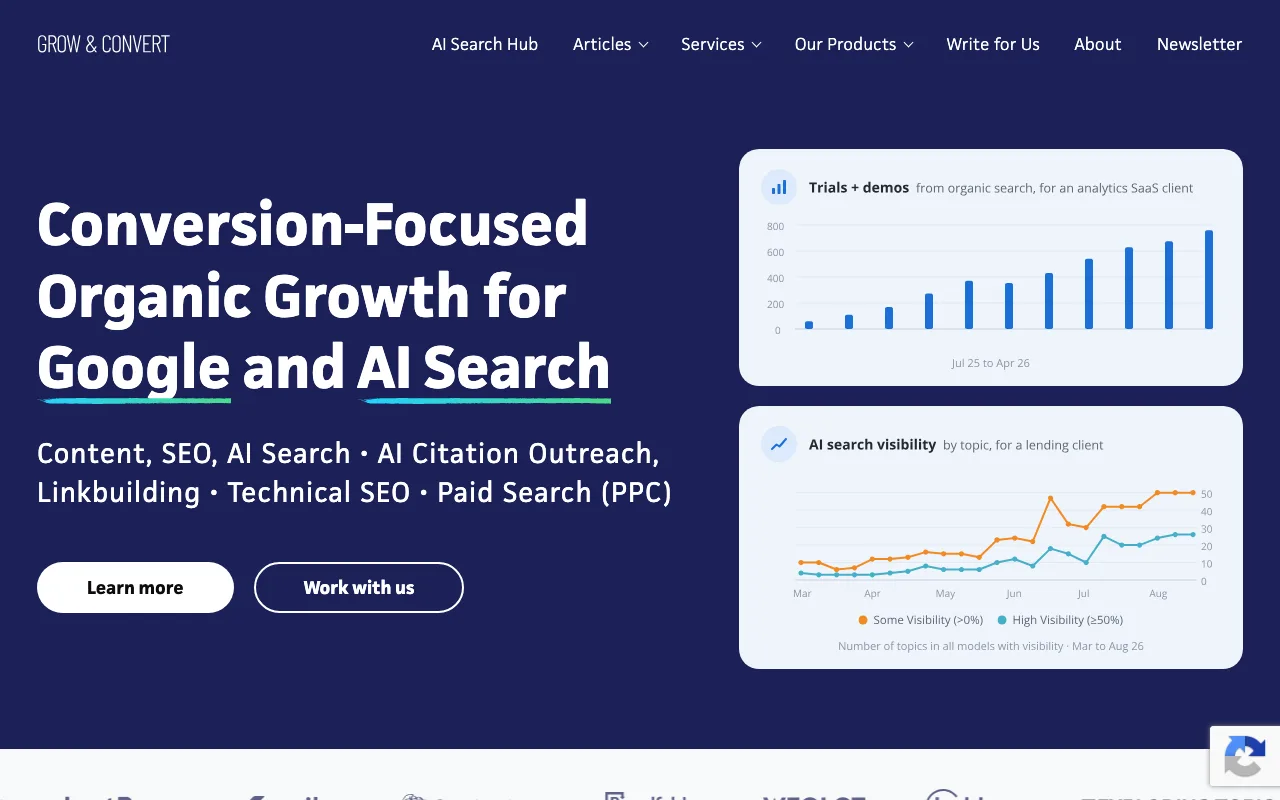
Grow and Convert is famous for its "Pain Point SEO" methodology. Co-founded by Benji Haviv and Devesh Khanal, they explicitly reject the standard agency playbook of chasing high-volume, Top-of-Funnel keywords. BOFU-first is their entire identity.
They target specific buyer pain points with in-depth, product-led content designed to rank for queries where the searcher is already looking to buy a solution. This deep editorial strategy requires heavy Subject Matter Expert (SME) interviews, making them an ideal fit for sales-led SaaS companies desperate for immediate pipeline rather than vanity traffic.
What to expect
- Strict adherence to the Pain Point SEO framework.
- Heavy focus on BOFU keywords over TOFU traffic volume.
- Deep editorial strategy requiring heavy SME interviews.
- Product-led content that drives immediate conversion intent.
Best fit for
- Sales-led SaaS companies with a high ACV that need pipeline immediately.
- Teams tired of getting traffic that fails to convert to demos.
Keep in mind: Because they target niche, high-intent BOFU terms, your overall organic traffic volume graph will not spike the way it would with a generic strategy, but your demo requests should rise significantly.
Reputation and recognition
- 10 verified reviews on Clutch (as of August 2026).
- Highly recognized proprietary methodology known across the industry.
Pricing
Project sizes typically run a minimum of $10,000.
Where These Agencies Share Their Playbooks
The best agencies do not hide their methodologies behind sales calls. They publish them in public. Reading an agency's free thought leadership is the easiest way to see if their philosophy matches your Go-To-Market motion before you ever send an inquiry.
- WeGrowth shares full-funnel SaaS teardowns and growth system frameworks on our blog, showing how organic search connects to the rest of the revenue engine.
- Grow and Convert is famous for publishing the exact mechanics of their Pain Point SEO strategy and conversion tracking.
- Siege Media regularly releases comprehensive data studies on content marketing ROI and link-building costs.
- Skale publishes deep dives into SaaS unit economics, LTV/CAC ratios, and how organic search impacts those metrics.
What B2B SaaS SEO Management Costs
SEO pricing in the SaaS space depends entirely on deliverables, speed, and specialization. Based on verified agency pricing, here is what the landscape looks like:
- Around $2,000 per month: Below this threshold, quality B2B SaaS SEO is rarely deliverable. Agencies at this price point usually offshore content, use questionable link farms, or recycle generic strategies.
- Around $5,000 per month: The starting point for competent, SaaS-specific strategy. Often includes a baseline of content production and technical advisory.
- $8,000 to $20,000 per month: The standard range for high-growth SaaS. This covers comprehensive technical SEO, high-velocity BOFU content production, authoritative link building, and deep CRM integration for pipeline tracking.
- $30,000+ per month: Reserved for massive programmatic SEO rollouts, enterprise digital PR, and highly complex, multi-region technical architectures.
The crossover point for outsourcing versus hiring in-house hits right around the $10,000 to $20,000 per month mark, roughly the fully-loaded cost of a senior internal hire. Retainers win early because you get a breadth of skills (technical, content, links, design) with zero management overhead. Building in-house wins later, once organic search is a proven channel driving predictable revenue.
Before you hire, run your numbers through our free SaaS unit economics calculator to see what CAC and payback period your budget can actually support. And because SEO compounds slowly, check your timeline with the SaaS growth calculator: it shows when your current pipeline gets you to your ARR target.
How to Choose the Right Type for Your Stage
Your SaaS company's growth stage dictates the type of agency methodology you need.
- Lean stage (Seed / Pre-PMF). Do not hire a heavy SEO retainer yet. If your messaging is not validated and product-market fit is shaky, SEO will just amplify the wrong message. Focus on founder-led sales and direct outreach.
- Growth stage (Series A–B). You have PMF, you know who your buyers are, and you need to capture existing demand. Hire an agency with a strong BOFU-first or pipeline-focused methodology (like Grow and Convert, or WeGrowth's connected system) to turn search intent into demos.
- Enterprise stage (Series B+). You have tapped out bottom-of-funnel demand and need to scale topical authority across broader categories. Look for agencies with high-volume content production, digital PR scale, and heavy technical capabilities (like Siege Media or MADX Digital).
Common Mistakes B2B SaaS Teams Make With SEO
You can hire a great agency and still watch the channel limp. Here are the mistakes that bleed a SaaS budget, and the fix for each.
-
Measuring Success in Traffic, Not Pipeline
Why it happens: It is easier for agencies to report on sessions than to connect organic clicks to CRM data. Fix: Mandate that the primary KPIs are SQLs and closed-won MRR. Redefine the goal from rankings to revenue.
-
Hiring Before Product-Market Fit
Why it happens: Founders want a scalable inbound channel early and view SEO as free traffic. Fix: Wait until your messaging actually converts in outbound or paid channels before funding organic amplification.
-
Chasing TOFU Volume Over BOFU Intent
Why it happens: Top-of-Funnel keywords have high search volume, providing quick traffic wins that never intersect with buying intent. Fix: Demand a BOFU-first strategy. Rank for competitor alternatives and specific pain points before writing generic glossary terms.
-
Treating SEO as a 90-Day Project
Why it happens: SaaS moves fast, and leadership expects immediate ROI similar to performance marketing. Fix: Treat SEO as an asset-building exercise that takes nine to twelve months to mature. If you need pipeline next week, run Google Ads.
-
Not Resourcing the Client Side
Why it happens: Companies view SEO as something they can fully outsource, failing to realize the agency needs internal support. Fix: Allocate internal resources. The agency needs your SMEs for interviews, your developers for technical tickets, and a streamlined approval cycle to maintain velocity.
Before You Sign: Checklist and Questions
A rigorous vetting process separates the specialists from the generic vendors. Check that they specialize explicitly in B2B/SaaS, offer transparent pricing, have a clear framework for CRM attribution, and require access to your Subject Matter Experts. Then, run this vetting interview:
- "Show me a content brief you would write for my category." A strong response features heavy product integration. A weak one looks like a generic freelance outline.
- "Walk me through attributing a demo to organic." Look for a clear CRM and analytics flow, not vague talk about assisted conversions.
- "Who actually writes the content?" They should use vetted niche writers or SME-interviewed writers, rather than pointing to mass AI generation.
- "What is your link-building source?" Look for digital PR and targeted outreach, avoiding vendors that buy cheap guest posts.
- "Show me an AI-citation report for a current client." This is the real-versus-relabelled GEO test. They should be able to track generative metrics and show dedicated AEO deliverables, rather than dismissing AI Overviews entirely.
- "What do you need from us?" A serious agency demands SME time and developer resources. Run if they say they handle everything while you sit back.
What a Good First 90 Days Looks Like
A healthy engagement moves through a predictable arc, allowing you to judge progress early.
- Month 1: Foundation. Deep onboarding, technical audits, setting up pipeline attribution in your CRM, and competitive gap analysis. Red flags include no requests for product demos or SME interviews.
- Month 2: Strategy and Briefs. Delivery of the BOFU content roadmap, technical remediation tickets sent to your development team, and the first wave of in-depth content briefs. Red flags include generic, high-volume TOFU keyword lists.
- Month 3: Execution and Velocity. Content begins publishing, initial link acquisition kicks off, and baseline metrics are established. Red flags include radio silence or missed publishing targets due to lack of internal approvals.
Conclusion
Finding the right B2B SaaS SEO agency requires looking past the vanity metrics of traffic and keyword volume. The best partners align directly with your Go-To-Market motion, adapt to the realities of AI Overviews, and hold themselves accountable to pipeline and MRR. Match the methodology to your stage first, then judge individual agencies on their trade-offs and verified capabilities.
If you are ready to build an organic engine that actually drives revenue, our team can review your current setup and map the highest-impact changes. Book a strategy call and let's see how we can work together.