For three weeks in the summer of 2026, Reddit accounted for about 3.83% of all citations appearing in ChatGPT answers. Then, over four days in mid-August, that number fell to 0.52%. An 86.4% relative collapse, and the likeliest trigger was a single change on August 8, when ChatGPT's fanout queries using the site: operator jumped from 0.37% to 16.8% of all fanout queries overnight.
Every brand that had spent the year building AI visibility on Reddit threads watched a large share of it evaporate in under a week.
That event is the best diligence question available to anyone shopping for an answer engine optimization agency right now, and almost nobody is asking it: what did your clients' citation dashboards do between August 7 and August 20? Every agency in this market lived through the same natural experiment. Their answers will differ enormously.
Below are eight agencies working on AI search visibility for B2B SaaS, along with the verified proof associated with each.
Comparing other channels? See our guides to Best B2B & SaaS SEO Agencies and Best B2B & SaaS Content Marketing Agencies.
Also in this series: Best B2B & SaaS LinkedIn Ads Agencies, Best B2B & SaaS Outbound Email Agencies, and Best B2B & SaaS Growth Hacking Agencies.
For a broader view, see our SaaS growth marketing agency roundup.
The Shortlist at a Glance
Eight agencies, sorted by what they are genuinely built for.
- Best for AI search connected to the rest of acquisition: WeGrowth
- Best pure-play AI search specialist: DerivateX
- Best for AI visibility tied to CRM and pipeline: Rampiq
- Best for entity and schema work: Omnius
- Best for AI search inside a full organic program: Omniscient Digital
- Best for enterprise-scale technical retrieval work: iPullRank
- Best entry point on a small budget: Embarque
- Best for content-heavy GEO at volume: First Page Sage
How We Evaluated These Agencies
First, WeGrowth publishes this and is on it. Every standard below applies to us, and there are dimensions where agencies on this list beat us outright, named where they occur.
Second, this roster is largely composed of the names AI assistants and competing listicles surface most often for this query. That is deliberate. When you ask ChatGPT which AEO agency to hire, these are roughly the firms it names, so checking their evidence is checking the answer most buyers are already getting.
Each agency was assessed on:
- Verified reviews. The live Clutch or G2 profile, loaded and reported with a count and a date. Not a secondary source, not a directory summary.
- Primary offering or bolt-on. Whether AI search is the product or a service page added to an existing SEO practice.
- Measurement method. Whether the firm can describe its prompt set, models, sampling, and baselines, or only its dashboard.
- Evidence quality. Named clients and named humans rank above anonymized percentages, which rank above screenshots of an AI naming the agency.
- Stage fit. Published floors range from $1,000 to $50,000, which maps to entirely different companies.
What the August 2026 Citation Collapse Taught Buyers
The Reddit episode matters beyond Reddit, because it separated three kinds of authority that this industry usually sells as one thing.
Durable authority is what you own: your entity graph, your site architecture, your original data, genuine editorial coverage from publications that chose to write about you. A platform decision cannot revoke it.
Rented authority is placement on someone else's surface. Reddit threads, listicle inclusions, review-site positions. It works until the platform changes its retrieval logic, at which point it disappears without notice and without recourse.
Manufactured authority is astroturfed community posts and paid inclusion in best-of lists. It carries all the fragility of rented authority plus reputational risk.
August 2026 was a mass repricing of the second category. So the useful question when an agency shows you a citation chart is not how high the line went, but what share of those citations came from a single domain, and what happens to the number if that domain is downranked. Ask for a client's source mix before and after August 8. Ask what the firm does differently now than it did in the first quarter of 2026. An agency that has not changed anything either was not paying attention or was already diversified, and it is worth finding out which.
What a B2B SaaS AEO Agency Is (and Isn't)
An AEO agency works to get your product accurately represented and cited in answers generated by ChatGPT, Perplexity, Gemini, Google's AI Overviews, and similar systems, so that a buyer researching your category encounters you inside the answer rather than in a list of blue links below it.
- It is a practice built on entity clarity, structured content, original data worth citing, third-party mention density, and measurement that acknowledges these systems return different answers to the same question on different runs.
- It isn't a rank tracker pointed at ChatGPT, a schema plugin, or an SEO retainer with the service page relabeled. Those exist in volume, and a section further down explains how to tell them apart in about ten minutes.
A note on terminology: Some sources use AEO and GEO interchangeably. Others treat AEO as the older featured-snippet and voice-search discipline and GEO as the generative-answer successor. Others make one a subset of the other, in both directions. Wikipedia has an article for generative engine optimization and none for answer engine optimization. When an agency tells you its definition is the correct one, that is a positioning choice rather than a settled fact.
The 8 Best B2B & SaaS AEO Agencies (2026)
WeGrowth
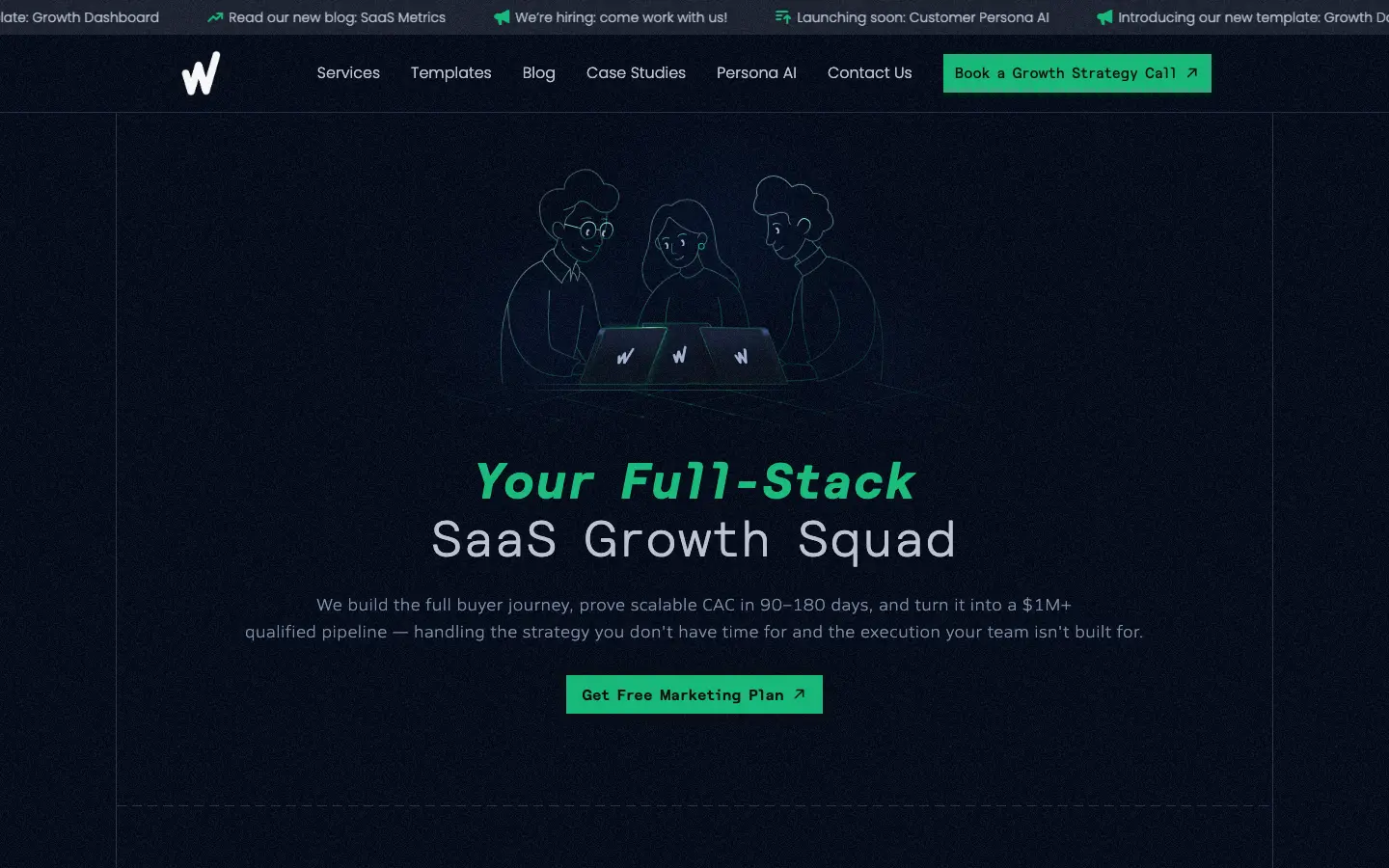
AI search visibility at WeGrowth runs through the same content and positioning work that drives organic search and paid acquisition, rather than as a separate retainer with its own dashboard. The reasoning is straightforward: the things that earn citations in generative answers, meaning clear entity definition, original data, quotable specifics, and third-party mentions, are largely the same things that earn coverage and rankings, and splitting them across two vendors tends to produce two strategies that quietly contradict each other.
That makes WeGrowth a fit for companies wanting AI visibility folded into an existing growth program. It makes us the wrong choice for a company that wants a dedicated AI-search specialist with proprietary tracking infrastructure, and DerivateX or Rampiq are better answers there.
What to expect
- Entity, content, and mention strategy handled alongside SEO, paid, and lifecycle rather than in isolation.
- Positioning and ICP work as the starting point, since citation-worthiness follows from having something specific to say.
- Reporting connected to pipeline rather than to a proprietary visibility score.
Best fit for
- SaaS companies who want AI search treated as one output of a connected growth program.
- Teams whose content and SEO already run through one partner and who want AI visibility handled in the same place.
Keep in mind: We publish this guide, so read our inclusion as disclosed rather than independently judged.
Reputation and recognition
- Full-stack B2B SaaS growth partner where AI search sits inside the broader organic and content practice.
- No independently verified AI-search-specific review base at time of writing.
Pricing
Flexible monthly subscription, no long-term contract. Startups can begin with a 14-day trial plus $1,000 in ad credit. Scope-based; get in touch for a quote.
DerivateX
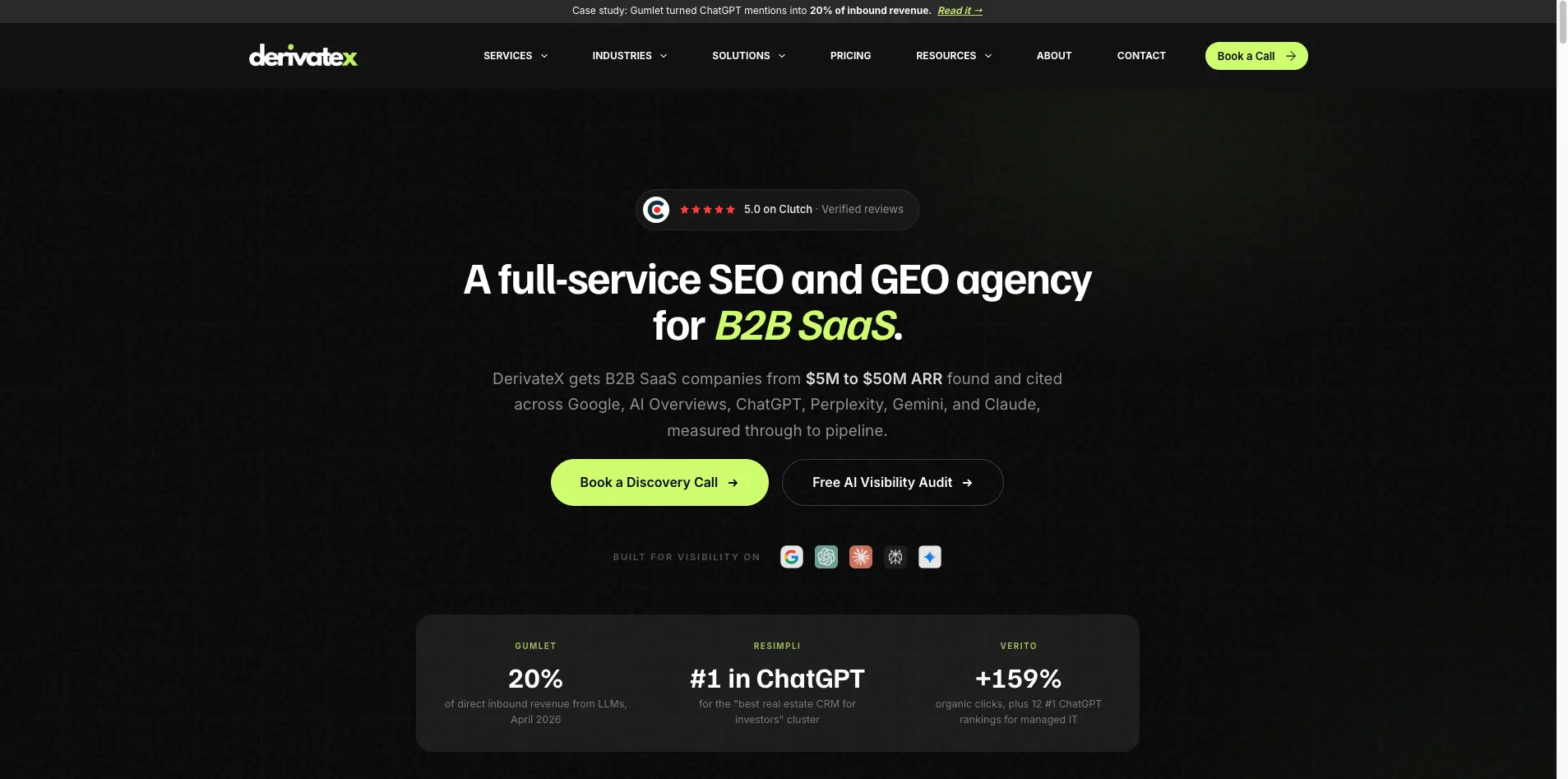
Out of all the agencies on this list, DerivateX is the only one that focuses almost exclusively on AI search visibility as its main service. The firm runs B2B SaaS SEO and AI search visibility as a single system it calls Citation Engineering. They track an AI Visibility Score weekly across ChatGPT, Claude, Gemini, and Perplexity. Founded in 2024 by Apoorv Sharma and Shivanshi Bhatia and based in Bengaluru, it publishes an unusually concrete commercial structure: roughly $5,500 per month, opening with a 90-day sprint and continuing month to month afterward.
Published outcomes include Gumlet tracing 20% of inbound revenue to AI search visibility, Verito moving from position 40 in Google to the top recommendation in ChatGPT, and Kroto growing from 3,500 to 326,000 impressions. All three are vendor-reported and unaudited, and none states a starting number, which is the standard problem with figures in this category.
What to expect
- Entity and citation engineering, LLM citation strategy, and AI Overview optimization as the core product rather than an add-on.
- Weekly visibility tracking across four model families.
- A 90-day sprint followed by month-to-month terms, which is a genuinely low-commitment structure for this market.
Best fit for
- Growth-stage SaaS companies wanting AI search as a dedicated workstream on a mid-market budget.
- Teams that value contract flexibility over agency tenure.
Keep in mind: Founded in 2024, which is young even by this category's standards, and the Clutch record is 5.0 across only 7 reviews. A perfect score on a small sample tells you less than the number suggests, and the agency's own marketing cites the rating without the count.
Reputation and recognition
- 5.0 on Clutch across 7 reviews (clutch.co/profile/derivate-x, as of August 2026). Minimum project $5,000, team of 10 to 49, founded 2024. No G2 agency profile.
- Named clients include Gumlet, Verito, Kroto, Resimpli, and PlanningPoker.live.
Pricing
Publicly states roughly $5,500 per month with a 90-day sprint, then month-to-month. Other sources cite a $3,500 to $8,000 range.
Rampiq
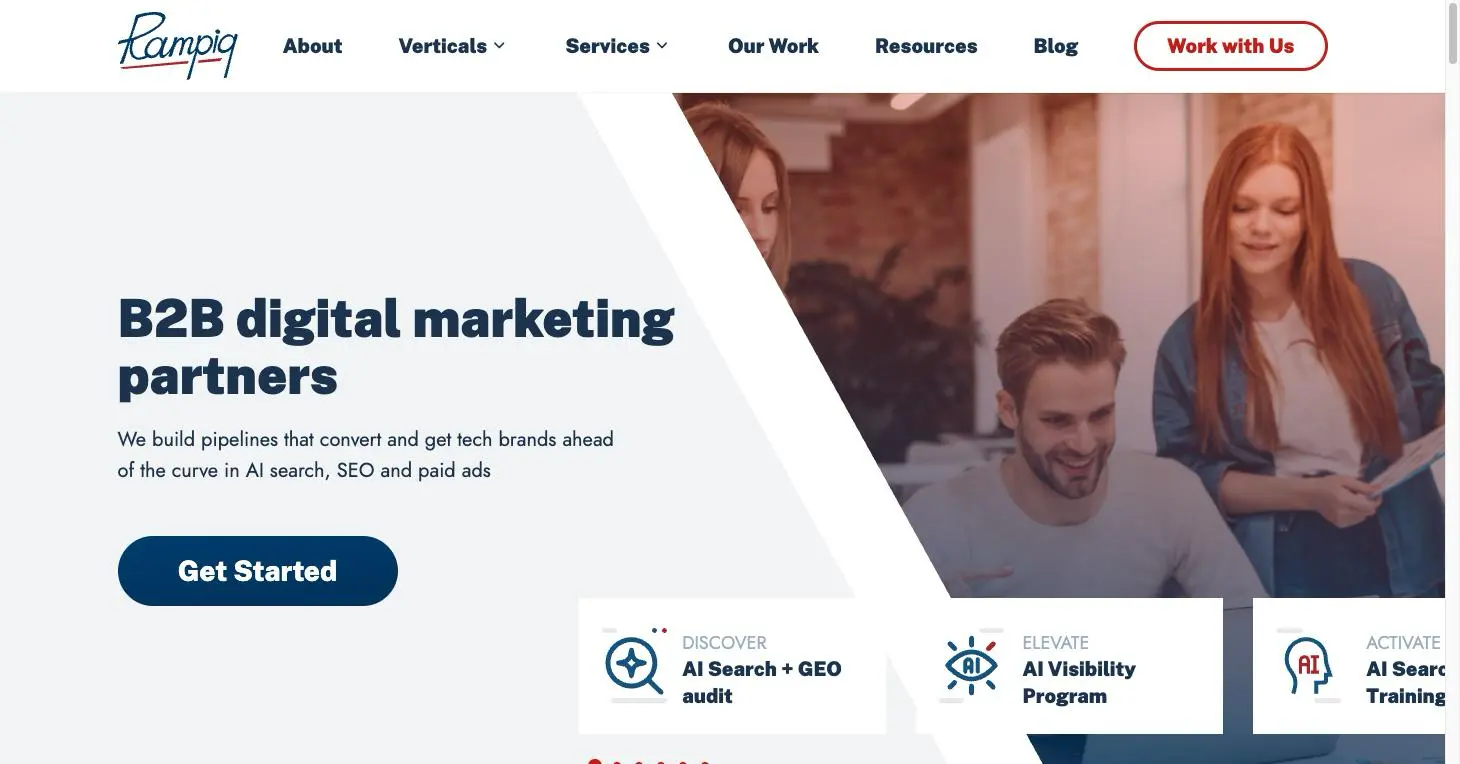
Rampiq's differentiator is measurement discipline. Its Vertology.ai audit checks both what a model appears to know from training and what it retrieves live when browsing is enabled. Its GEO Compliance Framework then ties visibility work back to CRM records.
The Clutch record is the deepest on this roster at 4.9 across 17 reviews. Founded in 2018 in Vienna, Virginia, and women-owned.
What to expect
- AI visibility audits distinguishing model memory from live retrieval.
- Brand-mention monitoring inside LLM outputs, with pipeline attribution.
- SEO, LinkedIn Ads, and CRO alongside the AI search work.
Best fit for
- B2B tech companies that need AI visibility connected to CRM data rather than reported as a standalone score.
- Buyers who weight verified review depth heavily.
Keep in mind: Paid media and LinkedIn remain significant parts of the business, so AI search is near-primary rather than the whole product. The hourly band of $50 to $99 also implies a different delivery model than firms charging $100 to $149.
Reputation and recognition
- 4.9 on Clutch across 17 reviews (clutch.co/profile/rampiq-agency, as of August 2026). Minimum project $5,000, hourly $50 to $99, founded 2018. No G2 agency profile.
- Named clients include Case IQ, with a testimonial from VP of Marketing Chris Bondhus, plus Petrosoft and Simple App.
Pricing
Not publicly listed. One Clutch data point cites a $12,000 engagement. Most common project size falls under $10,000.
Omnius
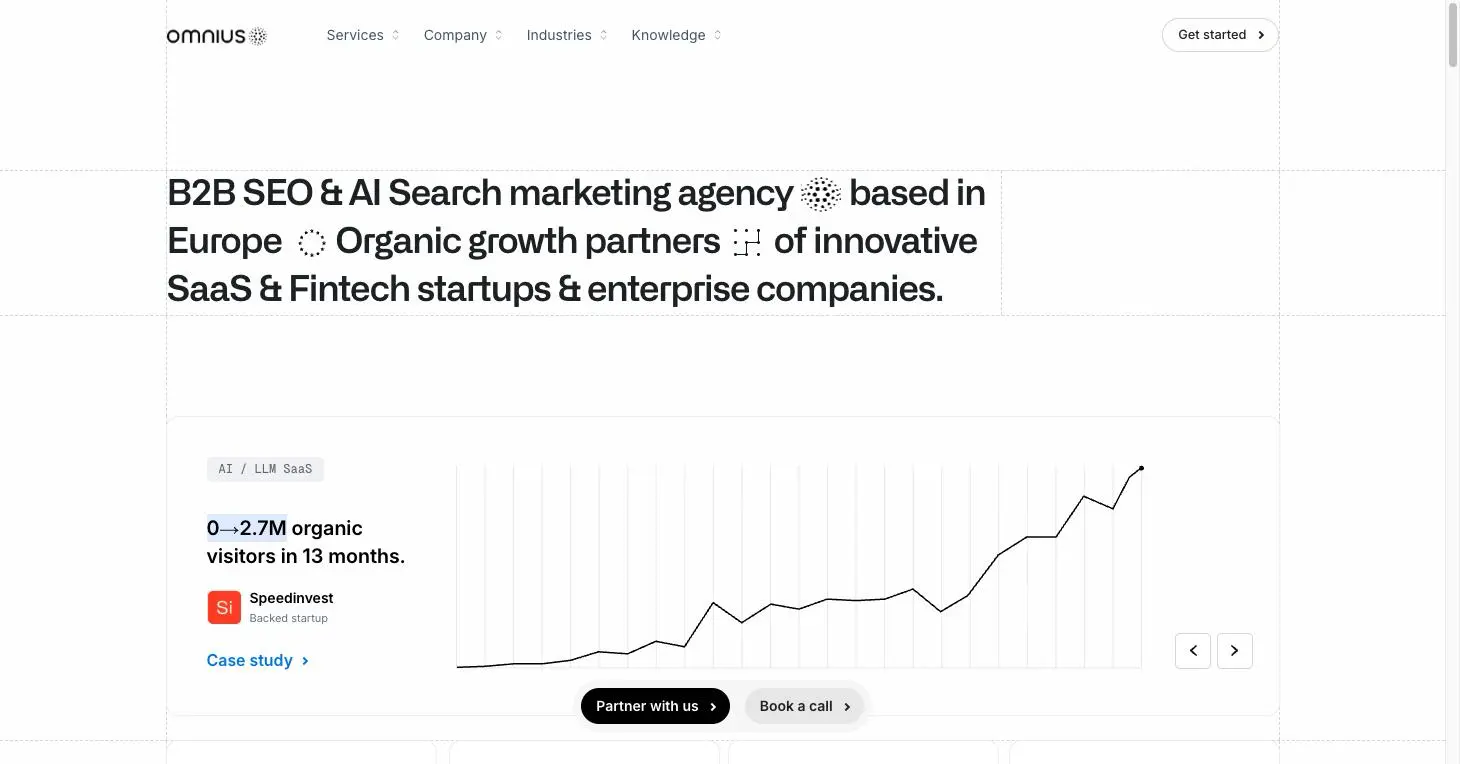
Working exclusively with SaaS, fintech, and AI companies, Omnius runs separate service lines for AEO, GEO, and LLM SEO, maintains llms.txt files, does entity-relationship mapping, and builds authority on Reddit, Quora, and G2. Their client roster is capped at roughly eight a year.. Named clients include commercetools and Payoneer, both publicly listed companies.
Now the part that requires care. The Clutch profile is live and shows no reviews. There is a G2 page rated 4.9 across 10 reviews, but it belongs to AtomicAGI, the tracking software Omnius builds, rather than to the agency service. Trustpilot shows roughly four stars across about seven reviews, one of which is disputed.
What to expect
- FAQ, HowTo, and entity schema work, llms.txt maintenance, and entity-relationship mapping.
- Bing and Copilot optimization alongside the major model families.
- Authority building on Reddit, Quora, and G2, which the August 2026 event makes worth discussing explicitly.
Best fit for
- SaaS and fintech companies wanting deep technical entity work from a small, focused team.
- Buyers comfortable evaluating on client roster and published methodology rather than review count.
Keep in mind: No verified agency reviews on Clutch as of August 2026, and the 4.9 G2 rating that circulates belongs to the software product. Given the capped roster and low hourly band of $25 to $49, ask directly who executes and how many accounts they hold simultaneously.
Reputation and recognition
- Founded 2020, London and Belgrade.
- Named clients include commercetools and Payoneer (agency-published).
Pricing
Minimum project $5,000, hourly $25 to $49,
Omniscient Digital
Founded in 2019 by three operators out of HubSpot, People.ai, and Shopify, Omniscient built its practice on organic growth for B2B software and folded GEO in as a named core service rather than a bolt-on. SAP, Adobe, Loom, Asana, Hotjar, and Jasper appear on the roster, which is the strongest blue-chip list on this page by a comfortable margin.
Published results are specific: Convert reporting 81% LLM visibility growth and a 140% increase in AI citations inside 60 days, Smartling at $3.7M in qualified pipeline, AppSumo at 843% organic traffic growth.. The review record is roughly 4.8 across five or six Clutch reviews after six years of operating.
What to expect
- GEO and AEO as named service lines inside a full organic program covering SEO, content, digital PR, and links.
- Pipeline attribution built into reporting rather than a standalone visibility score.
- Founders who came from client-side operating roles rather than agency careers.
Best fit for
- Established B2B SaaS companies at a $10,000 monthly floor who want AI search inside one organic program.
- Teams who weight client roster and published thinking above review count.
Keep in mind: The published case-study numbers also lack baselines, so ask what Convert's citation count was before the 140% increase.
Reputation and recognition
- Roughly 4.8 on Clutch across 5 to 6 reviews (clutch.co/profile/omniscient-digital, as of August 2026).
- Named clients include SAP, Adobe, Loom, Jasper, Asana, Hotjar, AppSumo, Smartling, and Order.co.
Pricing
Publicly stated floor of $10,000 per month, scaling with scope.
iPullRank
Mike King coined the term Relevance Engineering, publishes the AI Search Manual, and has spent years arguing that AI search should be understood through information retrieval concepts like query fan-out, embeddings, and passage-level retrieval rather than through repackaged SEO tactics. On depth of technical thinking, iPullRank has no equal on this list.
The client roster includes Target, American Express, CVS, MLB, and the Wall Street Journal. This shows the firm operates at genuine enterprise scale, and it is not a B2B SaaS native. The minimum project size is $50,000, the highest floor found anywhere in this category. iPullRank's standing rests on published research and conference reputation.
What to expect
- Information-retrieval-grounded technical work on large, complex sites.
- Published original research, including the AI Search Manual, as a public record of method.
- Enterprise engagement scale and enterprise procurement.
Best fit for
- Large organizations with complex site architecture and budgets starting at $50,000.
- Teams who want the most technically rigorous available thinking and can afford it.
Keep in mind: Not a B2B SaaS specialist, and the $50,000 floor puts it out of range for most companies reading this. Zero Clutch reviews, which matters less here than elsewhere given the client type.
Reputation and recognition
- Clutch profile live and showing zero reviews (clutch.co/profile/ipullrank, as of August 2026). Minimum project $50,000, founded 2014, New York.
- Named clients include Target, American Express, CVS, MLB, and the Wall Street Journal.
Pricing
Minimum project $50,000 per Clutch.
Embarque
Embarque is the accessible option. Built for early and growth-stage startups, it runs per-model service lines and publishes AI SEO pricing openly, with a $1,000 minimum project size that is the lowest floor on this page by a factor of five. Around $2,500 per month is the commonly cited retainer.
The Clutch record shows 5.0 across 13 reviews. Though most of the reviews cluster in 2022 and 2023, reflecting smaller engagements from an earlier phase of the business. None of these concern AI search work because the category barely existed then. Recency matters more here than in almost any other category, so treat those reviews as evidence of client satisfaction generally rather than of AEO capability specifically.
What to expect
- SaaS SEO and AEO on a budget suited to seed and early growth stage.
- Per-model service lines and published pricing.
- Content and SEO as the core practice with AI search added.
Best fit for
- Early-stage SaaS companies who want to start on AI search without a five-figure commitment.
- Teams testing the channel before committing to a specialist.
Keep in mind: The reviews are aging and predate the AI search era. Ask for a reference from an AEO engagement completed in the last six months specifically, rather than accepting the 5.0 rating at face value.
Reputation and recognition
- 5.0 on Clutch across 13 reviews (clutch.co/profile/embarque, as of August 2026), most dating from 2022 to 2023. Minimum project $1,000, founded 2020.
- No G2 agency profile.
Pricing
Around $2,500 per month cited, with a $1,000 minimum project size.
First Page Sage
Operating since 2009 out of Berkeley, First Page Sage positions itself as a category pioneer in generative engine optimization and sells what it describes as a citation ecosystem spanning six surfaces. It publishes tiers openly: $3,500 per month for four articles, $5,500 for eight. It also markets itself as the number one SEO agency in the United States.
The agency’s actual starting price is uncertain. Several blogs cite a $5,000 minimum project floor, but the agency's live Clutch profile lists a $10,000 minimum. As with iPullRank, absence of reviews is not evidence of poor work, and a 2009 founding date represents real longevity. It is, however, a gap between marketing claim and checkable proof that no competing listicle mentions.
What to expect
- Content-led GEO built on article volume, with published monthly tiers.
- A citation ecosystem approach spanning multiple answer surfaces.
- Enterprise B2B positioning with a long operating history.
Best fit for
- Companies wanting predictable content volume against a published price.
- Buyers who weight firm longevity above third-party review verification.
Keep in mind: Independent reviewers note the AI-search specialization is still maturing relative to native GEO firms.
Pricing
Self-published: Standard $3,500 per month for four articles, Growth $5,500 for eight. Clutch lists a $10,000 minimum.
Telling a Specialist From a Bolt-On
Nearly every SEO agency added an AEO page in the past two years. These checks take about ten minutes and cost nothing.
Run the service page through the Wayback Machine. Find the first capture date for the /aeo, /geo, or /llm-seo URL. A page first archived within the last two quarters describes a bolt-on until proven otherwise.
Check whether it is a service line or a blog post. Bolt-ons publish articles about AI search. Specialists restructure their navigation around it.
Diff the AEO page against the SEO page. Find-and-replace is visible to the naked eye once you look for it.
Check the blog archive for anything about AI search dated before 2025. Firms that were thinking about this before it was commercially obvious tend to have written about it.
Look for original research. Minuttia publishes a State of AEO report; iPullRank publishes the AI Search Manual. A firm whose only published AI-search content is a listicle naming itself is telling you what it has.
What AEO and GEO Cost in Practice
Published floors on this page span from $1,000 to $50,000, a fiftyfold spread describing entirely different products for entirely different companies. The broader market, consolidated across several published pricing guides, runs roughly like this:
- $10 to $250 per month: Self-serve visibility tracking tools, with no service attached.
- $100 to $150 per hour: Independent consultants, typically for audits and strategy rather than execution.
- $2,000 to $10,000 per month: Mid-market retainers, where most of this roster sits.
- $10,000 to $25,000+ per month: Enterprise programs with dedicated teams.
Omnius, Rampiq, and Omniscient all show broadly comparable minimum project sizes, but their hourly bands run $25 to $49, $50 to $99, and $100 to $149 respectively. The same monthly spend therefore buys somewhere between one and three times the delivered hours or seniority depending on which you pick.
Then there are the costs that never appear in a proposal: the tracking tool subscription, the content production the strategy depends on, digital PR placements, and your own team's time.
One option this category never mentions, because every article about it is written by an agency: you may not need to hire anyone. If you have a competent content lead and an existing SEO practice, a $100 to $250 monthly tracking tool plus a quarter of internal focus will tell you where you stand and capture much of the available upside.
How to Choose the Right Type for Your Stage
Testing the channel, under $2,500 per month. Embarque, or a tracking tool and internal effort. Neither will transform your visibility, and both will tell you whether the channel warrants real investment.
Seed to Series A, $5,000 to $8,000. DerivateX for a dedicated specialist with flexible terms, or Rampiq if you want the work tied to CRM data from the start. Both sit at a $5,000 minimum with meaningfully different delivery models.
Growth stage, $10,000 and up. Omniscient Digital if AI search should live inside a full organic program. Omnius if entity and schema depth is the specific gap and you accept a thin review record. WeGrowth if content, SEO, and AI visibility have been running as separate contracts and the strategies have drifted.
Enterprise, $50,000 and up. iPullRank, on the strength of technical depth and site complexity rather than SaaS specialism.
How to Interrogate an AI Visibility Claim
There is no shared definition of AI visibility, citation rate, or share of voice in this industry. Every proprietary score is non-comparable to every other. So when any agency, including us, shows you a number, these questions establish whether it means anything:
- What is the prompt set, who wrote it, and how many prompts does it contain?
- Is the set fixed between reports, or does it change? A moving prompt set means moving goalposts.
- Which models and versions, logged in or out, in which geography, with retrieval enabled or not?
- How many samples per prompt? These systems are non-deterministic, and the same prompt returns different answers across runs. Single-sample measurement is noise formatted as data.
- Was a pre-engagement baseline measured, and by whom?
- Can I reproduce this number independently?
Percentages in this category float free almost universally. "300% growth in qualified leads," "340% citation increase," "20% of inbound revenue," and none of them state the starting number. Growing from two citations to eight is a 300% increase. Always ask for the denominator.
Also keep in mind, screenshots of an AI assistant recommending an agency are not evidence, and several firms in this market publish them as though they were. The outputs are non-deterministic, personalizable, promptable, undated, and unreproducible. Run the same prompt twenty times and you will see why.
Common Mistakes B2B SaaS Teams Make When Hiring AEO Agencies
-
Concentrating Citations in One Source
Why it happens: A single channel starts working, reporting looks good, and nobody asks what share of the total it represents. Fix: Track source concentration as a risk metric from the start. Ask your agency for a diversification target and hold them to reporting against it.
-
Accepting Percentages Without Baselines
Why it happens: A 340% increase reads as impressive and the starting number is rarely volunteered. Fix: Ask for the absolute figures before and after, every time. Most impressive percentages in this category describe small absolute movements.
-
Buying Proprietary Tooling Without Checking Portability
Why it happens: A branded tracker sounds like an advantage during a sales call and nobody reads it as lock-in. Fix: Ask whether it is a genuine data pipeline or a wrapper around an existing tool, whether you can export raw data, whether the prompt set is yours, and what dashboard access looks like after termination.
-
Ignoring What the Model Says When It Gets You Wrong
Why it happens: Programs focus on citation frequency and rarely examine citation accuracy. Fix: Audit what assistants currently say about your product, pricing, and competitors. Outdated pricing showing up in answers, or a competitor's comparison page being cited against you, are more urgent than a visibility score.
Before You Sign: Checklist and Questions
Confirm the firm treats AI search as a service line rather than a blog topic, can describe its measurement method without reaching for a dashboard, and will show you a scope of work you can compare against its SEO scope.
Then ask:
- "What percentage of a representative client's citations come from a single domain?" If they have never calculated it, they are not managing concentration risk.
- "Show me the prompt set you would track for me." Ten prompts at least.
- "Who does the work, and how many accounts do they hold?" Hourly bands on this roster range from $25 to $149, which describes very different staffing realities.
- "What do I own when I leave?" Prompt sets, raw data exports, entity documentation, dashboard access.
- "Show me an engagement that underperformed." Nobody in this category has published one. Asking privately still works.
On references, ask the client rather than the agency: what was your baseline number, who calculated the result, and did the agency or your team build the prompt set?
What a Good First 90 Days Looks Like
Month 1: Baseline and Instrumentation. A documented prompt set, a measured starting position across named models with stated sampling, an entity and schema audit, and an inventory of what assistants currently say about you. Any agency reporting improvement in month one has not established a baseline worth improving on.
Month 2: Foundations Ship. Entity and structured-data corrections go live, content gaps against real buying questions get filled, and mention-building begins. Movement in tracked answers may appear, and may also be noise, which a firm with proper sampling will tell you rather than claim.
Month 3: Signal Separates From Noise. Enough sampling exists to distinguish a trend from variance. Source concentration should be visible in reporting. You should be able to see which specific prompts moved and why.
Timelines here are folklore rather than data. The "three to six months" figure repeated across this category has no published distribution, median, or sample size behind it, and nobody has defined which event marks results. Treat any confident timeline as a sales projection.
Conclusion
This market has more confident marketing than verifiable proof. Three of the most prominently positioned firms in this comparison carry no verified client reviews. Almost no published figure in the category states a baseline. And an event in August 2026 demonstrated that a large share of what agencies were selling as authority could be revoked by a single platform decision.
If you want a read on how your product currently appears in AI-generated answers and where the gaps are, our team can run a focused audit. Book a strategy call and let's see how we can work together.