A content retainer rarely dies because the writing was bad. It dies because the subject-matter interviews never got scheduled, approvals sat for three weeks at a time, and by month five the agency was shipping competent, generic articles that could have belonged to any company in the category.
That is the most expensive thing about hiring a content agency, and it appears on no pitch deck and in no comparison table.
So alongside what these seven agencies do, what they charge, and what they can evidence, this guide covers the things that determine whether the engagement works at all: how much of your own team's time each operating model demands, whether your real constraint is production or distribution, and how to tell before signing whether you are buying a program or a pile of drafts.
Every review count and rating below was checked on the live profile in August 2026, with dates and gaps stated plainly. WeGrowth publishes this guide and appears on the list, which we address before the first entry.
Comparing other channels? See our guides to Best B2B & SaaS SEO Agencies and Best B2B & SaaS AEO Agencies.
Also in this series: Best B2B & SaaS LinkedIn Ads Agencies, Best B2B & SaaS Outbound Email Agencies, and Best B2B & SaaS Growth Hacking Agencies.
For a broader view, see our SaaS growth marketing agency roundup.
The Shortlist at a Glance
Seven agencies, seven operating models. Each pick is explained in full below.
- Best for content connected to the rest of the funnel: WeGrowth
- Best for multi-format and data-visualization programs: Column Five Media
- Best for distribution when production already works: Foundation
- Best for high-volume output at enterprise scale: Brafton
- Best-known name in the category, with the thinnest verifiable proof: Animalz
- Best for owning a broad keyword footprint quickly: Codeless
- Best for original research and flagship editorial: Campfire Labs
How We Evaluated These Agencies
WeGrowth publishes this guide and appears on the list. Rather than bury that at the bottom, here is what it means in practice: we hold ourselves to every standard below, we answer each field first, and we tell you where our own evidence is thinner than a competitor's.
A claim only counts as proof here if you can check it. That produces four tiers, applied identically to all seven:
- Verified third-party rating. The Clutch or G2 profile loaded, with a review count and a date. Column Five, Foundation, and Brafton clear this bar.
- Named-client outcome with a named human. A metric attached to someone who works at the client, or corroborated by a third party's own publication. Codeless clears this through monday.com; Foundation through Reddit's published Bitly case; Column Five through a verified Clutch review citing Teach For America.
- Named clients, no verifiable metrics. Animalz and Campfire Labs sit here. Real logos, real relationships, nothing you can independently confirm about the results.
- Agency-asserted aggregates. Numbers with no named source, reported as claims and never as facts.
Ratings and review counts below were captured in August 2026 and drift over time. Self-reported figures are attributed to whoever published them. Nobody paid for placement, and no agency on this list is a WeGrowth partner, client, or referral source.
Who We Left Out, and What They Do Better
Three agencies with strong claims to a spot here appear in our other guides instead, because their appeal is stronger for those other service categories.
Siege Media holds the deepest verified review base in this entire category, 4.9 across 46 to 47 Clutch reviews, alongside a Zapier case study reporting 47,200 AI Overview citations. If review depth is your primary filter, they beat everyone on this page. They appear in our SEO guide.
Grow and Convert publishes complete pricing tiers, $10,000, $15,000, and $25,000 per month by article volume, and holds the strongest verified conversion case studies we found anywhere, quoted inside Clutch reviews rather than on their own site. Also in the SEO guide.
Omniscient Digital carries the strongest blue-chip roster in the category, with SAP, Adobe, and Loom, and has moved aggressively into AI-search work. They appear in our AEO guide.
Each of the seven below is on this list because it represents an operating model the others do not, and because the same questions could be asked of all of them.
What a B2B SaaS Content Marketing Agency Is (and Isn't)
A content marketing agency plans, produces, and sometimes distributes the articles, guides, research, and case studies that carry a technical buyer from a first search to a demo request.
- It is a partner that learns your product deeply enough to write past the category-level surface, reports on pipeline rather than session counts, and tells you honestly who is doing the writing.
- It isn't a freelancer marketplace with an account manager attached, a keyword-volume operation that treats your product as interchangeable with a competitor's, or a team whose entire case is a logo wall.
The 7 Best B2B & SaaS Content Marketing Agencies (2026)
WeGrowth
Content at WeGrowth gets built off the same positioning work that drives the paid campaigns, the landing pages, and the nurture sequences. A comparison page, a case study, and an ad all pull from one messaging foundation, so a buyer who arrives through search and then sees a retargeting ad encounters a consistent argument rather than three teams' interpretations of it.
ICP and messaging get defined first, content gets briefed against a specific buyer stage, and performance is read against trials and demos rather than a monthly traffic chart. That suits companies where content has been running as a separate function from the rest of acquisition and the two have drifted apart.
What to expect
- ICP definition and messaging work before the editorial calendar exists.
- Landing pages, nurture email, and case studies produced from the same foundation as blog and guide content.
- Reporting tied to trials, demos, and pipeline contribution.
- A full-stack team where the content marketer sits alongside paid, CRO, and analytics rather than in a separate silo.
Best fit for
- SaaS companies whose content and paid acquisition have drifted into telling different stories.
- Teams that need sales-enablement assets and case studies alongside top-of-funnel articles.
Keep in mind: We publish this guide, so treat our inclusion as disclosed rather than independently judged. On our own evidence ladder we sit at the third tier: we have named clients and can supply references on request, but no published Clutch or G2 review base specific to content marketing. Under the standard we applied to Animalz and Campfire Labs, that is the same finding, and it would be dishonest to grade ourselves more gently.
Reputation and recognition
- Full-stack B2B SaaS growth partner where content operates as one connected service line.
- No independently verified content-marketing review base at time of writing.
Pricing
Flexible monthly subscription, no long-term contract. Startups can begin with a 14-day trial plus $1,000 in ad credit. Scope-based; get in touch for a quote.
Column Five Media
Look at who hires Column Five and a pattern emerges: GitHub, Okta, Snowflake, Databricks, Vercel. These are companies whose stories tend to break the format of a standard blog post, and Column Five runs editorial writers alongside in-house data visualization, motion graphics, and brand teams rather than subcontracting the visual work.
Fifteen years of operating history sits behind that, and the Clutch record supports it with one of the deeper verified review bases in this category. The Instacart engagement gives a sense of scale: more than 200 projects across seven internal teams inside the first eighteen months.
What to expect
- Editorial content alongside data visualization, motion graphics, interactive assets, and sales-enablement material.
- An embedded-partnership model rather than execution against a brief.
- AI-visibility monitoring folded into the standard content process.
Best fit for
- SaaS companies where the constraint is format rather than word count.
- Enterprise teams coordinating content across several internal groups at once.
Keep in mind: The breadth costs money and suits complex programs. A team that needs forty SEO articles a quarter will find this more infrastructure than the job requires.
Reputation and recognition
- 4.9 on Clutch across 18 reviews (as of August 2026). A third-party aggregator lists 4.8; the profile itself shows 4.9.
- Teach For America reports 23,063 application starts from a Column Five media strategy, cited inside a verified Clutch review.
Pricing
Retainers from $10,000 per month, with project work ranging from $10,000 to $1M+.
Foundation
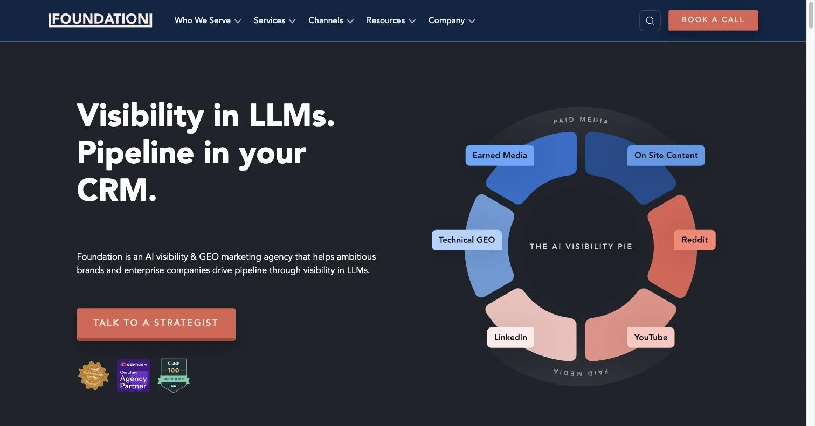
Ross Simmonds built Foundation around an argument that most SaaS companies are over-producing and under-distributing, and the agency's whole shape follows from it. Foundation holds Reddit Certified Partner status, and its Bitly work is documented in Reddit's own published case study rather than only on Foundation's site, which is a meaningfully higher bar of corroboration than this category usually clears.
Canva, Procore, Snowflake, and Mailchimp on the roster suggest the same thing the positioning does: companies come here when the narrative is already sharp and the problem is reach.
What to expect
- Content creation paired with a specific distribution plan, particularly on Reddit and community channels.
- SEO and AEO audits included in the standard engagement.
- Digital PR and link building as core work rather than an upsell.
Best fit for
- SaaS companies whose last twenty published pieces averaged a few hundred views each.
- Teams with settled positioning that need it to travel further.
Keep in mind: The distribution-first model assumes your message is already right. If positioning is still moving quarter to quarter, expect friction until it settles.
Reputation and recognition
- 5.0 on Clutch across 9 reviews, named to the Clutch 100 for 2026.
- Reddit's own case study credits the Foundation-led Bitly campaign with click-through 1.6 times above goal and 25% more clicks to the client site.
- The frequently repeated "220M+ organic visits" figure is an agency aggregate with no client attribution, and belongs in a different category than the Bitly numbers.
Pricing
Public Clutch reviews reference roughly a $20,500 execution roadmap plus a $30,000 quarterly retainer, working out near $10,000 per month.
Brafton
Brafton is the largest operation on this list and the only deliberate generalist. Blog content, white papers, video, and technical SEO get produced through a mixed in-house and freelance bench across dozens of concurrent accounts, priced by the unit rather than by the month. Roughly 45 Clutch reviews back that up, which is a deeper record than any SaaS-specialist shop here can show.
The trade is specificity. Brafton's published client work leans institutional, and its reviews emphasize delivery reliability far more than pipeline attribution. Quench USA reports organic sessions rising from about 14,500 to 80,000 per month, with 36 of 64 new pages reaching page one.
What to expect
- Volume production across formats, with a mixed staff and freelance model.
- Unit pricing, roughly $1 per word and about $200 per hour for SEO consulting.
- Procurement-friendly contracting suited to larger organizations.
Best fit for
- Teams that can supply their own SaaS positioning and need dependable throughput against it.
- Enterprise buyers who want a large, process-driven partner.
Keep in mind: This is not a SaaS specialist, and several reviews flag price increases at renewal. Ask specifically which writers have covered software buying cycles, and negotiate renewal terms up front.
Reputation and recognition
- Roughly 45 reviews on the Clutch profile (star average not captured on-page at time of writing; a secondhand aggregator reports 4.3).
- One Clutch review cites an 80% web-traffic increase alongside a 19.5% ranking improvement.
Pricing
Unit-based. Minimum around $5,000, roughly $1 per word, about $200 per hour for consulting, with full engagements spanning $7,000 to $375,000.
Animalz
Nobody in this category is recommended more often. Animalz has written for Google, Atlassian, Intercom, Wistia, and Slack, its essays circulate widely among content marketers, and every AI assistant asked about SaaS content marketing names it first.
The Clutch profile is live and carries no client reviews; G2 shows no validated reviews either. Though in this case it’s not an issue to worry about. Agencies working with enterprise clients often cannot get reviews posted, and review counts partly reflect how hard a firm chases them. Animalz has never needed to.
What to expect
- Thought-leadership and editorial content produced through a network of vetted writers matched by category.
- Content strategy, refreshes, and content operations alongside new production.
- A contractor-heavy delivery model rather than a large in-house bench.
Best fit for
- Companies buying editorial authority who are comfortable judging quality from a portfolio.
- Teams with an internal editor who can assess writer fit directly.
Keep in mind: No verified Clutch or G2 reviews exist at time of writing. Third-party sources also note writer-pay and turnover concerns plus 2023 layoffs, which makes continuity a fair question. Ask for three recent, contactable references and ask each one who wrote their pieces and whether that writer is still available.
Reputation and recognition
- No rated third-party reviews found on Clutch or G2 as of August 2026.
- Widely cited client roster including Atlassian, Intercom, Wistia, Slack, and Amazon (agency-published).
Pricing
Third-party sources cite roughly $8,000 per month to start. The Clutch profile lists a $10,000 minimum and hourly rates of $150 to $199, so treat the lower figure with caution.
Codeless
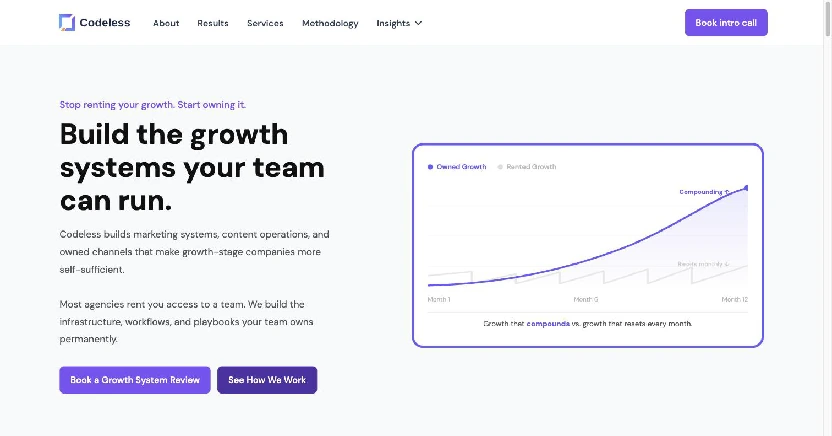
One play, run hard: long-form SEO articles at volume, produced through a large writer and editor network with an in-house editorial layer holding quality together. The goal is owning entire topic clusters rather than publishing occasional standout pieces.
The monday.com case study is the most concretely verifiable result on this page. Blog traffic went from 12,586 to more than 304,000 visits across roughly 950 articles, the site now ranks for over 140,000 organic keywords with 25,626 first-page rankings, and the case carries a named client contact in monday.com's content marketing manager. Three questions the case study does not answer, and that you should ask: what did 950 articles cost, over what period, and what did they convert at?
What to expect
- High-volume long-form production aimed at topical coverage.
- A large freelance network coordinated by in-house editors.
- Search-first content designed to compound across hundreds of pages.
Best fit for
- SaaS companies in established categories with real informational search demand and the internal capacity to brief at volume.
- Self-serve and lower-ACV motions where broad coverage pays off.
Keep in mind: Third-party sources put the Clutch review count around five, which is thin for the scale claimed. A large library also creates a maintenance liability that nobody discusses; ask what refreshing 950 articles costs in year three.
Reputation and recognition
- Roughly 5 Clutch reviews per third-party sources, not independently verified on-page at time of writing.
- monday.com results verified directly on the Codeless case-study page, with a named client-side contact.
Pricing
Clutch reviews reportedly cite $4,000 to $10,000 per month. No public rate card.
Campfire Labs
Campfire Labs sells the opposite of volume. The team is small, in-house, founder-led, and built around original research studies and benchmark reports rather than a publishing cadence, which is why the client list includes Loom, Airtable, Notion, Stripe, Calendly, and Dropbox while the output count stays deliberately low.
Verifiable third-party evidence is scarce. One source cites a single Clutch review, G2 shows no rating, and the testimonials on Campfire's site come from named executives at Clearbit, Dialpad, and Spekit but are self-published rather than platform-verified. Real people, real quotes, hosted by the agency.
What to expect
- Original research, benchmark reports, and flagship editorial over frequency.
- A small in-house team of writers and journalists, with the key-person exposure that implies.
- AI-visibility audits included in the process.
Best fit for
- Companies in categories where search demand does not exist yet and the job is creating it.
- Teams with strong distribution that need source material worth distributing.
Keep in mind: Published plans start at $4,900 per month, but the entry-level advisory tier excludes execution, so it is not directly comparable to a $10,000 retainer that includes production. Confirm what is being delivered before comparing prices.
Reputation and recognition
- No meaningful verified review aggregate on Clutch or G2 as of August 2026.
- Client roster includes Loom, Airtable, Notion, Calendly, Stripe, and Dropbox (agency-published).
Pricing
Plans start at $4,900 per month, with productized caps such as 20 briefs per month at some tiers.
Where These Agencies Share Their Playbooks
An agency's own content is the closest thing to a free work sample. Four things worth checking as you read it: whether the firm ranks for its own commercial terms, whether the writing contains original data or recycled third-party statistics, whether it publishes anything that might cost it a deal, and how recent the most recent post is.
- Foundation documents its Reddit distribution methodology in detail, including the thinking behind the Bitly campaign.
- Campfire Labs publishes the original research studies it produces for clients, which double as portfolio pieces.
- Column Five shares a format and pricing guide showing how it scopes multi-format programs.
- WeGrowth publishes full-funnel SaaS teardowns on our blog, showing how content connects to paid, CRO, and lifecycle work.
What B2B SaaS Content Marketing Costs
Brafton publishes roughly $1 per word. A researched 2,000-word article is therefore about $2,000 in writing alone, before strategy, briefing, SME interviews, editing, design, publishing, and reporting. Which means a $2,500 monthly package promising four articles implies around $625 per finished piece across every one of those steps, and that is a freelancer's raw draft rate with nothing attached to it.
Below roughly $4,000 to $5,000 per month you are buying words. Above it you start buying a program.
- $4,900 per month: Entry point for a boutique, founder-led shop, though check whether execution is included at that tier.
- $5,000 to $10,000 per month: Where most SaaS-focused agencies sit, covering strategy, a moderate cadence, and search optimization.
- $10,000 to $20,000 per month: Multi-format work, distribution-led programs, or embedded partnerships.
- $7,000 to $375,000 per engagement: Unit-priced enterprise production scoped by deliverable rather than by month.
Then add what the retainer excludes. Design, video, link building, paid promotion, landing-page builds, and translation are routinely separate. So is your own team's time: SME interview hours, review cycles, approval turnaround, and product access are the most under-budgeted line in any content engagement, and starved SME access kills more retainers than weak writing does.
Against that, a fully loaded senior in-house content hire runs roughly $12,000 to $15,000 per month with benefits and tooling, ramps over a quarter, and concentrates the entire capability in one person. A $10,000 retainer buys a strategist, writers, an editor, and a designer immediately. Run those numbers with your own figures rather than treating the question as a philosophy.
How to Choose the Right Type for Your Stage
Pre-PMF or under $5,000 per month. No agency on this list is a good fit, and the honest recommendation is to spend the budget elsewhere. A senior freelancer plus a few hours of strategy will serve you better while positioning is still moving. Campfire's advisory tier is the one arguable exception, and only for strategy.
Seed to Series A, $5,000 to $10,000. You need first BOFU pages and a repeatable process. Codeless suits a broad TAM in a category people already search. Brafton suits teams who value reliable volume and straightforward contracting over SaaS specialism. Campfire suits the case where one strong research piece would outperform twenty posts.
Series B, $10,000 to $20,000. The engine exists and pipeline pressure has arrived. Foundation if production works and distribution is the broken link. Column Five if format is the constraint. WeGrowth if content and the rest of acquisition have stopped telling the same story. Animalz if editorial authority is genuinely the gap and you accept the evidence limitations knowingly.
Series C and above, $20,000+. Multiple teams, multiple formats, multiple product lines. Column Five and Foundation both operate at this scale, and Brafton reaches the top of its range here.
Category creation, where nobody is searching yet. Campfire Labs or Animalz, and treat rankings as the wrong measure entirely. A volume-SEO agency is the wrong purchase when the keywords do not exist.
The Questions That Separate These Agencies
Most vetting advice fails a simple test: if all seven agencies would answer identically, the question is decoration. "Look for an agency that understands your audience" and "ask for case studies" both fail it. These do not.
- Instead of check their reviews, ask: "Send me your Clutch profile link and your two lowest-rated reviews." Three of the seven cannot produce the first half of that.
- Instead of ask for case studies, ask: "Show me a case study where I can contact the client-side owner by name."
- Instead of make sure they do BOFU content, ask: "Who writes the BOFU pages, and do they listen to sales calls before drafting?"
- Instead of set clear KPIs, ask: "Which metric goes in the contract, and at what cadence?" The ladder runs impressions, sessions, engaged sessions, signups, SQLs, pipeline dollars, closed-won. Most agencies report at rung two and describe it as revenue impact.
- Instead of ensure they align with your goals, ask: "What would you tell us not to buy from you?" An agency that can scope you out of something is advising. One that says yes to everything is taking orders.
Two more that no listicle raises. Ask what percentage of a first draft is model-generated and who is accountable for factual accuracy, because the price of raw words collapsed over the past two years while the price of original research and editorial judgment did not. And ask whether the agency currently writes for a direct competitor, because Codeless works with monday.com and Animalz has written for Slack, Atlassian, and Intercom.
Common Mistakes B2B SaaS Teams Make With Content Marketing
-
Buying From the Logo Wall
Why it happens: Brand names are the easiest thing to put on a homepage and the easiest thing for a buyer to be moved by. Fix: Ask for a live review link with a date. A logo tells you who signed a contract, not what the work produced or when.
-
Never Asking Who Holds the Pen
Why it happens: Agencies rarely volunteer whether writing comes from staff or a rotating contractor pool, and the sales call is usually run by neither. Fix: Ask whether the same writer will produce your pieces for six months, what the writer retention rate is, and whether writers are bylined. The answers change how much internal oversight you need to budget.
-
Reporting Traffic and Calling It Revenue
Why it happens: Sessions are easy to measure, easy to grow, and easy to present well in a monthly deck. Fix: Pick a rung on the metrics ladder above sessions, write it into the contract, and ask your reference calls how the client attributed results rather than what the results were.
-
Matching the Wrong Model to the Job
Why it happens: A boutique research shop and a volume production house get compared side by side as though they solve the same problem. Fix: Decide first whether you need broad topical coverage or a few exceptional pieces. Broad TAM, established category, real search demand, and a self-serve motion point toward volume. Narrow ICP, high ACV, and a category still being defined point the other way.
-
Treating GEO as a Checkbox
Why it happens: Nearly every agency added an AI-search line to its services page without changing how content gets produced. Fix: Ask for a real AI-citation report from a current client rather than a description of a framework. Original data, quotable statistics, and third-party mention density drive citations now, and a firm doing that work can show you the output.
Before You Sign: Checklist and Questions
The single most useful thing you can do costs about $2,000 and two weeks. Commission the same brief from two or three finalists: one BOFU comparison page or product-led tutorial, 1,500 to 2,000 words, identical source material and product access for each. It is the only apples-to-apples signal a buyer can generate.
Score each draft on:
- Product accuracy. Does it describe the actual workflow without you correcting it?
- Vocabulary. Does it use your product's object model and naming, or generic category language?
- Competitor handling. Is the comparison accurate and defensible, or hedged into mush?
- CTA placement. Does the ask arrive at the moment of intent, or bolted onto the end?
- Sourcing. Real citations, or statistics recycled from other blogs?
- Editing load. How many rounds to publishable, and how much did you end up writing yourself?
Two faster tests worth running alongside it. Ask for accurate in-product screenshots and step-by-step instructions, which a writer who has never logged in cannot fake. And sit in on one SME interview: watch whether the writer probes for the objection your team hears most and the alternative you lose to, or simply asks your engineer to fill in an outline.
Then confirm the contract terms nobody publishes. Who owns the briefs, style guide, keyword map, interview recordings, and research data when the engagement ends. What the notice period is. Whether writers get sandbox product access and under whose NDA they interview your customers. And what happens to your traffic if you stop, because a large content library decays without maintenance.
What a Good First 90 Days Looks Like
Month 1: Foundation. ICP and messaging alignment, a competitive content audit, attribution instrumented, and a briefing rhythm established with your SMEs. A brief returned in 48 hours with no clarifying questions is a warning, not efficiency.
Month 2: Production Finds Its Range. First pieces publish, briefs tighten, and the editing load per piece should start falling. Drafts that could belong to any company in your category mean the SME rhythm has not taken hold.
Month 3: Early Signal and a Real Gate. BOFU pieces begin producing measurable conversions; informational pieces will not have matured yet, and judging them now is a category error. By day 90 you should have briefs shipped, pieces live, attribution working, and a functioning SME cadence. Missing two of those four is grounds to end it rather than extend.
Time-to-signal varies more by content type than any generic "six to twelve months" answer suggests. A BOFU comparison page in a low-competition niche can rank within weeks. A category-creation thought-leadership piece may never rank and should not be measured on rankings at all.
Conclusion
Three decisions do most of the work here, and none of them is which logo looks best. Whether you need broad coverage or a few flagship pieces. Whether your constraint sits in production or distribution. And how much of your own team's time you can genuinely commit, because that number determines which operating model can succeed at your company more than any agency's methodology does.
Settle those first, then hold every candidate to the same standard on reviews, team model, and what happens when the engagement ends. Including us.
If you want a read on where your content program is leaking pipeline, our team can review your current setup and map the highest-impact changes. Book a strategy call and let's see how we can work together.