Take a B2B SaaS company with 4,000 monthly visitors and 45 demo requests. Now try to run a valid A/B test on its pricing page. To detect a 20% relative lift with any statistical confidence, that test needs to run for something close to a year, by which point the page, the product, and the market have all changed underneath it.
A large share of the people searching for a growth hacking agency are in roughly that position. Not one of the dozen listicles competing for this term mentions it.
That silence is the shape of the category. Experimentation gets sold enthusiastically to companies who lack the traffic to run experiments. This guide covers eleven agencies working on growth experimentation for B2B SaaS, states which review claims survive a check and which do not, and starts by helping you work out whether you should be buying this at all.
WeGrowth publishes this and appears on the list, addressed directly before the first entry.
Comparing other channels? See our guides to Best B2B & SaaS SEO Agencies and Best B2B & SaaS LinkedIn Ads Agencies.
Also in this series: Best B2B & SaaS Content Marketing Agencies, Best B2B & SaaS Outbound Email Agencies, and Best B2B & SaaS AEO Agencies.
For a broader view, see our SaaS growth marketing agency roundup.
The Shortlist at a Glance
Eleven agencies, grouped by the job each one is genuinely built for.
- Best for experimentation connected to the full funnel: WeGrowth
- Best for sprint-based CRO with the strongest verified rating: GrowthHit
- Best for high-volume paid experimentation at proven scale: Ladder
- Best for statistically rigorous experimentation at volume: Cro Metrics
- Best for creative-heavy testing with engineering depth: Growthcurve
- Best for seed-stage channel validation: Growth Division
- Best for an embedded plug-in growth team: Tuff
- Best for SaaS positioning and messaging bottlenecks: Kurve
- Best for budget-constrained execution: Growth Hackers
- Best for product-market-fit and PLG groundwork: GrowthRocks
- Best for PLG and demand generation in one program: Voxturr
How We Evaluated These Agencies
WeGrowth publishes this guide and is on the list. Every criterion below applies to us, and where an agency here beats us, it is named.
The evaluation ran on four things:
- Verified reviews. Loaded on the live Clutch or G2 profile, reported with a count. Five of these eleven have a confirmed star rating. Three have a confirmed review count with no confirmed average. Three could not be confirmed at all, and all of that is stated per agency rather than smoothed over.
- Experimentation rigor. Whether the firm claims statistical capability, who executes, and whether the work can reach the product or only the marketing site.
- Engagement model. Embedded pod, independent agency, hybrid freelance bench, or consultancy. Each fails differently.
- Honest pricing. Published hourly bands and project minimums, which vary across this roster by roughly a factor of six.
Everything was checked in August 2026.
Do You Have Enough Traffic to Experiment?
Work this out before you shortlist anybody, because it determines whether most of what these agencies sell can function at your company.
Page-level A/B testing needs conversion volume, not visitor volume. The working rule of thumb is roughly 1,000 conversions per variation to detect a modest effect reliably. Below a few hundred conversions a month, classic split testing on your site becomes impractical, and any agency that runs it anyway will be calling results early on underpowered tests, which produces confident conclusions that do not replicate.
If your numbers are below that line, experimentation is still available to you. It just looks different:
- Channel-level experiments rather than page-level. Test messages and offers where you control volume, which usually means paid traffic.
- Painted-door tests to measure demand for something before building it.
- Sequential testing and bandit approaches, which handle low volume more gracefully than fixed-horizon A/B tests.
- Qualitative research and user testing, which need five participants rather than five thousand and frequently surface bigger problems than a button-color test ever will.
Bring this to the first sales call. Ask directly what an agency would do given your actual conversion volume, and listen for whether the answer changes based on your numbers. A firm that pitches the same testing program regardless of your traffic is selling a template.
What a B2B SaaS Growth Hacking Agency Is (and Isn't)
A growth hacking agency runs structured experiments across your funnel to find what moves acquisition, activation, or revenue, then scales what works and kills what does not.
- It is a team with a documented experiment backlog, a stated method for sizing and stopping tests, and the discipline to report losses alongside wins, because losses are the majority outcome for everyone.
- It isn't a source of clever one-off tricks. The mechanism is cadence and compounding small wins. Any agency selling a single transformative hack is describing a lottery ticket.
The label itself is contested, and the honest version is that growth hacking now means growth marketing with a tighter feedback loop. The distinction that matters for buying is not definitional but practical: if you cannot name your best channel, buy experimentation. If you can name it and it is under-scaled, buy execution. Those are different products, frequently sold under the same keyword.
The 11 Best B2B & SaaS Growth Hacking Agencies (2026)
WeGrowth
Experimentation at WeGrowth runs across the whole funnel rather than inside a single channel. Hooks, offers, landing pages, and messaging get tested against tracked metrics on a weekly cadence, with CAC, ROAS, conversion rate, and LTV visible on live dashboards, and the full customer journey mapped end to end rather than stopping at the click.
That structure suits lean SaaS teams who need to find out what works before committing budget to scaling it. Where it fits less well: we are not a dedicated conversion-optimization shop with statisticians on staff, and a company with high traffic wanting a rigorous, high-volume testing program should look at Cro Metrics.
What to expect
- Weekly experiment cycles with tracked results across paid, landing pages, and messaging.
- Live dashboards covering CAC, ROAS, conversion rate, and LTV rather than channel-level vanity metrics.
- Full-journey mapping across acquisition, activation, retention, referral, and revenue.
- A full-stack team where testing sits alongside content, paid, and analytics.
Best fit for
- Lean SaaS teams validating what moves the needle before scaling spend behind it.
- Companies whose growth work is currently split across channels with no shared measurement.
Keep in mind: We publish this guide, so treat our position as disclosed rather than earned through independent assessment.
Reputation and recognition
- Full-stack B2B SaaS growth partner running experimentation across the funnel.
- No independently verified experimentation-specific review base at time of writing.
Pricing
Flexible monthly subscription, no long-term contract. Startups can begin with a 14-day trial plus $1,000 in ad credit. Scope-based; get in touch for a quote.
GrowthHit
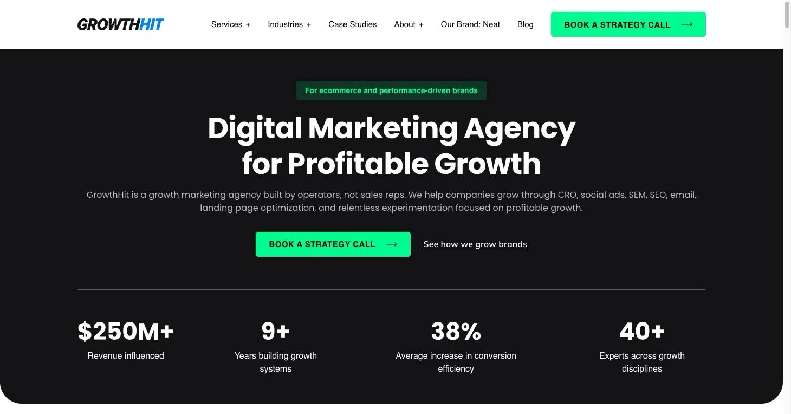
GrowthHit holds the strongest verified rating on this page: 5.0 across 20 Clutch reviews, with a cost rating of 4.9. The Seattle team runs what it calls the Leverage Point Growth System across CRO, paid, social, email, and SEO, weighted toward conversion work, and operates on a sprint cadence with clients describing weekly calls and daily Slack access.
The headline claim needs a caveat. GrowthHit's homepage states a 38% experiment win rate, defined as one in three tests lifting revenue by more than 10%. That sits above every independent benchmark, and the section below on win rates explains why both figures can be sincere. Published results include Bullseye Education, a K-12 SaaS company, reporting a bounce rate cut by more than half and cost per meeting booked reduced by more than 55%.
What to expect
- Sprint-based experimentation weighted toward CRO, with paid, email, and SEO alongside.
- Web development capability in-house, which extends what can be tested.
- An embedded working style with high-frequency client contact.
Best fit for
- Series A and growth-stage companies wanting conversion work with cross-channel support.
- Teams that want a low-commitment entry point, since the $1,000 project minimum makes a paid pilot genuinely feasible.
Keep in mind: The 38% win rate is self-reported and sits above independent benchmarks. Ask for the denominator and the definition of a win. A high rate can indicate an unoptimized starting point rather than superior method, and sometimes indicates underpowered tests called early.
Reputation and recognition
- 5.0 on Clutch across 20 reviews (clutch.co/profile/growthhit, as of August 2026). Cost rating 4.9. Founded around 2016, 50 to 249 employees.
- A Clutch review from a luxury fashion retailer cites a 90% conversion rate increase on day one. CEO Jim Huffman states the firm has helped earn over $250 million in client revenue, which is an agency aggregate rather than a client-attributable figure.
Pricing
Minimum project $1,000, hourly $100 to $149, with most engagements falling between $10,000 and $49,999.
Ladder
Ladder is the single most-recurring name across everything currently ranking for "growth hacking agency," and it wants nothing to do with the term. The agency publishes its own case against it, arguing what most of this category eventually concedes: growth hacking is growth marketing with a tighter feedback loop. Founded in 2014 and running teams out of New York, London, and Wrocław, Ladder builds a "Growth Stack" that maps every experiment to a metric before a single test goes live, then works in two-week sprints across paid, CRO, and channel testing.
The scale is real. The agency cites more than 8,000 experiments run and over $40 million in managed ad spend, backed by proprietary tooling (Nucleus) that ties test results back to the roadmap.
What to expect
- Systematic paid media and experimentation under one roof, not run as separate disciplines.
- Two-week sprint cycles with in-house design, copy, and CRO support.
- Proprietary experiment-tracking tooling tying tests to a shared roadmap.
Best fit for
- Companies with enough paid budget and traffic to make an 8,000-experiment playbook worth applying.
- Teams that want paid, creative, and conversion work run by one accountable team instead of stitched across vendors.
Keep in mind: Ladder also appears in our Meta Ads guide elsewhere in this series, where its paid-social work is profiled separately.Reviews are mixed rather than uniformly strong: alongside several 5-star ratings, one Clutch review cites missed deadlines and PM turnover, worth asking about directly.
Reputation and recognition
- 4.4 on Clutch across 14 reviews, Clutch-Verified (clutch.co/profile/ladderio, as of August 2026, last updated October 2025).
- Named clients include Booking.com, Facebook, Nestlé, and Y-Combinator-backed startups.
Pricing
Consultation-based. One Clutch review cites roughly $20,000 for a five-month engagement.
Cro Metrics

Nobody else on this list brings this level of statistical apparatus. Cro Metrics employs statisticians, runs a proprietary experimentation platform called Iris, and grounds its recommendations in what it describes as insights from more than 35,000 experiments across industries, built over nearly two decades of operating. Clutch classifies it as 100% conversion optimization, which is unusually undiluted for this category.
Calendly and Pantheon anchor the SaaS side of the roster. Published client outcomes carry real specificity: Earnest reporting that a single test moving the application onto the landing page raised conversion by 17%, Blink Fitness recording a 14% decrease in online cancellations, Calendly describing hundreds of shipped experiments.
What to expect
- Experiment-led growth with statisticians involved in design and analysis.
- A proprietary testing platform and structured experiment archives.
- Work alongside existing internal teams rather than replacing them.
Best fit for
- Companies with enough traffic to make rigorous testing viable, which the Calendly and Pantheon profile illustrates well.
- Organizations wanting experimentation treated as an operating discipline rather than a campaign.
Keep in mind: This is the most expensive option here by a wide margin, running roughly $185,000 to $200,000 annually with one client citing $50,000 per quarter. The 9-review base is also thin relative to the firm's size and age, and the cost rating of 4.4 is the lowest on this page.
Reputation and recognition
- 4.9 on Clutch across 9 reviews, carrying the Clutch-Verified designation (clutch.co/profile/cro-metrics, as of August 2026). Founded 2010, 50 to 249 employees.
- The 35,000-experiment figure is a self-reported volume count and describes scale rather than success rate.
Pricing
Minimum $10,000, with most engagements between $200,000 and $999,999. Roughly $185,000 to $200,000 per year for larger clients.
Growthcurve
Engineers and quants sit on the delivery team here, which shows up in what Growthcurve is able to test. The London and New York firm fuses data science, performance creative, and rapid iteration in embedded pods that ship weekly. Its Coinbase results page reports 27% lower KYC drop-off, a 14% higher first-trade rate, and a 22% lift in referral signups.
Coinbase and Monzo make this a fintech-heavy roster rather than a pure SaaS one. Even so, the underlying capability (high-volume creative testing with technical depth) transfers well. The Clutch record is strong at 4.9 across 19 reviews.
What to expect
- Paid social and search, CRO, lifecycle, and performance creative under one roof.
- Rapid creative testing supported by server-side tracking.
- An embedded pod model described by clients as an extension of their own team.
Best fit for
- Companies where creative volume and iteration speed are the constraint.
- Teams needing technical implementation depth alongside media buying.
Keep in mind: At $150 to $199 hourly this sits at the upper end of the roster, and the client profile skews fintech and consumer-facing. If your product is a low-volume enterprise SaaS tool, ask specifically about comparable engagements.
Reputation and recognition
- 4.9 on Clutch across 19 reviews (clutch.co/profile/growthcurve, as of August 2026). Cost rating 4.6. Founded 2017, 10 to 49 employees.
- Named clients include Coinbase and Monzo.
Pricing
Minimum project $5,000, hourly $150 to $199.
Growth Division
With 31 Clutch reviews, Growth Division has the deepest verified record on this page, and it earned that record doing something quite specific: helping seed-stage startups find which channels work before they commit to scaling any of them. The founders built and exited a SaaS company themselves, and the operating model pairs a small core team with freelance specialists brought in per channel.
That model is also the main thing to interrogate. A lean core plus contracted specialists keeps hourly rates at $50 to $99 and makes the agency accessible to companies that could not afford a pod, but it introduces variability in who ends up doing your work, which one third-party assessment flags directly.
What to expect
- Channel testing and validation across paid, SEO, CRO, email, ABM, and community.
- Growth infrastructure and analytics setup for companies building it for the first time.
- A hybrid model of core strategists plus freelance channel specialists.
Best fit for
- Seed and pre-Series A companies that need to identify a working channel rather than optimize a known one.
- Teams on a budget that still want senior strategic input.
Keep in mind: The freelance execution model creates real variability in team quality. Ask for the specific specialists assigned to your account by name, with their track record, and get replacement terms in writing.
Reputation and recognition
- 4.7 on Clutch across 31 reviews, Premier Verified, last updated June 2026 (clutch.co/profile/growth-division). Cost rating 4.6. Founded 2019, 2 to 9 core employees.
- One Clutch review reports 40,000+ LinkedIn post views in the first five months, an average of 20 leads per month, and a 46% open rate across 2,000 recipients.
Pricing
Hourly $50 to $99. Project sizes not publicly disclosed.
Tuff
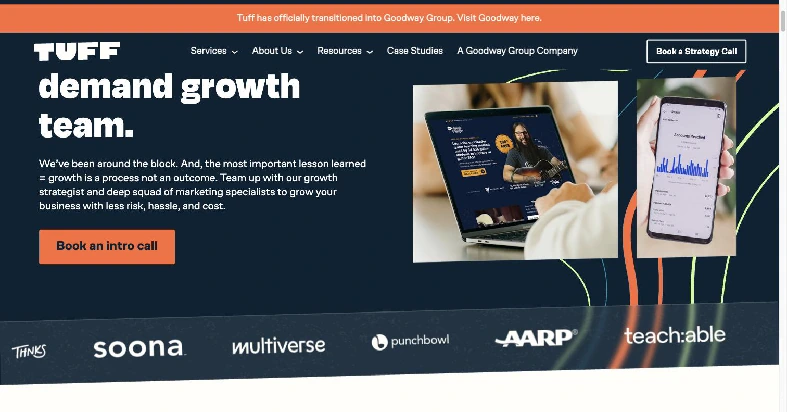
Tuff builds custom cross-functional squads that operate as your in-house growth team, covering paid media, performance creative, SEO, CRO, and analytics in one unit, with radical transparency as an explicit operating value. More than 50 startups have worked with the firm across DTC, B2B, and SaaS.
Two facts materially change the buying decision and appear in almost no competing listicle. Tuff is now a division of Goodway Group rather than the independent boutique most lists still describe, and its current Clutch profile shows only three reviews. G2 shows none. Third-party sources note mixed reviews and staff turnover affecting consistency.
What to expect
- A cross-functional embedded squad across paid, creative, SEO, CRO, and analytics.
- Rapid message and multivariate testing.
- Backing and resources of a larger parent organization.
Best fit for
- Startups wanting an outsourced team that functions as an internal one.
- Companies that value transparency in reporting and want a single accountable squad.
Keep in mind: Three Clutch reviews with no confirmable star average is thin, and the ownership change is worth raising directly. Ask how Goodway ownership has affected staffing continuity and who specifically will hold your account.
Reputation and recognition
- 3 reviews on the current Clutch profile with the aggregate star rating not confirmable on-page (clutch.co/profile/tuff, as of August 2026). G2 shows 0 reviews.
- Named clients include goHappy, Communities Foundation of Texas, and Susan G. Komen. A secondary source reports FYXER results of 10,000+ new customers and Google Ads driving 12% of ARR, which we could not verify at source.
Pricing
Minimum project $5,000, with monthly minimums described by third parties as relatively high.
Kurve
Oren Greenberg runs Kurve as a hybrid of agency and consultancy, building a team around the brief rather than fitting the brief into a fixed team. What distinguishes it on this roster is a dedicated B2B SaaS positioning and messaging specialism, which matters because a meaningful share of growth problems that arrive labeled as conversion problems turn out to be message problems.
The published flagship case is Sweatcoin, where viral loop work helped the app rank first in the UK within weeks and reach the global top five in Health and Fitness, growing to roughly 60 million registered users over seven years. However, that is a consumer app, and consumer virality mechanics transfer to B2B SaaS only partially.
What to expect
- Positioning and messaging work for SaaS scaleups alongside execution.
- Organic and paid search, CRO, analytics, and mobile user acquisition.
- Flexible engagement as either retainer or defined project.
Best fit for
- Companies whose growth is constrained by unclear positioning rather than by channel execution.
- Teams wanting a defined project rather than an open-ended retainer, given the published $5,000 to $25,000 project band.
Keep in mind: Only 2 Clutch reviews, with no confirmable star average. The headline case study is a consumer app, so ask for B2B SaaS references specifically rather than accepting the Sweatcoin result as evidence of fit.
Reputation and recognition
- 2 reviews on Clutch with the aggregate star not confirmable on-page (clutch.co/profile/kurve, as of August 2026). Minimum project $10,000, hourly $150 to $199.
- Named App Marketing Agency of the Year 2023 at the App Growth Awards. Named clients include Sweatcoin, Treecard, and Nutmeg.
Pricing
Growth hacking projects published at $5,000 to $25,000. Minimum project $10,000 per Clutch, hourly $150 to $199.
Growth Hackers

The budget tier on this list (and honest about being one). Growth Hackers is an India-based performance marketing agency working at $25 to $49 hourly with a $1,000 project minimum, running SEO, PPC, media buying, CRO, web development, and content in small teams of two to five people per account. It holds 22 Clutch reviews, the second-deepest count here, and won Clutch Global Spring 2024 and Clutch Champion 2023 recognition.
Published client outcomes include a 63% increase in organic search traffic, a 70% improvement in landing page conversion rates, and a 35% increase in qualified lead generation. The named client roster runs Decathlon, ITC, Paytm, and Tata Communications, which is enterprise and consumer-heavy rather than B2B SaaS.
What to expect
- Performance marketing across SEO, PPC, media buying, and CRO at a low hourly rate.
- Small dedicated teams per account.
- Execution capability rather than experimentation strategy.
Best fit for
- Budget-constrained teams that need execution hands and already know what they want run.
- Companies wanting to extend a limited growth budget across several channels.
Keep in mind: Presenting this firm as a peer of Cro Metrics on experimentation rigor would be misleading, and it is a poor fit if statistical discipline is what you are buying. The client roster is also light on B2B SaaS. The star average on those 22 reviews could not be confirmed on-page.
Reputation and recognition
- 22 reviews on Clutch with the aggregate star not confirmable on-page (clutch.co/profile/growth-hackers-0, as of August 2026). Minimum project $1,000, hourly $25 to $49.
- Clutch Global Spring Winner 2024; Clutch Champion and Global Leader 2023.
Pricing
Minimum project $1,000, hourly $25 to $49. The budget tier of this roster.
GrowthRocks
Among the earliest firms to build an identity around growth hacking, GrowthRocks has operated since 2014 out of London with roots in Athens and offices in New York and Lisbon. Founders Theodore Moulos and Savvas Zortikis focus the practice on product-market fit work, launch campaigns, early traction, and product-led growth motions, and pair execution with a training arm that builds internal client capability rather than creating dependency.
The verification picture is the weakest on this page. Secondary roundups cite a 4.9 Clutch rating, but the live profile and review count could not be confirmed, and G2 shows zero reviews. Glassdoor sits at 3.7 across 21 reviews, which reflects employee sentiment rather than client outcomes but is worth knowing.
What to expect
- Growth sprints oriented toward product-market fit and early traction.
- Product-led growth motions and channel discovery.
- Training and education delivered alongside execution.
Best fit for
- Companies working through product-market fit that want capability transferred rather than rented.
- Teams wanting a PLG motion designed rather than a paid channel scaled.
Keep in mind: No verifiable client rating on either platform. Given that this firm sells into the pre-product-market-fit stage, where agency value is most contested, ask for three recent contactable references before committing.
Reputation and recognition
- Clutch rating unconfirmed on the live profile; secondary sources cite 4.9. G2 shows 0 reviews (as of August 2026).
- Founded 2014, roughly 11 to 50 employees, London headquarters.
Pricing
Not publicly disclosed. Retainer-based.
Voxturr
Voxturr sits closest to product-led growth of anyone here, combining strategic consulting with full-funnel execution across demand generation, outbound ABM, inbound SEO, paid media, webinars, and onboarding and retention content. Manish Tahiliani leads a team of 20-plus, and the named client roster is genuinely enterprise: IBM, Microsoft, Automation Anywhere, Freshworks, and CleverTap.
Verification is the weak point. No confirmed Clutch or G2 aggregate exists, and the roughly 11 reviews visible through directory sites come from a single platform. A published CleverTap result reports 2,500-plus registrations at a 25% conversion rate from webinar and review campaigns.
What to expect
- Product-led growth strategy alongside demand generation execution.
- Outbound ABM, inbound SEO, paid media, and webinar programs in one scope.
- Onboarding and retention content, which most of this roster does not touch.
Best fit for
- SaaS companies wanting PLG motion design connected to demand generation.
- Teams needing broad execution coverage from one partner.
Keep in mind: No verifiable third-party rating, and the offering leans toward demand generation rather than structured experimentation. If disciplined testing is what you need, this is a different product.
Reputation and recognition
- Clutch and G2 ratings unconfirmed (as of August 2026). Roughly 11 reviews visible via directory sites, sourced from a single platform.
- Named clients include IBM, Microsoft, Automation Anywhere, Freshworks, and CleverTap.
Pricing
Project bands from $0 to $200,000 depending on scope, per directory data.
What Experiment Win Rates Really Look Like
GrowthHit advertises a 38% win rate. The most widely cited independent benchmark, from an analysis of more than 127,000 experiments across roughly 1,100 companies, puts the figure closer to 12% of tests producing a statistically significant improvement on the primary metric. Practitioner ranges published elsewhere run roughly 10% to 33%, with the low end at properties already heavily optimized.
Both numbers can be sincere, and understanding why is the most useful thing in this article.
Win rate depends on four things: how optimized the baseline already is, what minimum effect the test is powered to detect, whether "win" means any positive movement or a statistically significant one, and how much traffic is available. Testing an unoptimized page produces easy wins. Testing a mature funnel does not. And a high advertised win rate can be a warning rather than a credential, because the fastest route to one is stopping tests the moment they cross significance, which systematically overstates effects.
For planning, assume something in the 12% to 25% range. At four tests a month, that means roughly one meaningful win per month, and the value compounds through accumulated learning rather than arriving in a single result. Judge an agency on test throughput multiplied by learning quality.
The checkable version, which works on any agency: ask for the denominator and the definition. How many tests ran last quarter, how many won, and what counted as a win. A firm that cannot produce both numbers is quoting marketing rather than measurement.
What Growth Experimentation Costs
Six distinct products get sold under this one keyword, and the corpus answer of "$2,500 to $5,000 per month" describes only one of them.
- Diagnostic or audit: low four figures, one-off. GrowthHit's $1,000 project minimum makes this concretely available.
- Growth sprint, two to six weeks: $5,000 to $25,000, which is Kurve's published band.
- Budget retainer: $2,500 to $5,000 monthly, roughly where Growth Hackers operates.
- Mid-market retainer: $10,000 to $25,000 monthly, GrowthHit's typical range.
- Embedded pod: $15,000 to $50,000 monthly, where Growthcurve and Tuff sit.
- Enterprise experimentation program: $185,000 to $200,000 annually, which is Cro Metrics.
Now the costs that never appear in the proposal. Experimentation tooling runs as a separate subscription. Creative production for variants is frequently billed on top. Media spend is yours. And any test touching the product itself consumes your engineering time, the most expensive input in the entire arrangement.
The honest comparison is not agency against nothing. A US head of growth is a six-figure salaried commitment plus a hiring lag of several months, and concentrates the capability in one person. A fractional growth lead sits between the two. Run all three against your own numbers.
One structural point that determines what you can buy at all: most agencies can touch your marketing site freely and your product barely at all. Since activation and retention experiments live inside the product, an agency without engineering access cannot address them regardless of what its positioning claims. Ask who ships the change, and ask early.
How to Choose the Right Type for Your Stage
Pre-product-market-fit. The honest answer is usually to not hire an experimentation agency. There is a well-known view in founder circles that agencies rarely deliver qualified leads at the earliest stages, and it exists for good reason: you are testing whether anyone wants the product, which is founder work. GrowthRocks is the roster exception, selling deliberately into this stage, and worth a conversation with that caveat attached.
Seed, validating channels. Growth Division, explicitly built for this at $50 to $99 hourly with the deepest verified review base here.
Series A, scaling acquisition and conversion. GrowthHit, Ladder, Growthcurve, or Tuff, depending on whether you need CRO depth, high-volume paid experimentation, creative volume, or an embedded squad.
Growth stage with real traffic. Cro Metrics, whose model requires the conversion volume that companies like Calendly and Pantheon have.
Positioning is the actual bottleneck. Kurve, whose SaaS messaging specialism addresses the problem that testing cannot fix.
Budget-constrained execution. Growth Hackers, understanding you are buying hands rather than experimental rigor.
PLG and activation. Voxturr or GrowthRocks, with the caveat that both carry unverified review records.
One gap worth naming: not one agency on this roster is a retention or expansion specialist. Net dollar retention is where SaaS companies create the most durable value, and this category has almost nobody selling into it. If retention is your bottleneck, you are probably looking at a product hire rather than an agency.
Auditing Experimentation Rigor Before You Sign
Asking about process gets you a rehearsed answer. These questions do not have rehearsed answers.
- "Show me a redacted experiment log, including the losers." Rigorous shops maintain one as a matter of course. Pitch-driven shops produce a case study PDF instead.
- "How do you compute sample size?" A real answer names baseline conversion rate, minimum detectable effect, statistical power, and significance threshold. A weak answer is some version of running it until the result looks clear.
- "What is your stopping rule?" You want a pre-registered runtime with no stopping the moment significance appears. Calling tests at 95% whenever it happens to arrive is the most common source of results that fail to replicate.
- "Do you check for sample ratio mismatch?" Almost nobody asks this in a sales process, and it separates practitioners from marketers faster than any other single question.
- "What share of tests won last quarter, and how do you define a win?" Anything above roughly 35% means cherry-picking, a loose definition, or very unoptimized pages.
- "Give me one test that failed and what changed because of it." Learning quality shows here or nowhere.
- "Who is on the pod, by name, with percentage allocation?" Then put those names in the statement of work with a replacement-notification clause.
Where budgets allow it, buy a paid pilot before a retainer. GrowthHit's $1,000 minimum and Kurve's published project band make this genuinely possible with parts of this roster, and a single scoped sprint tells you more than any number of reference calls.
Common Mistakes B2B SaaS Teams Make With Growth Agencies
-
Shortlisting Before Diagnosing
Why it happens: It is easier to browse agencies than to work out which part of the funnel is broken. Fix: Establish whether acquisition, activation, retention, or revenue is the actual constraint first. Buying acquisition help for an activation problem is the most common expensive mistake in this category.
-
Accepting Percentage-of-Spend Pricing Without Question
Why it happens: It is presented as standard and appears to align incentives. Fix: Ask for a flat-fee quote alongside it, then ask what happens if the correct recommendation is to cut spend. The answer tells you which way the incentive points.
-
Judging Month Two by Month Twelve Standards
Why it happens: Nobody sets a ramp expectation, so buyers apply steady-state assumptions to the setup phase. Fix: Agree what months one through three should produce, which is instrumentation, baselines, and first tests, rather than results. Then agree what month six looks like.
-
Leaving the Learnings Behind
Why it happens: The experiment archive feels like a byproduct rather than an asset until the engagement ends. Fix: Contract for ownership of the test documentation, hypothesis backlog, and results archive from day one, along with your ad accounts, analytics, and creative files.
-
Buying Testing Without the Traffic to Support It
Why it happens: Every agency in the category sells experimentation, and few will disqualify a paying prospect. Fix: Run the conversion-volume math before the first call, and ask each agency what it would do differently given your actual numbers.
Before You Sign: Checklist and Questions
Confirm that the agency can articulate a stopping rule, will name its pod members, can reach whatever part of your stack the work requires, and has verifiable references from the last six months.
Then work through the terms:
- Ownership. Ad accounts, analytics, test archive, and creative files in your entity from day one.
- Contract shape. Ask for a 30-day notice period after an initial 90-day term, and prefer a paid pilot to a long commitment.
- Staffing. Named people in the statement of work, with a replacement-notification clause.
- Pricing model. Understand which behavior your fee structure rewards. Percentage of spend rewards spending more. Hourly rewards more hours. Flat retainer rewards efficiency but can tempt understaffing.
- Evidence. Ask for baseline, duration, and sample size behind every case-study number, and treat any figure repeated across listicles with no primary source as unverified until you see it.
What a Good First 90 Days Looks Like
Month 1: Instrumentation and Baseline. Analytics validated, tracking gaps closed, conversion volumes measured, and an experiment backlog built with hypotheses tied to a diagnosed bottleneck. An agency launching tests in week one has not established what it is measuring against.
Month 2: First Tests Ship. Two to four experiments running depending on your traffic, with pre-registered primary metrics and stated runtimes. Expect most to be inconclusive. That is the normal outcome and a firm treating it as failure is setting up for cherry-picking later.
Month 3: The Learning Rate Becomes Visible. You should be able to see how quickly hypotheses are being generated, tested, and either killed or scaled. One meaningful win in the first quarter is a reasonable expectation at typical win rates. Zero wins alongside a well-documented log of what was ruled out is a considerably better position than three wins nobody can explain.
Set the 90-day gate before you start. Instrumentation working, backlog documented, tests shipped at the agreed cadence, results honestly reported. Missing two of those four is grounds to end it rather than extend and hope.
Conclusion
Most of the buying decision in this category comes down to three questions that competing lists do not raise. Whether you have the traffic to make testing viable. Whether the agency can reach the part of your stack where the problem lives. And whether their advertised win rate survives contact with a denominator.
Answer those before you compare logos. Then hold every firm here, ours included, to the same standard on verification, staffing, and what happens when the tests lose.
If you want a read on where your funnel is leaking and whether experimentation is the right tool for it, our team can review your setup and map the highest-impact tests. Book a strategy call and let's see how we can work together.