Some SaaS products are inherently easier to scale than others.
Two companies can have the same ARR, yet one can double acquisition and watch revenue compound while the other gets higher CAC, more churn and an overloaded team.
The difference is rarely one marketing tactic. It is the strength of the entire growth system.
A scalable SaaS business can add recurring revenue without acquisition costs, service costs and operational complexity rising at the same rate. That depends on factors across your market, product, acquisition, activation, retention, monetization, operations and technology.
So before asking which channel to scale next, assess what will happen when you add more volume.
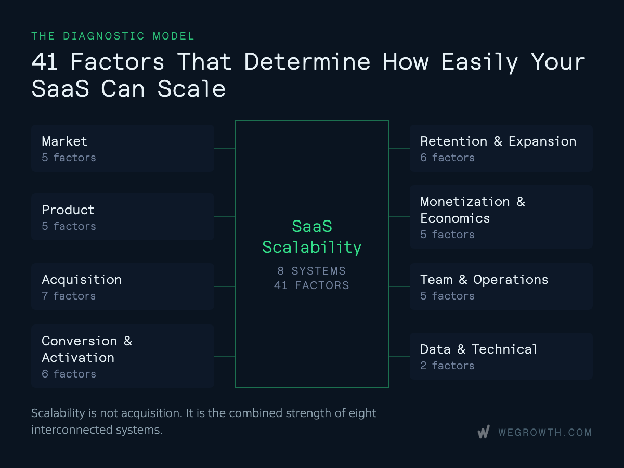
These 41 SaaS growth factors help you do exactly that.
What Makes a SaaS Business Scalable?
SaaS growth and SaaS scaling are related, but they are not the same.
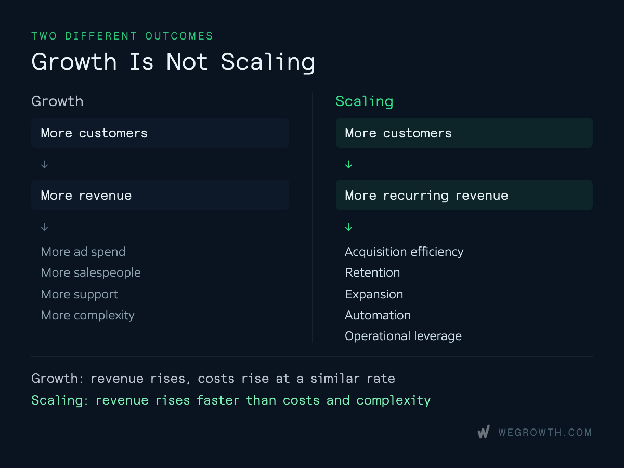
Growth means increasing customers, usage or revenue. Scaling means increasing those outcomes efficiently.
A company can grow by continuously adding salespeople, support staff and advertising spend. But if costs increase almost as quickly as revenue, the underlying model has limited scalability.
A stronger SaaS growth strategy creates leverage: acquisition produces the right customers, customers reach value quickly, retention preserves revenue, expansion increases account value, margins fund reinvestment and the company can support additional volume without proportional increases in cost.
Market Scalability
Your market determines how much room you have to grow and how difficult it will be to capture that growth.
1. Market Size and Reachable Demand
A large theoretical TAM means little if only a small portion is realistically reachable.
Estimate how many suitable customers exist within the geographies, segments and channels you can serve. Then compare that with the customer volume required to reach your ARR target.
If the plan requires unrealistic market penetration, execution alone will not solve the problem.
2. ICP Specificity
A precise ideal customer profile makes almost every part of growth more efficient.
You can target more accurately, write more relevant messaging, qualify leads faster and identify which customers are most likely to retain.
The goal is not to make your market unnecessarily narrow. It is to know which customers produce the strongest combination of conversion, retention and lifetime value.
3. Problem Severity
Products addressing expensive or disruptive problems generally require less persuasion than products solving minor inconveniences.
Assess the consequence of doing nothing.
If the problem costs customers revenue, time, risk or operational efficiency, the business has a stronger foundation for acquisition than one relying mainly on curiosity or convenience.
4. Buying Urgency
Severity and urgency are different.
A customer may consider a problem important but have no reason to solve it this quarter.
Growth becomes easier when identifiable events create urgency: regulatory changes, hiring, funding, rapid growth, existing-tool failure, contract renewal or another deadline.
Strong buying triggers shorten the distance between interest and action.
5. Competitive Differentiation
If prospects see your product as interchangeable with five alternatives, growth becomes increasingly dependent on price, sales effort or marketing spend.
Strong differentiation gives buyers a clear reason to choose you.
That advantage might come from specialization, workflow, technology, distribution, integrations, service or positioning. What matters is whether the target customer can recognize the difference quickly.
Product Scalability
Acquisition creates sustainable growth only when customers consistently experience enough value to keep using the product.
6. Product-Market Fit
Signups, launch interest and positive feedback are not enough to prove product-market fit.
Look for behavioral evidence: customers use the product repeatedly, renew, recommend it and demonstrate that losing access would matter.
Retention becomes increasingly important as SaaS companies mature. ChartMogul's recent analysis found a strong relationship between NRR and long-term growth, while companies with weak retention were much more likely to shrink.
7. Time to Value
Time to value measures how quickly a customer reaches the outcome that justified signing up.
Every extra step before that moment creates another opportunity for abandonment.
Reducing time to value may involve simplifying setup, importing existing data, offering templates or directing users toward one high-value workflow instead of introducing the entire product at once.
8. Activation Rate
Activation should represent a meaningful product behavior associated with future retention or conversion.
Creating an account is usually not activation.
Define the action or combination of actions that indicates a user has experienced initial value. Then measure what percentage of new users reach that point.
If acquisition increases while activation remains weak, most of the additional volume will be wasted.
9. Usage Frequency
How naturally does the product fit into the customer's workflow?
A product used daily has different retention dynamics from one needed twice per year.
Low frequency is not automatically a weakness. The important question is whether usage matches the natural frequency of the problem and whether customers continue receiving enough value between purchase and renewal.
10. Implementation Friction
Implementation can limit SaaS scalability before acquisition does.
Integrations, data migration, configuration, training and stakeholder approval all add friction.
Complexity is often unavoidable in higher-value B2B SaaS. The challenge is making that complexity repeatable through documented processes, templates, integrations and standardized onboarding rather than rebuilding implementation for every customer.
Acquisition Scalability
A channel is not truly scalable because it generated customers once. It is scalable when it can produce additional qualified customers without economics deteriorating beyond acceptable levels.
11. Channel-Market Fit
Your best acquisition channels depend on how your customers discover and evaluate software.
Developers may respond to technical content and communities. Enterprise buyers may require outbound, partnerships and sales. Search-led categories can support SEO and paid search.
Good channel-market fit means acquiring customers through environments where buying behavior already exists instead of forcing a channel to work because competitors use it.
12. Paid Acquisition Scalability
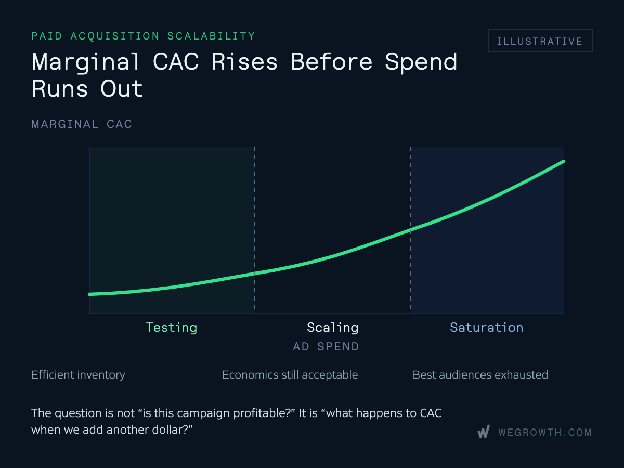
A profitable campaign at $2,000 per month does not guarantee profitability at $20,000.
As spend rises, efficient inventory can run out, audiences become saturated and marginal CAC can increase.
Measure how CAC, conversion rate, payback and customer quality change as budget increases.
In WeGrowth's Vacation Tracker case study, Facebook CAC fell from $600 to $300 before the campaign was scaled at higher budgets.
13. Organic Search Potential
SEO is most scalable when relevant search demand already exists around the customer's problem, use cases, alternatives and purchase decision.
Traffic alone is not the objective.
Evaluate whether search can consistently produce qualified visitors and whether those visitors convert into trials, demos or customers.
For Ucraft, WeGrowth's documented SEO work grew organic traffic to 30,000 monthly visitors and generated 400+ monthly signups.
14. Outbound Efficiency
For sales-led SaaS, outbound scale depends on both prospect volume and conversion economics.
Track the full funnel from targeted accounts through replies, meetings, qualified opportunities and closed customers.
If performance falls sharply after the easiest segment is exhausted, the channel may have less scalable capacity than initial results suggested.
15. Referral Potential
Customers can become an acquisition channel.
Direct referrals, recommendations and affiliate programs can lower blended CAC when customers consistently introduce new buyers.
Referral potential is strongest when users receive clear value, the product is easy to recommend and the referred customer has a similar problem.
16. Product-Led Virality
Referral and virality are not identical.
True product-led loops occur when normal product usage exposes or invites additional users, for example through collaboration, shared outputs, invitations or network participation.
The strongest loops make acquisition partly self-reinforcing because every new user creates opportunities to acquire additional users.
17. Owned Distribution
An audience you control reduces dependence on rented acquisition.
Search visibility, email lists, communities, founder audiences, partner networks and category authority can repeatedly expose prospects to the product without paying for every interaction.
Distribution is particularly valuable because competitors can often copy features faster than they can reproduce years of audience and brand development.
Conversion and Activation Scalability
More acquisition only helps when the funnel can turn additional demand into activated users and customers.
18. Positioning Clarity
Prospects should quickly understand what the product is, who it is for and why it matters.
If they cannot categorize the product or connect it to a relevant problem, every acquisition channel has to work harder.
Strong positioning gives marketing, sales and product communication a consistent foundation.
19. Messaging Relevance
Positioning establishes the category and difference. Messaging connects that position to the customer's specific pains, priorities and desired outcomes.
Generic messaging can suppress conversion even when the product itself is strong.
The best test is simple: does the target customer recognize their situation in the page without needing someone to explain why the product is relevant?
20. Website Conversion Rate
Before significantly increasing traffic, understand how efficiently existing traffic becomes pipeline.
Measure conversion by source, campaign, page, device and customer segment.
A low blended conversion rate may hide strong performance from one segment and weak performance from another, so diagnose the source of the problem before redesigning the entire site.
21. Signup or Demo Friction
Every field, step and decision between intent and action can affect conversion.
But less friction is not always better.
A self-service product may benefit from near-instant signup, while enterprise SaaS may intentionally qualify demo requests.
The right amount of friction is the minimum required to move the right prospect into the appropriate next step.
22. Onboarding Effectiveness
Good onboarding moves the customer toward value rather than giving them a tour of every feature.
Measure where users abandon the onboarding flow and whether completed steps correlate with activation.
If the same high-intent users repeatedly disappear before reaching value, improving onboarding may create more revenue than acquiring another batch of signups.
23. Sales Efficiency
Sales becomes a scalability constraint when additional pipeline does not produce proportional revenue.
Track metrics such as demo-to-opportunity conversion, win rate, sales cycle length and revenue per sales resource.
A scalable sales process should convert qualified demand without relying on the founder or one exceptional salesperson to rescue every important deal.
Retention and Expansion Scalability
Acquisition determines how quickly customers enter. Retention and expansion determine how much of that growth compounds.
24. Logo Churn
Logo churn measures the percentage of customers lost during a period.
Its impact becomes more significant as the customer base grows because acquisition must replace lost customers before producing net-new growth.
Benchmark churn against companies with comparable customer types and contract values rather than relying on one universal target.
25. Gross Revenue Retention
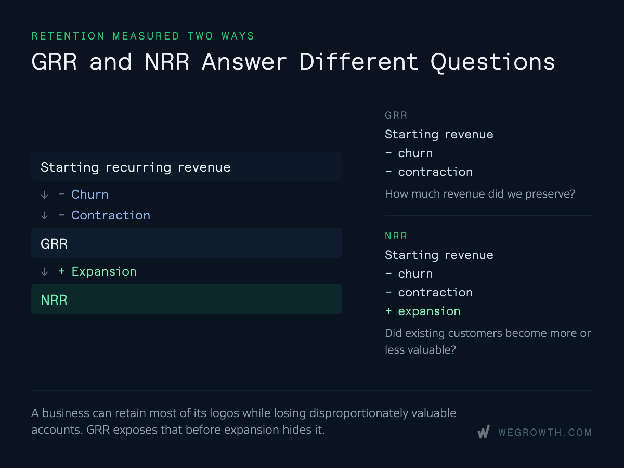
GRR measures how much recurring revenue remains after churn and contraction, excluding expansion.
It is especially useful when customers have very different account values.
A business can retain most of its logos while losing disproportionately valuable accounts. GRR exposes that weakness before upsells make overall revenue retention appear healthier.
26. Net Revenue Retention
NRR includes expansion alongside churn and contraction, showing whether the existing customer base becomes more or less valuable over time.
SaaS Capital's 2026 survey of more than 1,000 private B2B SaaS companies found growth positively correlated with NRR. Moving from the 90–100% NRR range into 100–110% was associated with five percentage points more growth.
27. Adoption Depth
Retention becomes stronger when the product is embedded across more workflows, features, integrations or users.
Monitor whether customers expand their usage after initial activation.
A customer relying on several important workflows usually has a stronger value relationship with the product than one occasionally using a single peripheral feature.
28. Expansion Potential
A scalable SaaS model can increase revenue from successful customers without reacquiring them.
Expansion may come through additional seats, usage, plans, products, locations or add-ons.
The strongest expansion mechanisms align price growth with customer value rather than relying on arbitrary upgrades.
29. Customer Concentration
Strong total ARR can hide significant dependence on a few accounts.
Measure the percentage of revenue represented by the largest customer and top customer group.
High concentration is not inherently bad, particularly in enterprise SaaS, but losing one account should not be able to destabilize the entire growth model without the risk being understood.
Monetization and Unit Economics
Revenue growth becomes easier to sustain when each customer generates enough economic value to fund future growth.
30. Pricing Power
Pricing power reflects how confidently the business can capture part of the value it creates.
It tends to improve when the product solves an important problem, has meaningful differentiation and is difficult to replace.
Weak pricing power limits how much CAC, service cost and product investment the business can economically support.
31. ARPA or ACV
Average revenue per account shapes the acquisition model you can afford.
A low-ticket self-service SaaS usually needs highly efficient acquisition and support. Higher ACV can justify sales and customer success involvement but often introduces longer buying cycles.
Higher ACV does not automatically create faster growth. SaaS Capital's 2026 data found no overall correlation between ACV and growth across its surveyed companies.
32. Gross Margin
Gross margin shows how much revenue remains after the direct costs required to serve customers.
Those costs can include infrastructure, customer support, payment processing, third-party APIs and – in AI products – model or inference usage.
A SaaS company can grow revenue quickly while becoming less attractive economically if cost to serve rises too quickly with usage.
33. LTV:CAC
LTV:CAC compares the estimated value of a customer with the cost required to acquire one.
Use it diagnostically rather than treating one ratio as universally correct.
Analyze it by channel, plan, geography and customer segment. A healthy blended number can otherwise hide acquisition sources where customer value does not justify spending.
34. CAC Payback
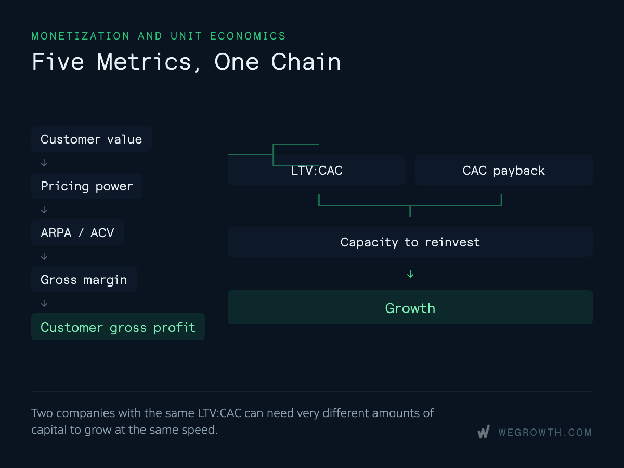
CAC payback asks a different question: how long does it take to recover acquisition cost from customer gross profit?
The longer the payback period, the more cash is tied up funding growth.
Two companies with similar LTV:CAC can therefore require very different levels of capital to scale at the same speed.
Team and Operational Scalability
At a certain point, the growth constraint can shift from market demand to the company's ability to execute.
35. Founder Dependency
If the founder must personally close every large deal, approve campaigns, onboard customers and solve critical problems, capacity has a hard ceiling.
Identify activities where results still depend on one person's knowledge or relationships.
The goal is not to remove the founder from growth. It is to make successful execution reproducible by the wider organization.
36. Process Repeatability
A successful outcome is not yet a system.
One founder repeatedly closing deals is different from a documented sales process that another capable person can execute. The same applies to campaigns, content, onboarding and customer success.
Repeatable processes turn individual expertise into organizational capacity.
37. Automation Potential
Look for activities where workload rises directly with customer volume.
Qualification, onboarding, reporting, lifecycle communication, billing and repetitive support can often be partly automated.
Prioritize stable, repeatable processes first. Automating something poorly understood usually increases speed without improving the underlying result.
38. Team Capability
Growth requires more than headcount.
Assess whether the company has access to the capabilities required at its current stage – strategy, acquisition, content, CRO, analytics, design, development, sales and customer success.
A capability gap can become a bottleneck even when the growth opportunity itself is clear.
39. Experimentation Velocity
A scalable company learns quickly.
Measure the time from identifying an important growth question to launching a test, collecting enough evidence and making a decision.
The goal is not to maximize the number of experiments. It is to shorten the learning cycle around the assumptions that most affect growth.
Data and Technical Scalability
As volume increases, both measurement quality and product infrastructure need to keep pace.
40. Analytics and Cohort Visibility
You should be able to connect acquisition with downstream outcomes such as activation, revenue and retention.
Then segment those results by channel, campaign, plan, customer type or cohort.
Stripe's current SaaS metrics framework similarly separates acquisition, engagement, retention, growth and economic metrics, reinforcing why top-line ARR alone is not enough to diagnose performance.
41. Technical and Cost-to-Serve Scalability
Ask what happens when customer volume doubles.
Can the product handle more users, requests, data and integrations reliably? Do infrastructure, API, support or implementation costs rise proportionally with every new account?
Technical scale and economic scale are connected. If serving twice as many customers requires nearly twice the infrastructure or manual work, revenue may grow without creating much operating leverage.
How to Turn These 41 Factors Into a SaaS Scaling Strategy
Do not try to improve all 41 factors at once.
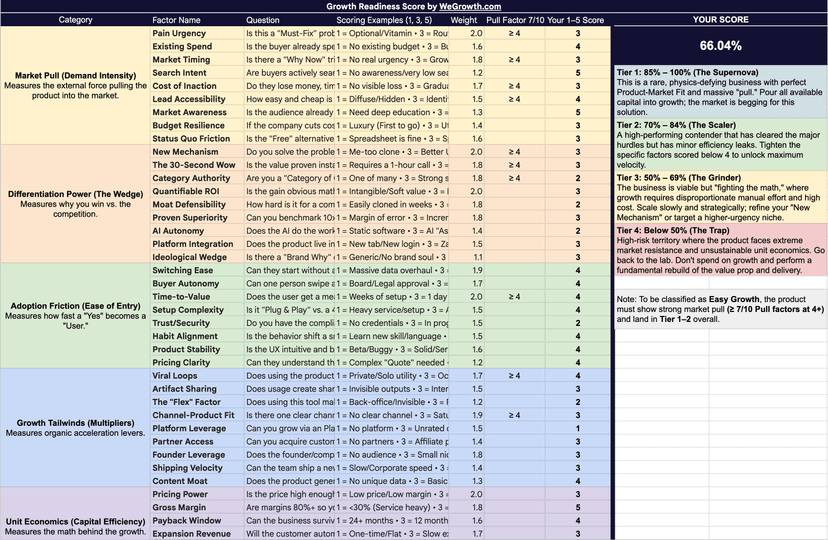
Score each factor from 1 to 5:
| Score | Meaning |
|---|---|
| 1 | Critical constraint |
| 2 | Significant weakness |
| 3 | Functional, but limiting |
| 4 | Ready to scale |
| 5 | Competitive growth advantage |
Then calculate an average for each of the eight areas: market, product, acquisition, conversion and activation, retention and expansion, monetization, operations, and data/technology.
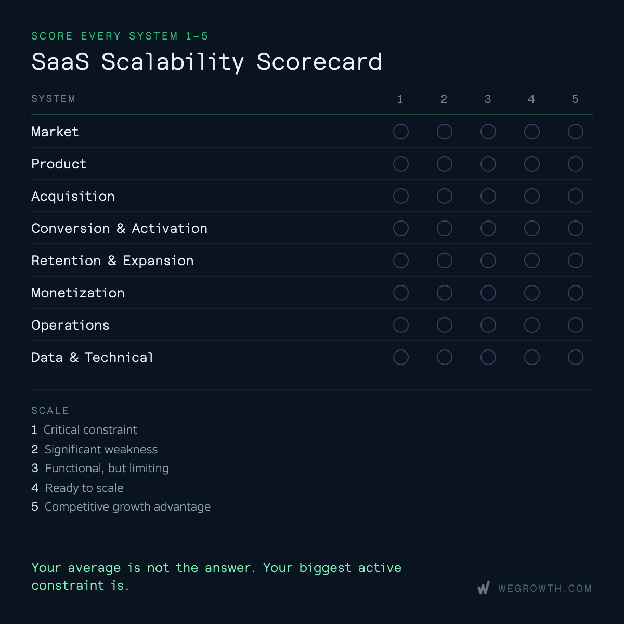
Your lowest score is not automatically the next priority. The priority is the factor creating the largest constraint on growth now.
For example, weak acquisition should not necessarily be fixed first if customers are churning before CAC can be recovered. Driving more traffic into that system would increase activity without solving the underlying economics.
A useful order of operations is:
Product value and retention → unit economics → conversion and activation → repeatable acquisition → operational scale.
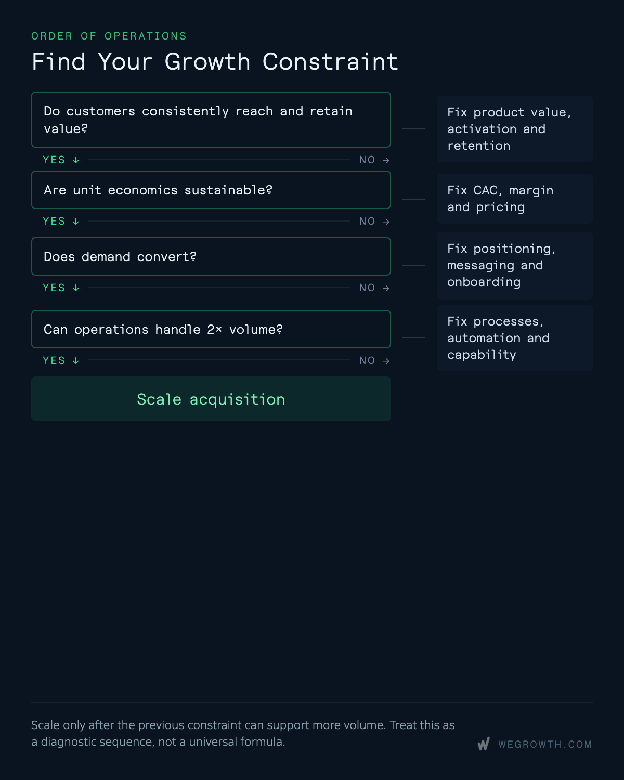
Treat that as a diagnostic sequence, not a universal growth formula. Different SaaS businesses will hit different constraints at different stages.
The Core Principle: Scale What Works, Fix What Breaks
A good SaaS growth strategy is not a collection of channels.
It is a system in which market demand, acquisition, product value, retention, monetization and operations reinforce each other.
If one critical part is weak, increasing volume can make the weakness more expensive.
If the fundamentals are strong, additional customers can create more revenue, more expansion, more data, stronger distribution and more capital to reinvest.
Before asking “How do we grow faster?”, ask:
“What would break first if we grew twice as fast?”
The answer is usually where your next growth priority should be.
Find Your Biggest SaaS Growth Constraint
You do not need all 41 factors to be perfect. You need to know which factors are strong enough to support more volume and which one is currently holding the growth engine back.
That is the point of the framework: find the constraint, fix it, measure the result and then scale what works.
If you want help diagnosing your SaaS growth engine, book a Growth Strategy Call with WeGrowth. We'll assess the funnel, growth economics and current acquisition system to identify where the biggest opportunities are.